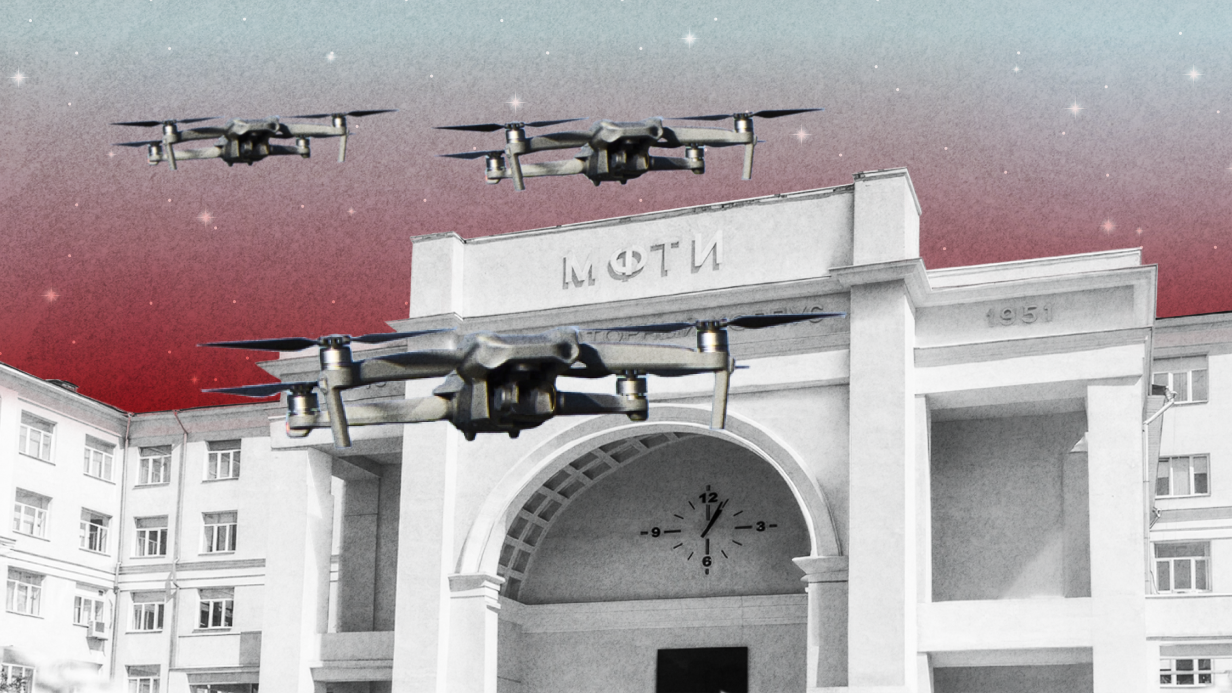
The Russian Ministry of Defense has started urging students at Russian universities to work as drone operators. But to do so, they must first sign a military service contract. Students are promised lump-sum payments of five million rubles and the option to terminate the contract after just one year. A T-invariant correspondent investigated whether the Defense Ministry’s promises can be trusted.
Earlier on T-INVARIANT
“Aerokitties” Fly in Swarms. How higher education programs in drone technology serve military objectives
“Sovereign” Means Military. How Russia has militarized the AI, drone, and cryptography industries
“Not recruiting, just information”
If you’ve flunked your exams, no worries — sign a contract with the Ministry of Defense, become a drone operator, then return to finish your degree for free while earning good money. With this enticing pitch, a representative of the Military Training Center at the Moscow Institute of Physics and Technology (MIPT, Phystech) spoke to students.
Just prior, university administration had informed faculty: “Representatives of MIPT’s Military Training Center (MTC) plan to take 5 minutes of lecture time to inform students about opportunities for contract military service.” On December 9, an MTC representative appeared at lectures on general physics and mathematical analysis. He immediately clarified that “this is not recruiting, just information,” and that students at other universities were receiving similar briefings. A recording of the presentation surfaced in a student Telegram channel, “Физтех.Underground.”
“The Ministry of Defense has an offer for students who may be struggling with subjects like physics or mathematics. If you’re not keeping up, need to build strength, study more, or have health issues — and you take academic leave — the proposal is to sign a contract with the Ministry of Defense during that leave and spend the year productively, both for yourself and for the Motherland,” the MTC representative said.
According to him, “the armed forces need new minds.” Time is tight — the Ministry wants the new drone-operator unit operational by January 2026.
“Unmanned systems involve brainwork, hands-on operation, and the very algorithms you’re studying here — putting them into practice,” the representative noted. “You’d kill two birds with one stone: you’re guaranteed to serve only in this branch, honing your skills. And the rector has agreed — after such leave, you’ll be welcomed back with open arms. Plus, you’ll receive a five-million-ruble enlistment bonus and free further education at the university, by the way.”
He noted that women are also welcome in unmanned units. Students, however, showed little enthusiasm, perhaps, the representative suggested, because such information would interest those skipping lectures more than those attending. He hoped word of mouth would do the job.
The flyer he distributed stated that service would take place away from the frontline — at a distance of 20 kilometers. The QR code on the flyer leads to the website of the Moscow Military Commissariat. It announces recruitment into a new branch of the armed forces, formed in 2024–2025. Service involves “conducting reconnaissance and carrying out fire strikes.” Recruits are promised payments starting at 5.2 million rubles ($65,000, including payouts from the Moscow government and the Ministry of Defense, plus a monthly salary of 210–260 thousand rubles [$2600–3250] depending on rank, position, and length of service).
However, the Defense Ministry’s promises cannot be trusted, wrote the authors of the Telegram channel that reported on the lecture:
“We recommend that everyone remember that 20 km in modern warfare is not such a great distance, and no one can guarantee your safety. Especially when drone operators are being deliberately targeted. Moreover, it’s important to exercise caution and compare the words in brochures and from outreach officers with actual legal documents and practices. The army is the army, and an order is an order — a brochure won’t protect you.”
“A quagmire that sucks you in”
The contract offer is presented as an opportunity, but in reality it’s “a quagmire that sucks you in and doesn’t let go,” an MIPT student named Ivan (last name withheld for safety) told T-invariant.
“There’s a risk that someone will see this pitch and think it’s like a short-term program. Many may not know the complications that arise when signing a contract with the Defense Ministry because they don’t follow the news — there simply isn’t time. But, as they joke at Phystech, we have plenty of ‘academicians’ — the ones who take academic leave. The program is tough, so academic leave is granted easily. I know many who’ve done it. Statistically, there’s a chance someone will sign up. Though our university is liberal, I think such cases will be an overwhelming minority,” he said.
In his view, the generous conditions announced to students may not hold true. “I once dealt with a military commissariat and know how they operate — they’ll feed you nonsense, but in reality they don’t care. They just need to make promises; what actually happens, no one knows,” Ivan emphasized.
The latest news on scientists’ work and experiences during the war, along with videos and infographics — subscribe to the T-invariant Telegram channel to stay updated.
“The fact that this is being pushed so aggressively at Phystech is, of course, sad and somewhat shocking,” said Nikita, another MIPT student. “Until now, Phystech existed in a kind of strange duality. On one hand, it’s a university under sanctions because it develops military and dual-use technologies. If you look, we have entire departments working on military aircraft and similar things. There was even a high-profile case that became a meme a couple of years ago when an International Physics Olympiad medal winner voluntarily went to the front. On the other hand, there was a sense of latitude. Anti-war students weren’t expelled. It’s clear that students overwhelmingly do not support either the war or the regime. So it’s surprising that they decided to launch this kind of campaign. Will anyone actually fall for it?”
According to him, a one-year contract that can be terminated is “utter nonsense.” The same goes for the five-million-ruble payout — it won’t lure a university graduate.
“For a strong MIPT graduate, that’s not huge amount of money. Plenty of our people go into data analysis or machine learning. Anyone who doesn’t stay in academia but enters industry will be earning those five million a year within a couple of years,” Nikita noted. “The general principle — that if you want to make money, it’s easier to do so as a programmer than by heading to the front — I think is shared by all students.”
“Imbued with a sense of responsibility”
Today, similar “information sessions” about contract service as drone operators are taking place at universities across the country. Drone operators are being recruited for the “newly established Unmanned Aerial Systems branch” among students at Siberian Federal University. Their one-time payout is lower than for Muscovites — 3.5 million rubles [$44,000]. They are promised “reduced risk of coming under enemy fire” and “acquisition of unique knowledge and skills in unmanned systems.” Contracts are offered for terms starting at one year, with “guaranteed release from service” promised upon expiration.
On December 5, a lecture for students took place at Belgorod State Technological University named after V.G. Shukhov. The speakers were staff from the N.F. Vatutin Military Training Center and representatives of the Belgorod contract service recruitment point.
“The students were filled with a sense of responsibility for the fate of the Motherland, realizing how important their decisions and actions are for the country’s future. After the meeting, some students began completing their contracts. Notably, among those who expressed interest in serving in the Russian army and sought consultation were foreign students as well,” the university’s website reported.
Students are not told which specific unit is recruiting. Most likely, however, it is the “Rubicon” center established in 2024 on the orders of Defense Minister Andrei Belousov. As reported by Business Online, drone operators are currently being actively recruited in Tatarstan, not only among students. On December 1, the task of recruiting contract soldiers for the new branch was issued to all military districts.
According to the outlet, the “Rubicon” center requires citizens with no criminal record, including administrative violations. The contract signed with the Ministry of Defense is standard, but includes two annexes. The first requires the contract soldier to undergo specialized training for working with unmanned systems. The second obligates the Ministry to discharge the soldier upon contract expiration if the individual does not wish to renew.
As journalists from RFE/RL discovered, “Rubicon” is considered one of the most effective initiatives of the Russian Ministry of Defense.
A blatant bait
Today, authorities are keen to attract educated individuals as drone operators — and students are ideal candidates, says Aleksey Tabalov, director of the “School for Conscripts”:
“You can’t take some guy from the sticks for this job. They need people with intellect and technical skills, who understand the field. That’s mainly students and young people. The issue is how it’s presented. Of course, it’s pure bait. What guarantees that they won’t be sent to the frontline? Once a citizen becomes a serviceman, he is entirely at the mercy of the Ministry of Defense and no longer controls his own life. If drones need to be operated from Belgorod Oblast, that’s where he’ll go. If from Zaporizhzhia, then there. And if they say the front is short of infantry and drones can wait, then operators will be sent as infantry.”
Up-to-date videos on science during wartime, interviews, podcasts, and streams with prominent scientists — subscribe to the T-invariant YouTube channel!
Today, a serviceman cannot terminate a contract with the Ministry of Defense. Partial mobilization continues in the country; Vladimir Putin has never signed a decree ending it. During mobilization, all military contracts are considered indefinite. Termination is possible only in exceptional cases — reaching the age limit or on health grounds.
“There are no one-year contracts. They formally exist, but cannot be terminated,” Tabalov explains. “The authorities are trying to sell old wine in new skins. If we saw this contract type and its appendices, we could analyze it. But there is Putin’s decree on indefinite contracts. How can anything be exempted from a decree that applies to all contracts? It doesn’t matter what appendix is signed. Perhaps they agreed: to attract youth to this branch, we’ll make an exception and not scare them. But today they agree, tomorrow they change their mind. Today the frontline situation is one way, tomorrow another.”
According to the lawyer, some students will sign such contracts: some support the war and the Russian authorities’ actions in Ukraine, others see war as a game.
“There are many romantics attracted to this war game. Assurances that you won’t be on the frontline but sitting in an office in Moscow City operating a drone only fuel the excitement. Plus, for a student, five million rubles is wow. Will they be sent to the front immediately? I think not. If the Ministry of Defense decided to run this campaign, they certainly won’t send them to the frontline — at least not at first, while forming these units. What happens later, no one knows.”