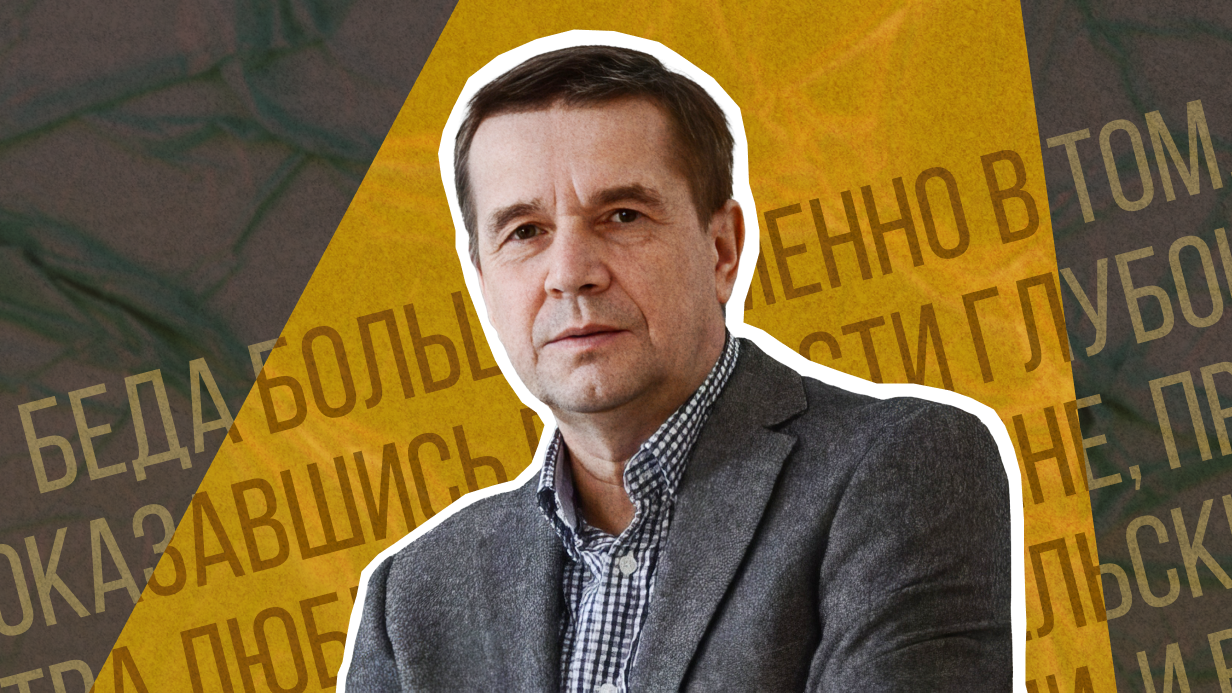
The Supreme Court of the Komi Republic has sentenced philosopher Nikolay Zyuzev to seven years in a strict-regime penal colony on treason charges. Zyuzev, who holds both Russian and Canadian citizenship, is one of the best-known scholars of the legacy of the Russian-American sociologist Pitirim Sorokin. He left Russia after the war began, but in the summer of 2025 he returned to his native village in Komi [a republic in northwestern Russia — T-invariant], where he was arrested. According to the FSB, the scholar was training leaders of national liberation movements among Russia’s small Indigenous peoples and receiving funding for his project from foreign organizations. T-invariant looks at what Zyuzev worked on, why he kept coming back to Russia, and what his friends and colleagues make of the treason charges.
Top news on scientists’ work and experiences during the war, along with videos and infographics — subscribe to the T-invariant Telegram channel to stay updated.
A Classic Liberal
In the summer of 2025, philosophy professor Nikolay Zyuzev traveled from Europe to his native village of Podyelsk in Komi to visit relatives. And then he vanished.
“After the war started, he left Russia, just like I did. Sometimes he came to see me in Europe. I was expecting him again in the fall of 2025. But that summer he went to Russia, even though we begged him not to. There was no way he wasn’t going — his relatives were waiting for him. I guess he figured he’d get away with it, that they wouldn’t touch him. He left. And one day he just stopped responding,” Zyuzev’s friend and former student Alexander (his name has been changed at his request) told T-invariant.
For about a month, there was no word from him. His relatives refused to talk, and his acquaintances had no idea what had happened to him.
“I started sounding the alarm. Mutual friends said he was probably off fishing in his village again. Then one night I snapped, grabbed my laptop, and did a little investigating. On a Komi court website, I found a record showing that his pretrial detention had been extended. So it turned out they’d taken him even earlier, sometime around the middle of the summer,” Alexander says.
The court record didn’t say why Zyuzev had been detained. In September 2025, the website of the Supreme Court of the Komi Republic posted a notice that a criminal case had been opened against the scholar under Article 275.1 of the Russian Criminal Code, “Confidential cooperation with a foreign state or an international or foreign organization.” As Komi Daily reported, investigators searched Zyuzev’s house in the village of Podyelsk, in the Kortkerossky District, in the summer of 2025.
Zyuzev spent more than a year in pretrial detention. According to Alexander, his cell had a refrigerator, and he was taken out for an hour-long walk every day. In his free time, he read books from the prison library and solved chess problems. At the same time, Alexander says, the scholar went through bouts of depression brought on by loneliness and uncertainty. On June 10, 2026, Zyuzev marked his 70th birthday in his cell.
“We write to each other — I’ve gotten five letters so far. He’s in a fighting mood, though one letter was pretty sad. He jokingly calls his imprisonment a cultural-studies expedition to pretrial detention,” Alexander says.
His friends still can’t understand why the scholar decided to go back to Russia. His former colleague, journalist Nikolai Vokuev, has a guess: “I suspect he thought nobody was particularly interested in him and that he could spend the summer in his village. Besides, he’d frankly grown tired of other countries. He complained that he didn’t like the climate in Canada and that things there generally weren’t much to his liking. So he went to do some fishing and spend the summer in his village. And yet back in 2020, he was the one who strongly urged me to leave Russia — he said you can’t stay here. And then he went back himself. I don’t understand why he did it. After all his English-language publications, where he openly condemned the war and the regime’s policies in general, how could he take a risk like that? And whether he was even aware of the risk, I can’t say.”
Nikolay Zyuzev holds a Doctor of Sciences degree in philosophy [Russia’s higher doctorate, above the Candidate of Sciences — T-invariant]. Before Russia’s full-scale invasion of Ukraine, he taught at the Komi State Pedagogical Institute, Syktyvkar State University, and Ukhta State Technical University, where he chaired the philosophy department. Much of Zyuzev’s scholarship is devoted to the legacy of the Russian-American sociologist Pitirim Sorokin. Like Zyuzev, Sorokin was ethnically Komi. After the 1917 revolution, he opposed Bolshevik policies, and in 1922 he was expelled from the country. Sorokin later moved to the United States and founded Harvard University’s sociology department. Zyuzev wrote both his Candidate and Doctor of Sciences dissertations on Sorokin’s legacy and published several books about him. Two of them, Pitirim Aleksandrovich Sorokin and Pitirim Sorokin: Teachings and Life, came out in Syktyvkar in 2019.
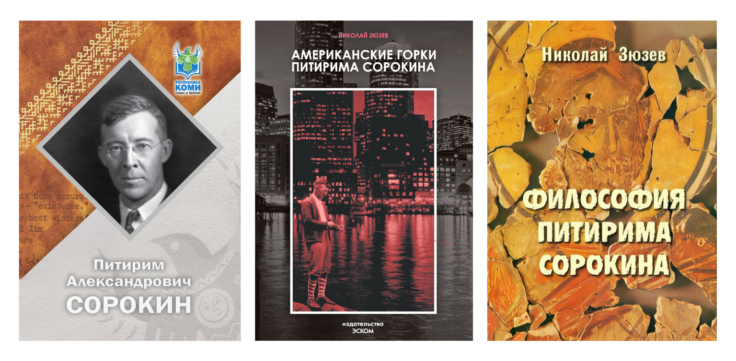
In 2005–2006, Zyuzev was a visiting professor at Harvard University, where he gathered material for his book Pitirim Sorokin’s Roller Coaster. “In America, Sorokin started almost from scratch and fairly quickly ended up at Harvard — and that ‘roller coaster’ is exactly what Nikolay Zyuzev studied,” Alexei, a historian who specializes in the history of the Russian scholarly emigration, told T-invariant (his last name is withheld at his request).
In 2009, Zyuzev moved to Canada, where he taught at Massey College at the University of Toronto, and in 2015 he became a Canadian citizen. That same year, he returned to Komi and resumed teaching at Syktyvkar University.
“Nikolay was my professor when I was doing my master’s at Syktyvkar State University. An amazing teacher, one of those people who make you want to learn — he got me hooked on the humanities right away. His liberal views were close to mine — a classic liberal,” Alexander recalls.
The FSB’s Show-and-Tell Video
After Russia launched its full-scale invasion of Ukraine in 2022, Zyuzev left the country. Even so, he kept returning to his native village of Podyelsk from time to time. According to people who know him, Zyuzev missed home and the chance to teach in his native language.
“Nikolay speaks, teaches, and writes beautifully in English — he has no problems with it whatsoever. But I know from my own experience, having lived in Germany for more than 30 years: you can feel completely at ease in a foreign language, like a fish in water. And yet that cozy, at-home feeling you get when you speak your native language may simply not be there in another language,” Gasan Guseinov, a professor at the Free University [founded in 2020 by academics forced out of Russian universities — T-invariant] and a Doctor of Sciences in philology, told T-invariant. “Pitirim Sorokin reflected on his emigration, wrote a great deal about it, and was a bilingual Komi-Russian person. And although he was completely integrated into American life, he never became trilingual, even though he wrote in English. Nikolay sensed this. On the one hand, it’s a very personal topic, and on the other, a politically charged one these days.”
On September 16, 2026, news broke that the Supreme Court of the Komi Republic had sentenced Zyuzev to seven years in a strict-regime penal colony. By then, the charge had been reclassified as high treason. Media outlets cited the FSB’s Public Relations Center, which said the scholar had been “training leaders of movements for the liberation of Russia’s small peoples and developing a project directed against Russia’s sovereignty,” with funding from foreign foundations and organizations designated as undesirable in Russia. According to the FSB, the defendant pleaded guilty. In a video released by the FSB, Zyuzev says he originally planned to create an educational website for teaching the humanities, but European sponsors showed no interest in the project. What interested them far more, Zyuzev said in the FSB video, was “spreading false information about what is happening in Russia, inciting interethnic hatred, criticizing the policies of the Russian authorities, and destabilizing Russia as a whole by developing national movements.”
“In the video, he mentions that he wanted to do an educational project — we corresponded about that too, but it didn’t work out. What he says after that is obviously a script written by ‘Comrade Major’ [a sardonic nickname for a security-service officer — T-invariant]. Those aren’t his words, you can tell — all that stuff about him supposedly wanting to destabilize the country and so on. That’s just not how he puts things,” Vokuev says.
According to the FSB, Zyuzev received a total of €2 million from 12 foreign organizations. They reportedly included German, Czech, Swedish, French, and British foundations designated as undesirable in Russia.
“Anyone who knows what life is like for people like us abroad these days understands that the grant amounts attributed to him in the indictment are absolutely astronomical — seven figures, literally the budget of an entire research center. It’s a bit like those confessions from the 1930s about a tunnel that people from Central Asia were supposedly going to dig to India or Japan to hand over secret information about the Soviet state’s defenses. Utterly unbelievable nonsense. And there were lawyers, even defense attorneys, who added all this to the case file, sat through it, and raised no objections,” Alexei notes.
“It’s a show-and-tell video about what great guys we are, what a fine job we’re doing. Here’s this terrible professor, a Canadian citizen: look, he’s got euros, he’s got a Canadian passport, while you’re living here in poverty, and they’re over there in their Canada trying to destroy our great Russia. Somebody’s getting another star on his shoulder boards for this,” Alexander says. “They say he received two million euros. That’s laughable. I wouldn’t call him a poor man, but his finances are clearly not those of someone who’s received two million euros in grants. I don’t buy it.”
Small Peoples Tearing Russia Apart
According to Zyuzev’s colleagues, preserving the languages and cultures of Indigenous peoples has always been important to him.
“His project may have been aimed, roughly speaking, at developing regional identity, supporting the Komi language, supporting small peoples. But to the FSB, that doesn’t sound so impressive. Whereas training separatist squads… Sorry, but that makes it sound like they caught some foreign superspy engaged in subversion. I think that even if the project was about developing national identity and preserving these peoples’ languages and cultures, the FSB simply recut it into its own propaganda,” Alexander says.
According to Nikolai Vokuev, after the full-scale war in Ukraine began, the situation of Indigenous peoples started getting noticeably more attention in Komi.
“When the war started, this became a common theme. A kind of wave took off, a realization that this war is also a war against the Indigenous peoples who live in Russia. In that context, there was a lot of talk about the Buryats, who were being sent to the front en masse. I work for Komi Daily. Once, for an anniversary of the start of the war, we did a story trying to figure out how many people from different Komi municipalities had been killed. And we concluded that, proportionally, more people were sent from the villages where Komi is predominantly spoken. In other words, the war hits Komi speakers wildly out of proportion,” Vokuev notes.
Vokuev suspects that Zyuzev’s interest in the situation of Indigenous peoples may have been one of the reasons he came to the FSB’s attention:
“Here’s the thing — separatism. That’s what the FSB guys love. It’s what lets them build nice careers and show how hard they’re working. They didn’t want to pass up a chance like that. They don’t have to make anything up. Here you go, a case — attempts to break up the country. And their worries probably aren’t groundless. Starting in 2020, people began rethinking their relationship with Moscow. The Shies affair had a big influence on that [mass protests against the construction of a landfill at Shies station in Arkhangelsk Oblast that began in 2018 — T-invariant]. And you could easily hear people arguing that Moscow’s policy is a colonial policy. In the 2010s, that was an extremely marginal view, but after Shies, that’s exactly how people came to see their relationship with Moscow. So I think the FSB sank its tentacles into this for a reason.”
“Komi is going through total Russification, of course. Under the republic’s constitution, we have two state languages — Russian and Komi. But there was a case where a young guy was detained at a rally in support of Navalny, back in what were, relatively speaking, less bloodthirsty times. And he tried to speak Komi in court. The judge answered him pretty rudely, something like: you went to a Russian school, what is this circus? But where else am I supposed to speak Komi, if not in Komi?” Alexander recalls.
Guseinov believes the Zyuzev case poses a threat to all scholars who work on the languages of small peoples.
“When the Soviet Union was being built, the Bolsheviks destroyed the independence of small nations, from Georgia to Tuva. But back then, the official ideology was one of bilingualism: the national language plus Russian. Russian scholars worked on the so-called young written languages. That is, languages were given writing systems, then they got their own writers, some publishing houses, films were made. These languages were built up and even brought back to life. And in nine cases out of ten, this was done artificially — in the sense that the language wouldn’t have survived on its own; it needed help, it needed education. Then the Soviet Union collapsed, and that official doctrine fell apart too. And suddenly, overnight, in 2018, people are told that small languages are of no use to anyone [that year, Russia amended its education law to make the study of the national republics’ languages optional — T-invariant]. And when someone like Nikolay Zyuzev swims against the current and comes back home to educate people, to work on his own language, they throw him in prison for God knows what,” Guseinov notes.
Up-to-date videos on science during wartime, interviews, podcasts, and streams with prominent scientists — subscribe to the T-invariant YouTube channel!
What May Have Caught the FSB’s Attention
According to Alexei, regional security services began taking an interest in humanities scholars long before the full-scale war in Ukraine: “The first talk I remember about local security officials in the regions actively calling humanities scholars in for ‘chats’ and narrowing their eyes knowingly whenever international research collaboration came up goes back to around 2007–2008. You’d think these were just distant clouds on the horizon, but it had already started: who are you working for, guys, whose money is paying for your publications — come on, let’s just have a little talk. This had been rolling through the regions for a long time and clearly started earlier than in Moscow and St. Petersburg. And it was aimed specifically at humanities scholars — historians, ethnologists, and sociologists.”
Zyuzev had laid out his views on the situation of the Komi people and on relations between Russia’s regions and the federal center in public. In January 2023, the Canadian current affairs magazine Maclean’s published a first-person account by Zyuzev, “I fled Putin’s Russia for Canada. It opened my eyes,” as told to journalist Adnan Khan. The piece also features in the FSB video about the Zyuzev case. In it, the scholar explained why he had left Russia, criticized Vladimir Putin’s policies, and wrote about the war in Chechnya and the murder of journalist Anna Politkovskaya.
“Politkovskaya’s murder was a warning to dissidents, and the crushing of the Chechen uprising was a warning to members of Russia’s Indigenous and ethnic minorities. I was both. I’m from the Komi minority, a Finno-Ugric people whose own republic, with a population of nearly one million, lies 1,000 kilometres northeast of Moscow. The Komi people have a distinct language and culture dating back at least two millennia, but under Putin’s rule, we face cultural and linguistic extinction. Like all of Russia’s nearly two dozen republics and four autonomous districts, the Komi Republic is supposed to have some degree of autonomy; in practice, it has none,” Zyuzev wrote.
In the same essay, Zyuzev recounted that in 2015 he was offered the chance to head a new research center at Syktyvkar State University. By then his daughter was already in her teens, his marriage had fallen apart, and he had failed to find an academic position in Canada — so the scholar decided to go back to Russia. According to him, the center’s mission was to build ties with scholars in Europe, North America, and other parts of the world. “So in the fall of 2021, I approached two friends—one a sociologist and retired politician, the other a linguist studying the Komi language — and brought to them a radical new idea: to establish an online Finno-Ugric University. It would offer high-quality social sciences education to Komi youth, help them think more critically and, importantly, raise awareness about the injustices suffered by the Komi people.” Zyuzev wrote.
According to Zyuzev, businessman Leonid Zilberg invited him to work with the outlet 7×7. After the war began, the project’s team left Russia and relocated to Lithuania. In May 2022, Zyuzev also moved to Vilnius and began looking for funding for the Indigenous Russia Information and Education Center.
“We sense an opportunity in the aftermath of Putin’s disastrous invasion of Ukraine: Indigenous peoples have been disproportionately affected by the war, both on the battlefield and as conscripts to Russia’s army. Minority groups in the republics are waking anew to the threat the Kremlin poses. Our hope is that demands for decolonization will become stronger, and the Kremlin will lose its grip on the republics. There may be a rare window of opportunity now to change the conversation in Russia — one we can’t waste,” Zyuzev argued. In closing, he wrote: “The only way to course-correct now is to repudiate Putin’s vision, and to embrace the diversity and vitality of [Russia’s] many peoples.”
“And the real tragedy is precisely that he, in the grip of a deep love for his homeland, came back to his part of the world to educate and enlighten. And now these brutes are pinning God knows what on him. Because the way they see it: we’ve got our own life here, everything’s under control, we don’t give a damn about this Komi language. And you’re just spoiled rotten. You went off to the West, picked up some ideas there, came back, and now you’re trying to lecture us — well, we’ll put you in your place, you lousy intellectual. It’s a kind of revenge for their own indifference, for their own wretchedness. Nikolay came back to a country that had already turned thoroughly fascist, where it was clear they would do something to him, some vile thing. Living under the rule of law had spoiled him. He couldn’t imagine they could do something like this to him. That’s the kind of naivety it was,” Guseinov emphasizes.
Zyuzev’s arrest came shortly before searches at Syktyvkar’s Revolt Center, an independent cultural space whose founders included Leonid Zilberg. In the summer of 2025, the center was designated a “foreign agent” and shut down, and one of its founders, Pavel Andreev, was later charged with treason. However, according to Andreev, Zyuzev had no connection to the Revolt Center team and had only spoken at its venue a few times.
Zyuzev’s friends are now trying to draw the international academic community’s attention to his case. “Right now we’re looking for prominent Canadian sociologists and philosophers who could bring the Zyuzev case to the attention of politicians. Maybe, with Canada moving closer to Europe, they’ll take an interest,” Alexander says.
Zyuzev is not the only Russian humanities scholar to receive a long sentence in a criminal case in recent years. Among others, sociologist and political scientistBoris Kagarlitsky, convicted under the law against justifying terrorism, is serving time in a penal colony.
“Quite a few people I know are in prison right now. Boris Kagarlitsky, whom I’ve known since childhood — we lived in the same building. It’s absurd. These are people who are in prison for being smart. That’s the tragedy. It’s the same kind of persecution we saw in the ’30s, the ’40s, and the ’50s: oh, you think you’re too smart — well, here’s what you get. Sociology is a science that makes it possible to improve society. Or to destroy it, if it gets snuffed out. And we’re watching the second process. These cretins don’t even understand what Nikolay Zyuzev’s work is about. They simply don’t understand what intellectual work is for. Because their brains just don’t work. What works are their jaws, which chew people up. And what’s especially painful with Nikolay is that no voice coming from the West, or that could come from there, from Canada, say, will ever reach his jailers’ ears. Maybe there will be some kind of prisoner swaps. There’s no other way he’ll be freed,” Guseinov says.
Alexei also sees the Zyuzev case as a warning to other scholars working on politically sensitive topics:
“Right now, any Tatar, Karelian, or Bashkir historian or ethnologist, say, who back in the 2010s traveled freely to Turkey or Finland, studied figures from the Civil War era and the emigration, and, God forbid, worked with some Germans on sensitive topics like wartime collaborationism, I think, feels like they’re in the crosshairs. For them, the Zyuzev case is an unmistakable signal that anything and everything can be held against them, now and in the future. It seems to me the goal right now is clearly to intimidate scholars. I hope there were no informers involved in the Zyuzev case. But in other fields, unfortunately, they may turn up: self-appointed guardians and pseudo-patriots from within the scholarly community itself.”
“The only thing we can count on is that scholars with an instinct for self-preservation, and people who would like their children to become scholars, will simply leave. Mobility today is completely different from what it was in the 20th century. People are highly mobile and can cross borders relatively easily. And if we prepare for this kind of movement, then young people, at least, can and should be taken out of the Russian Federation — so they can get a normal education and integrate into a more or less humane society,” Guseinov concludes.