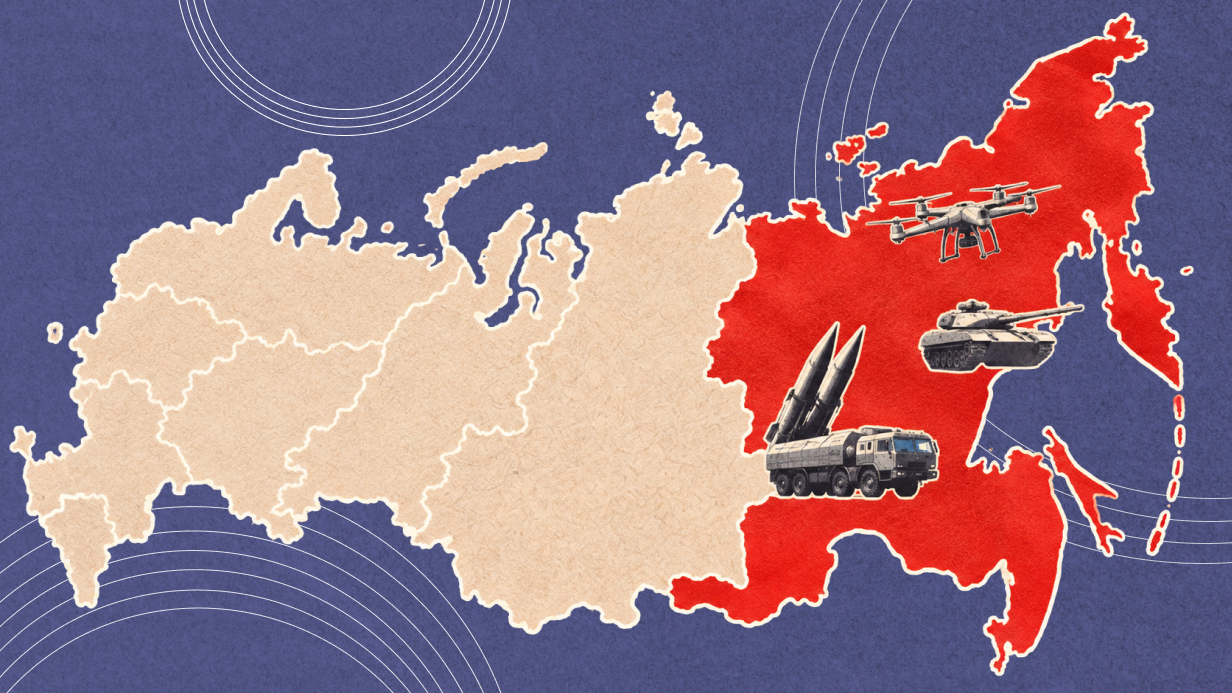
Russian authorities plan to attract scientists to the Far East with promises of help with housing and relocation. Meanwhile, research institutions in the region are increasingly being drawn into military work: universities are developing equipment for the army, regional governments are funding defense projects, and military contracts are pushing civilian research aside. T-invariant looked into how the work of Far Eastern scientists has changed since 2022, why they have to put their own projects on hold, and what restrictions they face when publishing their findings.
In the fall of 2022, an aviation manufacturer demanded that a laboratory at one of the Far East’s universities speed up work on a large order. After discussing the matter with the university’s leadership, the head of the lab told the staff that testing for the manufacturer was now the priority.
This account comes from Maxim, a staff member at the lab, which studied the properties of metals, welded joints, and protective coatings. The university had worked with industry before the war, but now the lab was fulfilling a state defense order. According to Maxim, this was clear from the accompanying paperwork. A representative of the manufacturer also said so explicitly at one of the meetings.
“I never saw any separate written order to stop civilian work. They just changed our equipment schedule,” Maxim recalls.
The new contract required testing rigs that had already been booked for experiments under a research grant awarded before the war. The experiments were postponed several times, and eventually part of the planned research had to be dropped. The industry contract brought the lab money for consumables, equipment repairs, and staff bonuses. But by 2023, Maxim says, defense assignments were coming in regularly and taking up more and more of the working day.
In September 2026, Vladimir Putin proposed developing a dedicated program to attract Russian and foreign scientists to the Far East. They are being promised help with housing and relocation. Meanwhile, over the past few years Far Eastern research institutions have taken on new tasks tied to military needs, and this is already affecting researchers’ work.
In 2023, Buryatia added military research and development to a competition for science grants funded from the republic’s budget. In Khabarovsk, a university design bureau began building equipment for the army; in Transbaikalia, students adapted civilian engineering projects for military use. On Sakhalin, drone production was set up on the premises of a research institution.
T-invariant spoke with staff at Russian laboratories, scientists, and other experts about how research conditions have changed since 2022. We checked their accounts against documents from government agencies, statements by manufacturers, and other open sources. We looked at how defense contracts affect civilian research, what kinds of projects universities and research institutions now carry out, and what restrictions scientists face.
Maxim, Ilya, Anna, Natalya, and Mikhail are pseudonyms. The real names and workplaces of these sources are withheld for security reasons. The research institutions and companies whose documents are cited in this article should not be associated with the anonymous interviews.
Science on Someone Else’s Schedule
Ilya, an engineer at a research and technology organization in the Far East, recalls a meeting where urgent defense-order assignments were discussed. He had hoped to keep some time for a civilian research project, but instead he had to decide which work could be put off. Ilya agreed to change his plan, expecting to get back to his research in a couple of weeks. But new assignments kept coming, and the deadlines kept slipping.
“The worst part was that at first I thought of the delay as temporary,” the engineer recalls.
The delay affected other staff as well. One colleague was supposed to process the results of a civilian study: check the data, prepare tables, and pass them on to the rest of the team. But he, too, was reassigned to urgent production tasks, so the team could not move forward. In the end, the study was delayed by about three months, and some of the questions the scientists had planned to explore were left unanswered.
The team did eventually return to the study, but they had to go back through the materials and work out where they had left off. “In research, a postponement doesn’t always mean the task has simply moved on the calendar. Sometimes you lose momentum, and then you have to spend extra time getting back into it,” Ilya explains. At the same time, he does not claim that all civilian research at his organization has come to a halt.
Industry contracts brought research institutions money that could be spent on consumables, instrument repairs, and staff bonuses. But the same equipment and specialists were needed both by the companies and by scientists for their own research. When a choice had to be made between civilian research and defense orders, management gave priority to the latter.
Anna, a science policy researcher, believes this is how research can change even without outright bans. Scientists can still apply for grants, propose topics, and run experiments, but if the equipment is constantly tied up with contract work, there may simply be no time left for their own research.
“There’s no need to shut down a basic research project. You can just keep putting it off,” Anna says.
Collaboration with large companies is nothing new for science in the Far East. In Komsomolsk-on-Amur, for example, home to the Gagarin Aircraft Plant, the local university began studying methods for manufacturing parts for Sukhoi aircraft as early as 2015. Under a contract with the plant, the university studied how to use materials more efficiently when making airframe parts and presented its findings to the Sukhoi Design Bureau.
Such ties between science and industry existed long before the war. But after 2022, Maxim and Ilya found themselves in a different situation: their plans now depended on defense orders. Elsewhere in the Far East, the changes can be traced through new projects for the army, research grants, and university-developed technology.
From Grants to Drones
In December 2023, Buryatia’s Ministry of Education and Science announced a competition for research grants. The priority areas included fighting wildfires, developing tourism on Lake Baikal, and energy efficiency. The same list also included “Scientific developments in support of the special military operation” [the Kremlin’s official term for the war against Ukraine — T-invariant].
That same month, five projects received a total of 10 million rubles from the republic’s budget. In September 2024, the grant recipients presented their work to the Council for Science and Innovation under the Head of the Republic. The projects shown included some intended for the army, but it is impossible to tell from the published reports which specific projects were funded by these grants.
Top news on scientists’ work and experiences during the war, along with videos and infographics — subscribe to the T-invariant Telegram channel to stay updated.
At East Siberia State University of Technology and Management, scientists made prototype composite propellers for drones. At the Institute of Physical Material Science of the Siberian Branch of the Russian Academy of Sciences, researchers studied ways to protect electronic warfare operators from electromagnetic radiation. As Novaya Buryatia reported, the researchers were advised by specialists from the 88th Separate Special-Purpose Radio Engineering Brigade. The Buryat State Agricultural Academy developed a beef concentrate and kissel [a thick fruit drink — T-invariant] for the army. Samples were sent to soldiers for taste-testing.
The fall 2022 order was not the last one for Maxim’s lab. The following year, the scientists planned to test how well metal joints resist corrosion, but the equipment was once again needed by a company working on defense contracts. As a result, the study was finished two months late, one staff member did not manage to prepare results in time for a conference, and work on a joint paper had to be put off.
For some students, military designs have been among their first engineering projects. In a video published in February 2025, a first-year student at Pacific National University solders parts for a future drone, while another student cuts out a printed circuit board to his own design. Artyom Kisel, head of the PolitekhProm student design bureau, talks about the Barmaley [named after the villain of Korney Chukovsky’s children’s poems — T-invariant], a drone built to a specific military technical specification.
The bureau had opened in Khabarovsk a year earlier under the Priority 2030 program [a federal program supporting university development — T-invariant]. Students built hardware, developed control systems, and tested equipment together with the Robotic Complexes of Khabarovsk Krai research and technology center. In January 2025, members of the bureau underwent training at a defense-industry enterprise in Kaluga Oblast. At the same time, they also worked on civilian projects, including a drone system for fighting wildfires.
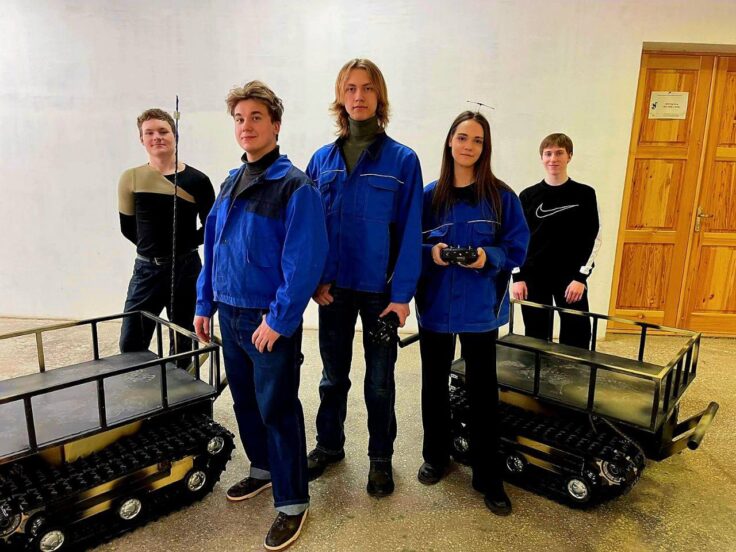
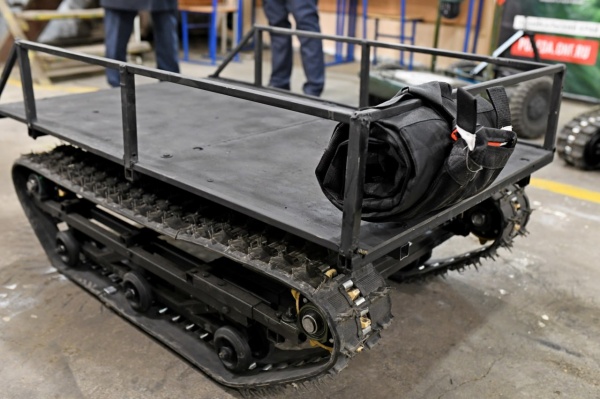
At Transbaikal State University, things started differently. Students first built robots for rescue operations and later began adapting their designs for the army. By May 2025, a university lab had produced a batch of Blokha (“Flea”) ground robots. The client was the regional Legislative Assembly: lawmakers pooled money for the parts, and after testing, the vehicles were to be handed over to the 29th Guards Combined Arms Army for reconnaissance and other tasks in the combat zone.
In October 2025, four robots were handed over to the military, and the students were already working on the next model, the Prokhodimets [roughly “rascal,” with a pun on the Russian word for off-road capability — T-invariant], designed to carry heavy loads. Once again, the lawmakers put up the money for its development.
On Sakhalin, a facility producing quadcopters for the army opened in November 2022. The workshop was located on the premises of the Special Research Bureau for Automation of Marine Researches of the Far Eastern Branch of the Russian Academy of Sciences, which worked on marine instrumentation. Production was organized by an outside company, Vistel, using technology developed by residents of Sakhalin’s IT park.
By February 2024, the facility had launched serial production of two models. The Far Eastern Branch of the Russian Academy of Sciences also confirmed that production at the bureau’s site had been launched back in 2022. Whether the bureau’s own staff took part in military development work is unknown. The only confirmed fact is that the production facility was located on the premises of a research institution.
In February 2024, Vladimir Putin approved Russia’s Strategy for Scientific and Technological Development, which describes the period from 2022 onward as a stage of “mobilization development of the scientific and technological sphere.” This is not only about defense research: the state also intends to tie science more closely to industry and to speed up the development of domestic technologies under sanctions.
How Research Money Is Allocated
After 2022, military objectives also began to appear in regional programs that support research. In December 2023, for example, the government of Primorsky Krai approved a program to develop unmanned aviation for 2024–2030. It provided for creating a research and production center, training specialists, and developing technologies for transportation, agriculture, forest protection, and other civilian purposes.
But in the March 2026 revision of the region’s industrial development program, the objectives of the Primorsky Krai Unmanned Systems Center came to include “meeting the needs of the special military operation” and strengthening the region’s defense capabilities. At the same time, the center is also expected to work on civilian and dual-use technologies.
Up-to-date videos on science during wartime, interviews, podcasts, and streams with prominent scientists — subscribe to the T-invariant YouTube channel!
In August, the authorities updated the unmanned aviation program. It allocated 110.23 million rubles in 2026 for creating and developing the research and production center, plus another 30 million rubles for grants to companies to research and improve unmanned vehicles and electronic warfare systems.
The latter 30 million rubles is earmarked specifically for development work. However, these are planned expenditures, not necessarily money that has already been spent. Moreover, drone technologies can be used for both military and civilian purposes. So the documents confirm that supplying the military has become one of the regional program’s objectives, but they do not make it possible to determine how much money will go specifically to military research.
With university research, the situation is more complicated, explains Natalya, an economist who studies research funding. A university might, for example, study the properties of materials for a company that then uses the results to produce military equipment. Yet such a contract will not necessarily be labeled as defense-related in the university’s reports.
To understand how the research priorities of individual institutions have changed since 2022, Natalya suggests comparing their contracts with companies over several years. This would show who has become the main client and what kinds of research are now getting more money.
In October 2026, at a meeting of representatives of Far Eastern universities, data were presented showing that from 2022 to 2025 the monetary value of university research and development nearly tripled. Government funding accounted for a large share of the growth, but how much of it went to defense projects is unknown.
That said, Far Eastern science depended on government money even before the war. According to data from Vostokgosplan [a state analytical center under the Ministry for the Development of the Far East and the Arctic — T-invariant], in 2023 the federal budget covered about 74% of R&D spending in the Far Eastern Federal District — roughly the same share as in 2018. So what matters is not only where the money comes from, but also what kind of research it goes to.
Julian Cooper, an emeritus professor at the University of Birmingham who studies Russia’s defense budget, suggested in a conversation with T-invariant that since the start of the full-scale war, military research in Russia has expanded partly at the expense of civilian research. It is not yet possible to gauge the scale of such changes in the Far East from financial statistics. But concrete shifts are already visible: military objectives are appearing in regional programs, and lab staff describe how defense orders are pushing civilian research aside.
Results That Cannot Be Published
In Maxim’s lab, the industrial client’s influence was felt not only in how equipment time was allocated. At one point, the staff had nearly finished a research paper, but publishing some of the results required the company’s consent. Those data had to be removed from the manuscript. The paper was eventually published, but part of the findings remained out of reach for the scientific community.
Such restrictions also occur in ordinary civilian contracts: companies may require publications to be cleared with them or prohibit the disclosure of technical information. In defense research, restrictions related to state secrets are sometimes added on top of that. Cooper notes that taking part in such projects can make international collaboration and travel abroad more difficult. For scientists who need to discuss their results with colleagues in other countries, this is a serious problem.

Margarita Zavadskaya, a senior research fellow at the Finnish Institute of International Affairs, points out that doing research is not enough to build a scientific career. The results have to be published, presented at conferences, and discussed with colleagues. Young scientists may be hit especially hard by such restrictions. Working on a complex engineering problem gives them valuable experience, but if the results cannot be published, a researcher may end up without the papers needed to advance their career.
“The main problem is not only the brain drain but also a gradual change in the very model of a scientific career,” Zavadskaya says in an interview with T-invariant. In her assessment, political loyalty and state contracts are playing an ever larger role in this model. A scientist may gain access to modern equipment and a well-paid project, but lose some independence in the process. For example, they will not always be able to decide for themselves which results to publish and what to work on next.
Money and Scientists
At the Eastern Economic Forum in September 2026, Putin proposed helping scientists who move to the Far East with housing, relocation allowances, and jobs for family members. The government was instructed to develop a dedicated program, but no specific payment amounts, selection rules, or application deadlines were announced at the time.
Sebastian Hoppe of the Berlin-based Centre for East European and International Studies (ZOiS)* points out in an interview with T-invariant that the state has long tried to attract specialists to the Far East through large-scale projects. Each project gets funding and a team, which is then kept busy for several years. But once the project ends, the support may stop. If researchers depend on a single client, they have to look for new funding or change the direction of their work.
Sites for new research teams are already being prepared in the Far East. Ahead of the Eastern Economic Forum, the management of the Russky Innovation Science and Technology Center [on Russky Island in Vladivostok — T-invariant] reported that 16 resident companies had set up production at its pilot site and that 30 tasks had been defined for scientists and engineers. New teams are to be assembled by the time the next clusters open.
To connect companies with researchers, the Russky center and the Far Eastern Branch of the Russian Academy of Sciences signed an agreement on September 1. The center will collect requests from companies, and RAS scientists will help find specialists to carry them out. The work in question includes testing, expert assessments, and setting up pilot production lines.
The Russky center already runs its own program, “100+ Research and Engineering Teams for Companies of the Far Eastern Federal District.” Scientists and engineers are offered grants, housing, health insurance, and reimbursement of relocation costs. The center’s areas of focus include pharmacogenetics and biomedicine. This program is not connected to Putin’s new initiative.
Meanwhile, the production of military equipment is expanding. The Khabarovsk-based company AERO-HIT, which has been supplying Veles military drones since 2023, reached an agreement in September 2026 with the Far East and Arctic Development Corporation to set up facilities producing printed circuit boards and drone components. The company plans to hire more than 1,500 engineers and production technologists to staff them.
Staffing problems in Far Eastern science emerged long before the war. According to data from Rosstat, Russia’s federal statistics agency, cited by Cooper, in 2024 the region accounted for just 1.8% of all Russian R&D personnel. Only 9.8% of researchers in the Far East were under 30, compared with 15.8% nationwide. But attracting young specialists is only part of the challenge. Just as important is whether they will be able to keep working once their first projects end.
Sociologist and historian Dmitry Dubrovsky told T-invariant that generous funding can indeed attract individual scientists to the Far East. But building a research center that can work successfully for many years is much harder. Scientists need not only salaries and equipment but also the freedom to choose their topics and the ability to publish their results and collaborate with colleagues abroad. According to Dubrovsky, political control, sanctions, and restrictions on international cooperation stand in the way of creating such conditions.
Mikhail, an expert on the situation of early-career researchers, explains that after graduate school a scientist can get a job at an institute and take part in grant-funded projects. The difficulties begin later, when they need to find money for their own research topic and build a research group. Institutes do not always have funds for permanent positions, and when one project ends, there is no guarantee another will follow. It is especially hard for scientists with narrow specializations: there may simply be no other lab in their city where they could continue their work. “In Moscow or St. Petersburg, a specialist can sometimes change institutes without changing the rest of their life,” Mikhail says.
In his view, it is wrong to judge programs for attracting scientists solely by the number of specialists who relocate. What matters is whether, a few years later, these people will be able to pursue their own research, build research groups, and train young staff. That is especially true in places with few other labs, where new projects are created to serve the needs of individual companies.
Can You Say No?
One of the staff members in Maxim’s lab refused to take part in the military contract.
A researcher who studies academia and spoke to T-invariant on condition of anonymity believes that taking part in defense work is above all a matter of personal choice. “The defense industry places an order, and the university takes it,” he says. In his view, even if management has decided to accept a military contract, each staff member is personally responsible for whether they take part in the project.
Dmitry Dubrovsky draws attention to the economic side of that choice. “The main problem arises when defense contracts become the decisive condition for getting resources,” he says. According to Dubrovsky, if an institute depends on such contracts, it is formally possible to turn down a particular assignment, but the consequences for staff may vary.
Maxim’s colleague was not fired, and he went on working on his own research topic. But according to Maxim, after his refusal the colleague was no longer invited to join some of the paid industry projects. As a result, he lost out on extra pay.
* Listed in Russia’s register of “undesirable” organizations