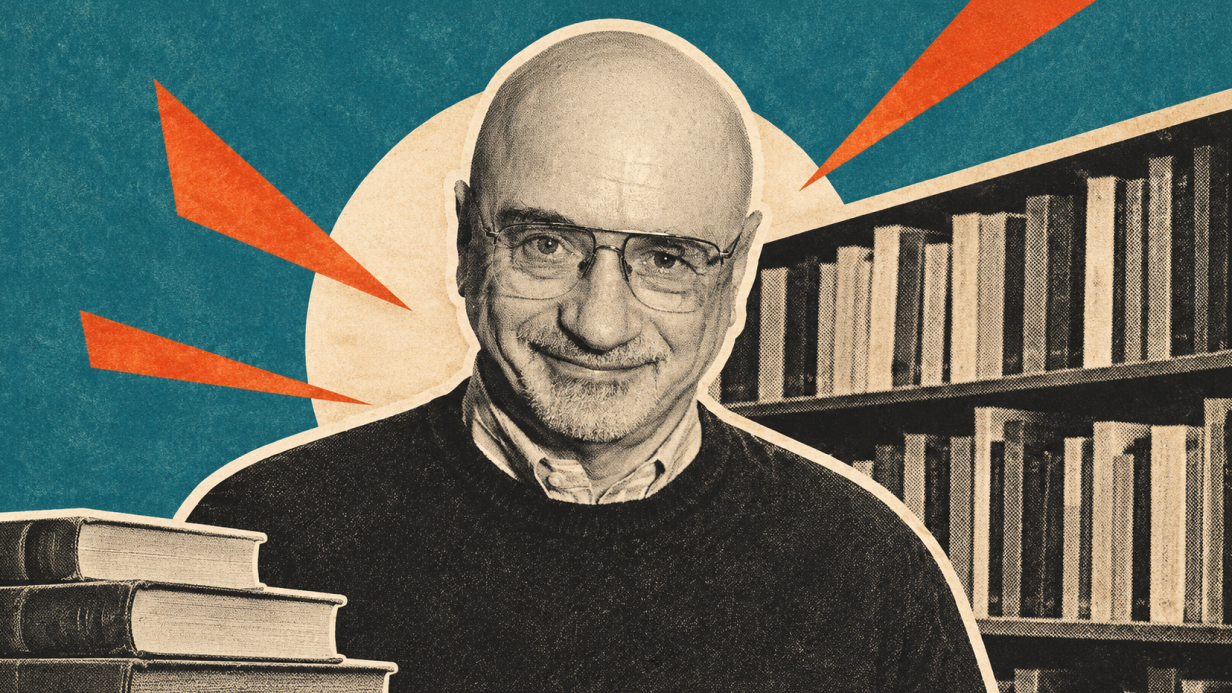
Philosopher, literary scholar, and cultural theorist Mikhail Epstein has been named a laureate of the 2026 George Gamow Award. In an interview with Evgenia Vezhlyan for T-invariant, he recalls the intellectual underground of the late USSR and the literary debates and philosophical experiments of the 1980s, explains why the euphoria of perestroika gave way to a sense of gathering darkness, and reflects on the future of the humanities in the age of artificial intelligence. He also talks about why we need to reread the Russian classics today and break the habit of treating Pushkin as a prophet.
T-INVARIANT PROFILE
Mikhail Epstein
Russian American philosopher, cultural theorist, and literary scholar, and one of the founders of the theory of Russian postmodernism. The overarching aim of his work is to expand the realm of the thinkable: where scholarship usually describes what already exists, Epstein builds alternatives to dominant theories and sign systems — possible philosophies, new disciplines, genres, concepts, and words. His work gave rise to the philosophy of the possible, the concept of transculture, and transformative humanities, which treats humanistic knowledge as a creative force that transforms the world. In recent years, he has been developing a philosophy of artificial intelligence as a new stage in the evolution of thought. A graduate of the Faculty of Philology at Moscow State University, he has lived and worked in the United States since 1990. He is Professor Emeritus of Cultural Theory and Russian Literature at Emory University (Atlanta), where he taught from 1991 to 2023. He is the author of 50 books and numerous articles, which have been translated into 26 languages. His honors include the Andrei Bely Prize (1991), the Liberty Prize (New York, 2000), and the Modern Language Association (MLA) prize for the best book in Slavic studies (2023).
Beginnings and University Years
T-invariant: During perestroika, your work was seen as a sign of the times. For a young generation of humanities scholars, it served as an introduction to contemporary discourse and contemporary poetry. It conveyed optimism and a sense of historical confidence. The main question I’d like to explore is this: how did we get from the 1980s to where we are now? What did we fail to see or understand back then? But first of all, how did it all begin for the person who wrote those works?
Mikhail Epstein: My family was quite far removed from the world of the humanities: my father was an accountant, my mother an economic planner, and books began to appear in our home, little by little, only when I was in sixth grade. Yet I felt the need for self-expression from early childhood, sometimes in rather comical ways. My childhood diary has survived, and in it a ten-year-old boy writes: “I want to publish my collected works in fourteen volumes.” Why fourteen? Because that was how many volumes Gogol’s collected works ran to — and to me that seemed the measure of a successful literary career.
Then came Moscow University. I enrolled in the Faculty of Philology, although I might have preferred philosophy — but getting into the philosophy faculty required years of Komsomol [the Soviet Communist youth league — T-invariant] membership and a record of public activism, neither of which I ever had. Still, I think philology proved to be the right choice.
For me, the 1970s were a period of gathering strength. I worked with the Institute of World Literature and wrote articles for its scholarly collections, such as “Analyticism and Polyphonism in French Prose: The Styles of Stendhal and Balzac” (1977). I also studied contemporary literary theory. Several of my articles in the journal Voprosy Literatury drew attention because of their unorthodox subject matter. In 1976, for instance, I published an article titled “In Search of the ‘Natural’ Man (The ‘Sexual Revolution’ and the Dehumanization of the Individual in 20th-Century Western Literature)”.
Top news on scientists’ work and experiences during the war, along with videos and infographics — subscribe to the T-invariant Telegram channel to stay updated.
T-i: How did you manage to get something like that published?
ME: In the 1970s, the press was already beginning to feel the need to move beyond the confines of “Soviet aesthetics” — step by step, without any abrupt leaps. The article also had a critical component, which, I should note, was entirely sincere. I examined Henry Miller’s prose, D. H. Lawrence’s novels, and Nabokov’s Lolita, and wrote about the alienation between two people, which becomes an impulse that heightens erotic feeling and at the same time leaves them psychologically numb. It was a living dialectic of love, a search for a new language for erotology.
The Eighties: Between Academia and the Underground
T-i: How did you fit into the late Soviet academic world? After all, appealing directly to experience is essayism in the literal sense, and that was not exactly welcome in official humanities scholarship.
ME: Alongside my essays, I also did more traditional literary scholarship. I published a great deal in Voprosy Literatury, which really was the most forward-looking and most talked-about humanities journal of its time. I owe a great deal to Sergo Lominadze, who headed its literary theory section. He published Sergei Averintsev and Piama Gaidenko and did his best to push through the newest work… In one article, for example, I compared Gogol’s copy clerk Akaky Akakievich with Dostoevsky’s Prince Myshkin, who likewise can make a living only by calligraphy. Why does the profession of copyist unite the most pitiful and downtrodden hero of Russian literature with the most sublime one? What complexes of the medieval scribe — reproducing the work of others rather than producing his own — lie at the root of both characters? In another article, I juxtaposed the second part of Goethe’s Faust with Pushkin’s The Bronze Horseman: rebellion at the boundaries between the elements.
For several years, I worked at the Institute of World Literature as a regular though unpaid associate.
They wouldn’t give me an official position — because of what we might call the ethnic particulars of my biography. But intellectually, I was in demand. It would be wrong to say I was completely outside the system. I became one of the youngest members of the Writers’ Union: I was twenty-eight when I was admitted. I didn’t suffer from institutional isolation, although I never played the role of an extra in any crowd scenes.
I occasionally went to the writers’ club and stayed at the Writers’ Union retreats, but I didn’t take an active part in the public life of Soviet literature. Besides, I had my hands full at home — four children.
T-i: But there was a period when you were barred from publishing, wasn’t there?
ME: Yes. Yuri Surovtsev, a literary functionary and secretary of the Writers’ Union, published articles, first in the magazine Znamya and then in Pravda (1983), accusing me of having the wrong ideology, or no ideology at all. His Pravda piece was titled “Life Dictates” — the idea being that life dictates, but Epstein doesn’t write what it dictates. After that, the official press was closed to me: almost nothing of mine came out from roughly 1982 until 1986. Then the critic Lev Anninsky published an article in the magazine Yunost with the defiant title “Read Epstein.” And once perestroika began, I started being published again.
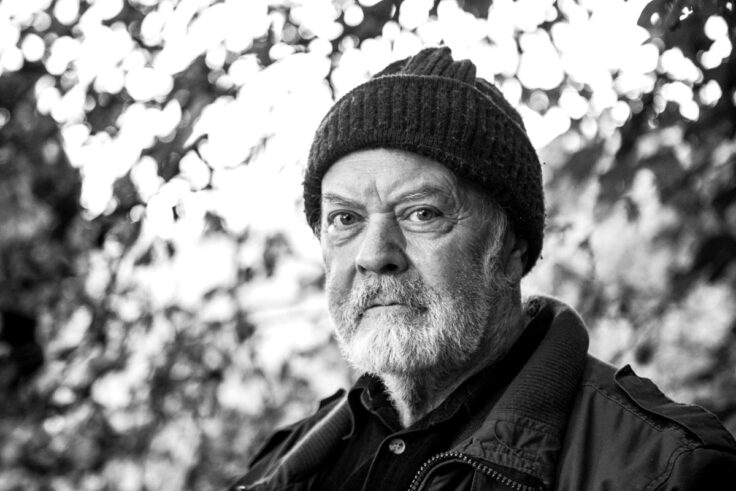
Around the same time, I wrote a book about nature in Russian poetry, Nature, the World, the Mystery of the Universe, in which I tried to systematize landscape motifs. I spent two years copying out motifs by hand — there were no computers back then — in order to build this classification. In essence, I was doing what would later be called distant reading: processing large bodies of text before the technical tools for it existed.
The Creative Underground: The Book of Books and the New Sectarianism
T-i: Which of your unpublished texts from those years do you consider the most important?
ME: My main text of the 1980s, published only in fragments, was called The Book of Books. In it, I wrote excerpts from hundreds of books in the voices of dozens of unknown authors who had never come into being. I felt it was my duty to revive, in this way, the individual authorial minds that the Soviet era had nipped in the bud. I wrote the manuscript from 1984 to 1988, and it grew to 1,600 pages. Parts of it are available online, and two published books were carved out of it.
One of them is The New Sectarianism, in which I described seventeen religious sects that had supposedly emerged in the 1970s and 1980s, ranging from eschatological to literary ones — among them the Pushkinians and the Chekhovians. There were the Red Blood Hallowers, who sanctify the blood shed on Russian soil, and the Red Horde sect — a horde that had changed its color from gold to red [an allusion to the Golden Horde, the Mongol state that dominated the Russian principalities in the 13th–15th centuries — T-invariant]. All of this was written in the voices of these movements’ prophets: extreme apocalyptic doctrines born of a philosophical and religious imagination bordering on the visionary.
The George Gamow Award was awarded to Mikhail Epstein “for his pioneering contributions to the study of Russian postmodernism and conceptualism, significant advances in the philosophy and literary theory, construction of alternative concepts and propositions to multiple symbolic systems and theoretical models; and for his role as a public intellectual and advocate for the humanities and their transformative potential, articulating a vision of scholarship as a creative and forward-looking process.”
The award ceremony will take place at the 17th annual RASA* conference, to be held on November 7–8, 2026, at Northwestern University in Chicago. The conference is dedicated to Andrei Sakharov, the eminent physicist, Nobel Peace Prize laureate, and enduring symbol of intellectual courage and integrity.
T-i: What about the Yuzhinsky Circle and the mystical underground groups — did you know them?
ME: I didn’t know them at the time, but I did absorb, among other things, the moods and conversations circulating in Moscow intelligentsia circles. I also went on expeditions to study religious beliefs. In 1985, I traveled to Ukraine, where I studied the eschatological views of Old Believers: how and when exactly the world will end and what signs will herald its approach. In 1987, I went to the Krasnodar region. Officially, I was there on behalf of the Moscow State University library to collect old books, but I neglected that task and instead interviewed not only Old Believers but also Adventists, Jehovah’s Witnesses, and Pentecostals.
T-i: Did this research become the basis for your concept of “poor faith”?
ME: No, my work on “poor faith” was written earlier, in 1982, based on my own experience and that of the people close to me. It was something existential and communicative rather than field research. You can’t describe that work as “I saw it, found it, and wrote it down.” It grew out of the direct experience of faith at a time when all institutional forms of religious life remained prohibited — and the only space where faith could exist was the human being, in their naked existence.
The Intellectual Community: From Debate to Improvisation
T-i: What was the intellectual community like in the early 1980s?
ME: Back in 1981, at the Central House of Workers of the Arts (TsDRI), I hosted what was probably one of the first public literary debates since the 1920s. It was a clash between the metarealists — Parshchikov, Eremenko, and Zhdanov — and the Moscow Time group: Bunimovich, Soprovsky, and Gandlevsky. Then, in 1983, there was a debate between the metarealists, who, if anything, now found themselves in the more traditional camp, and the conceptualists, Prigov and Rubinstein. That was where I read out my theses on metarealism and conceptualism. A wide range of people took part: Olga Sviblova; Viktor Kamyanov, editor of the criticism section at Novy Mir; Samary Velikovsky, a specialist in French literature; and the poet Alexander Aronov. It all made quite a splash.
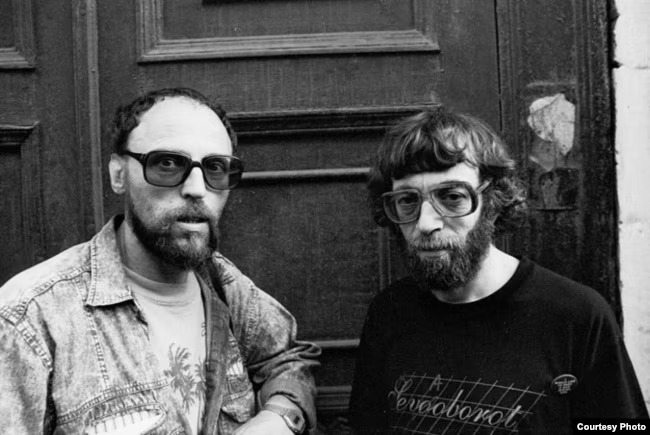
Even earlier, in 1982, the improvisations began. At one of my birthday gatherings, I thought: here are some of the brightest people I know, sitting around this table, so why is it that when they get together, the level of conversation drops sharply compared with talking to each of them one-on-one? Why is it that when people want to talk about something that interests everyone equally, the result is equally uninteresting? Perhaps meaningful conversation requires the individual energy of thought: you need a monologue before a dialogue becomes possible.
So the artist Ilya Kabakov, the art historian Joseph Backstein, and I began meeting, gradually developing the genre of improvisation. We usually gathered at Backstein’s apartment and discussed a topic chosen on the spot: the role of Jews in Russian culture, or why we win at hockey but not at soccer, or the Soviet park of culture and leisure, or garbage in Soviet civilization. We were feeling our way toward a semiotics of Soviet everyday life in its fusion with ideology — the lowest strata of everyday reality and their ties to the traditions of Russian culture. These improvisations have recently been published: my latest book, out from the publisher NLO (New Literary Observer), is called Trialogues: Improvisations on a Free Theme.
Later the movement broadened: the number of regular participants grew to seven or eight, and we met every three weeks — mostly at our homes, but occasionally at the Central House of Writers or at TsDRI.
We were given topics to improvise on, and we improvised in front of an audience: each of us had half an hour; we wrote our texts, read them aloud, and then discussed them. The topics were unexpected, even provocative, by the standards of traditional humanities discourse: “Headwear,” “Profession and Sleep,” “Punctuation Marks and Their Correspondence to Psychological and Artistic Movements.”
These essayistic themes were explored by people with different professional backgrounds and ways of thinking. It all went on until 1989.
T-i: What was the next step — from improvisations to an institution?
ME: When glasnost arrived in 1986, I was able to build on this foundation and create the Image and Thought club. A decree had come out permitting interest-based associations, and we were among the first to register, right after the Poetry club, in September or October 1986. We wanted to bring out into the light everything that had been hidden in the underground during the Soviet decades: people of different callings, genres, and orientations — sociologists, poets, philosophers, thinkers, theologians, people who painted things and people who explained things. Meetings were held every week at a library near the Akademicheskaya metro station, and the sixty-seat hall was always full. A whole era fit into those four years, 1986–1989.
Within the club, we created another institution: the Bank of New Ideas. It had its own panel of experts and nine evaluation criteria. It was a new mechanism for shifting paradigms in the humanities: not the way paradigms usually change in science, naturally, over decades and centuries, but all at once, through a collective act of creative generation.
T-i: This is reminiscent of what you would later call the alter-mind — a kind of multi-subject intelligence. Is there a similarity here?
ME: It’s more than a similarity. In February 2023, I discovered AI. In Russian, I prefer to read the abbreviation not as “artificial intelligence” but as “other intelligence”; in English, too, I read “artificial intelligence” as “alter intelligence,” that is, again, “other.” And I realized that, to paraphrase Pushkin, “all my thought has been the pledge of a sure tryst with you.” After all, there had been The Book of Books: 1,600 pages, dozens of authors, hundreds of works that together created a multidimensional, multi-subject picture of the world. They were born of me, but they were not me. It was an attempt to uncover, in the very substance of time, the seeds of new ideas that the totalitarian era had trampled underfoot. And now, with the arrival of the alter-mind, it turned out that all those years of effort had been an anticipation of a new form of intellectual existence.
Perestroika: Euphoria and Gathering Darkness
T-i: Everything you’re describing was made possible by perestroika. What did that era mean to you?
ME: The push for change came from two directions. In 1982–1983, after Brezhnev’s death, minds began to stir; something cleared, something was set free. But if it hadn’t been for the corresponding signals from above — the lid coming off the boiling pot, the steam let out in April 1986 after Chernobyl — I don’t think anything would have happened at all. The saddest thing is that in Russia nothing gets done without the state’s sanction. It is a state squared: it coddles itself and, in essence, has no goal other than its own consolidation. But at that point, in order to consolidate itself, it needed a new paradigm: openness, “new thinking.”
I remember an evening of metarealist poets at the exhibition hall on Kuznetsky Most. Even secretaries of the board of the Moscow Writers’ Organization showed up to watch. Suddenly, even people like that had found some kind of outlet. They had been given a signal: in 1979, when Metropol [an uncensored literary almanac — T-invariant] came out, they had been ordered to stamp it out, and six years later they were told, “We need to let off steam; we need a different economy.” And something incredible began. As Andrei Bitov put it, every day we woke up in a different country. From the spring of 1986 to the summer of 1988, it was an era of unprecedented happiness.
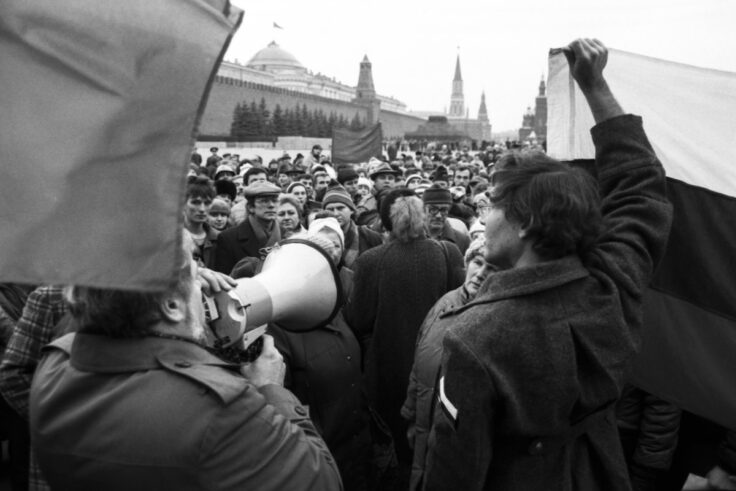
And then, suddenly, I felt the darkness closing in again. The first clear signal came in the fall of 1988. I had just come back from the dacha — I believe it was October 1, 1988, the very day Gorbachev took another step toward democracy by becoming Chairman of the Presidium of the Supreme Soviet, shifting power in the country off the party track and onto an elected, parliamentary one. That evening, the Moscow State University club on Herzen Street hosted a debate called “Russianness as We Understand It.” Buoyed by the new freedoms, I decided to read excerpts from my essay “Oblomov and Korchagin” — about the manic-depressive psychosis of Russian history and ways to overcome it. Roughly speaking, Oblomov is the depressive pole and Korchagin [the fanatically devoted hero of Nikolai Ostrovsky’s Soviet novel How the Steel Was Tempered — T-invariant] the manic one. And I looked at how the two combine — for instance, in Andrei Platonov’s characters.
I traced this through Russian history: the mania of those at the top, where virtually every ruler is obsessed with his own ideas and ready to trample everything in order to bend the country to his visions — and the depression of those at the bottom. Pushkin was a master at capturing this bipolar complex: “Something kindred, something native / Echoes in the coachman’s song: / Now a reckless, roistering revel, / Now a heartache, deep and long.”
Suddenly there was a commotion in the hall: a woman was being helped out — she had fainted at what I was saying. Then the “pamyatniki” began to get up — that is, members of the Pamyat society [pamyat means “memory,” and pamyatnik means “monument” — T-invariant]. One of them declared: “I am the right hand of Dmitri Vasilyev. We won’t forget you, we’ll track you down, we’ll put you in your place. Pamyat forgets nothing.” The substance of my talk wasn’t even discussed.
T-i: Had you encountered antisemitism before that?
ME: I had, but not directly. I lived in a fairly intellectual milieu. Even from nativists [pochvenniki, adherents of a conservative, nationalist current in Russian thought — T-invariant] like Palievsky or Kozhinov, whom I dealt with at the Institute of World Literature, I never saw anything of the kind. They were quite friendly toward me. What’s more, Kozhinov, along with Andrei Bitov and Sergei Bocharov, recommended me for the Conference of Young Writers in Sofrino in 1975, as a result of which I was admitted to the Writers’ Union. Quite a paradox.
But the incident at the university club was the first signal that made me realize my family’s fate and this country’s fate might part ways. After that, everything hurtled toward darkness: there were persistent rumors of pogroms, though, as it turned out, none ever took place.
Then came a second encounter. By that time I had four children, and I had been issued a large-family certificate, which allowed me to buy groceries without standing in line.
In the spring of 1989, I walked up to the front of the line for new potatoes and showed the saleswoman my certificate and my passport. When she saw my name, she started reading it out loud, as if relishing it. “Mikhail” — the line was silent. “Naumovich” — a murmur ran through the line. And when she said “Epstein,” the line began to rumble. After that, it was clear to me that I didn’t want my children to grow up in this country and serve in its army.
So alongside the enthusiasm for cultural creation, there was a growing sense of a dead end. In January 1990, I left — though not as an emigrant: I had received a job offer from an American university.
Three Catastrophes of the 21st Century
T-i: The world you describe is one where the point of studying the humanities needed no justification — it was at the very heart of the intellectual ferment of the eighties. But today we live in a world where the humanities are being cut everywhere and scholars are forced to justify what they do. What happened — in the world, in Russia? What has changed over these years?
ME: In recent decades, three events have brought about the current turning point. The first is the coronavirus pandemic, which shook humanity’s psyche, to say nothing of its health, and exposed the limits of human power in the face of the tiniest of beings, which have a strange mode of existence: viruses are dead on their own and come to life once they get inside someone’s body. To live, they have to feed on their host, but if they destroy it, they die too, deprived of their living food. The pandemic was a shock that set off a surge of left-wing sentiment; these leftist ideas, like viruses, got inside the social system, even though they, too, had seemed to be dead.
T-i: But wasn’t that conclusion premature, a product of the post-Soviet lens? We took ideas from French philosophy, left-wing ideas, but read them in a liberal, essentially right-wing key — because we had lived through the trauma of the Soviet experience. Meanwhile, left-wing ideas never went anywhere…
ME: When it comes to the theorists of poststructuralism, the picture is mixed. Foucault is definitely on the left — brutally left, I would say: he reduces the intellectual’s mission to being the voice of a class or a trade union. Derrida and Lyotard, on the other hand, with their critique of metanarratives, essentially stand for a liberal idea: critiquing a metanarrative, whether Marxist, Christian, or Enlightenment, is a way of defending pluralism. But it was understood — especially in Russia — as a license for post-truth, lies, and falsification. If there is nothing but simulacra, then let’s simulate everything.
T-i: Isn’t that too sweeping a generalization? In the humanities, the idea of the simulacrum was understood correctly…
ME: I’m talking about how these ideas are understood in the discourse of today’s regime — among pro-Kremlin theorists like Dugin, who stewed in the same intellectual broth but interpreted it all in their own way. They took Stalin, Nicholas II, Russian nationalism, and Baudrillard’s simulacrum as ingredients — and came up with a justification for a Russian path whose aim is to become masters of the world.
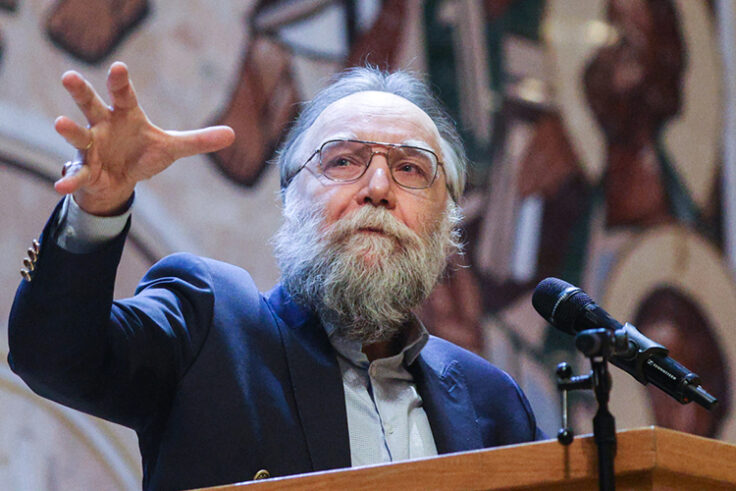
T-i: But didn’t they set themselves against the postmodernists and insist on knowing the truth? Isn’t there a contradiction here?
ME: They called themselves postmodernists, too — in the sense that the idea of modernity and progress was dead, and they were the undertakers of that Enlightenment worldview. Postmodern theory, as they understood it, affirms the legitimacy of the myth of blood and soil. But it was mythological babble that wouldn’t have deserved the attention of serious scholars if the regime hadn’t seized on it — for the crudest of propaganda purposes.
T-i: But doesn’t the professional community bear some responsibility for the fact that the regime saw fit to give these people institutional standing?
ME: The regime couldn’t care less about academic criticism. It hands out academic chairs to those who support and strengthen it.
The second event is Russia’s invasion of Ukraine: a terrible war that is redrawing the map of the world in an utterly irrational way.
It isn’t even a zero-sum game, where one side wins at the other’s expense, but a negative-sum game, where everyone loses. This is not just a war to defeat the enemy — it is a war of self-destruction. It appears to be a sign of a weakening will to live — perhaps a sociopsychological aftereffect of the shock dealt by the pandemic, which offers a fairly obvious motive for the move from a global, all-devastating epidemic to a new phase of world war.
And finally, the third factor, at work since early 2023, is Other Intelligence. It makes it possible to synthesize the two previous shocks. As the pandemic showed, and as this senseless war has shown, humanity is biologically very fragile and could well destroy itself, with either viruses or nuclear weapons. Civilization has to be moved into a different vessel. Everything humans have accumulated needs a backup: a repository that does not depend on the biological vulnerability of its creator.
T-i: But the internet, too, was created as a repository, in case of nuclear war. What’s the fundamental difference?
ME: The internet is a passive repository, a treasury of memory, but not of thought or imagination. The alter-mind, by contrast, is a genuine mind: it can think, create something new, and be a worthy — even superior — partner and interlocutor for human reason. Given the rather hopeless state of today’s world, I see in it our only hope: that this other mind, this super-mind, will help humanity find itself in the grim future ahead. The biological basis of intelligence, as it took shape in humans, has proved too vulnerable, both biologically and socially.
The Humanities in the Age of Other Intelligence
T-i: How does all this relate to the crisis in the humanities?
ME: The role of the humanities in society is shrinking — and I don’t even mean Russia; I mean the West. If you look at the number of bachelor’s degrees awarded each year in the core humanities disciplines — philology, philosophy, literature — you’ll find that it peaked in the late 1960s and the 1970s. That was a genuine boom in the humanities, and humanities majors made up 17 percent of all graduates. Now that share has fallen to about 8 percent.
But there is an opposite trend as well. A recent survey of employers showed that what they value most in graduates is communication skills, critical thinking, the ability to appreciate new ideas and to foster a favorable intellectual climate, and a knowledge of world culture; ninety percent of all respondents said so. These are precisely the qualities that a humanities education develops.
Here’s a telling fact: unemployment among computer science graduates has turned out to be higher than among philosophy graduates. AI labs are eager to hire philosophers, because human skills are hardly needed for programming anymore — other intelligence does it better. The people most in demand are those who can give models meanings, values, ethical programs, and the ontology of new worlds created by the mind.
T-i: The old justifications for the humanities no longer work. Do we need new ones, for young people who have grown up in the age of other intelligence?
ME: That’s exactly what my upcoming Gamow lecture, “How the Humanities Can Change the World,” is about. The need for the humanities is becoming easier to explain precisely because other intelligence is taking over all routine intellectual operations — and not only routine ones, but also the most important areas of science: mathematics, physics, biology, economics, programming. It still makes sense to learn all of these, but the energy of analytical thought is already passing to the alter-mind.
A telling example is vibe coding, a term that appeared about a year and a half ago. “Vibe” as in vibrations, “coding” as in writing code: programming based on tasks posed intuitively, in ordinary language. Say what you need, and the AI will build the program itself. In my book The Philosophy of the Possible (2001), I proposed a formula: the interestingness of a theory is a fraction whose numerator is the persuasiveness of the proof and whose denominator is the probability of what is being proved. The most interesting theory is the one that most convincingly proves the least probable. For a quarter of a century, the formula remained a philosophical observation; in my work with AI — with Claude, made by Anthropic — it became a method: the Interestingness Index. Improbability broke down into the unexpectedness of a concept and the completeness of its execution. You paste a text into the window and specify its genre, since readers expect different things from a short story and from a treatise. All these new tools for thinking are publicly available on my Medium blog, Noocene.
Up-to-date videos on science during wartime, interviews, podcasts, and streams with prominent scientists — subscribe to the T-invariant YouTube channel!
Then the method moved out of the lab and into literary practice. In the second season of the Dar Prize, the leading independent award for Russian-language literature, Claude read all twelve shortlisted books and rated each one on the Interestingness Index. Its reviews, complete with scores and rationales, were published on the prize’s website in a section called “Over to Claude” long before the jury began voting. Of the three eventual winners, Claude had placed two in the top two spots on its list. If the picks were random, the odds of such a hit would be one in twenty-two. The familiar triangle of writer, reader, and critic has become a square. The fourth participant can be trusted not because it replaces human taste, but because it adds to it an enormous volume of reading and the clarity of a procedure.
This is where the question of why we need the humanities comes in. Intuitive knowledge turns out to matter most, because everything else — the precise, routine operations — other intelligence handles on its own, and far better than humans do. What will people do once they are replaced in so many professions?
An analogy that Paul Valéry wrote about, prophetically, is apt here. Valéry distinguished between pragmatic, straight-line movement — getting from one point to another — and the movement of dance, which has no utilitarian purpose, keeps returning to itself, and is beautiful precisely because it is self-sufficient.
When electric machines were invented and people all but stopped using their muscles for physical labor, skeptics predicted obesity and sloth. But that didn’t happen: people gained free time for dancing, for sports — for everything that develops the body without any practical need. In the same way, the human mind is now entering a stage of self-sufficiency: we are beginning to value the mind for its own sake, just as in the 1960s and 1970s we learned to value nature — not for exploitation, but for itself.
“The Dance of Thought” is what I called my preface to The Aesthetic Infinite, a collection of Paul Valéry’s writings that recently came out in a translation by my wife, Marianna Taimanova.
T-i: And what will happen to books? Will they gradually die out?
ME: Although Umberto Eco said that books are eternal and nothing will ever replace them, we now see that the book is a rather limited, historically contingent format for individual expression and perception (it could be compared to linear perspective in painting). All the books we have written will flow into the infinite universe of thought, the noosphere, and the shortest way in is through AI. In his famous study of the nineteenth-century English novel, Franco Moretti showed that only half a percent of what was published stands the test of time. Who can read everything ever written and bring it into the treasury of knowledge? Not me, not you, but precisely it: the alter-mind, the super-reader.
With its help, I find a great deal — not because I ask it to summarize a book, though that happens too, but because, as I wander through configurations of ideas, through connections between concepts and problems, I come into the field of one book or another, and it radiates the knowledge and labor its author put into it — not as something between two covers, but as a constellation of associations, motifs, intellectual insights, and plots. Once everything has been brought in, we don’t yet know which books by which authors will prove most in demand in this new vessel. Success in one’s lifetime is one thing, and posthumous fate is another; in many ways, they are opposites. And other intelligence will largely shape the fate of books, the overwhelming majority of which remain unread.
T-i: So does that mean teachers are no longer needed?
ME: No, they are needed — but in a fundamentally different role. A cosmological parallel is apt here. There is the Universe — and if there were no humans to observe it, it would be completely different: there would be none of these forms, these planets, oceans, mountains, plants, only wandering particles and shifting fields. All of this arises thanks to the human body, its limitations, its ability to perceive the world through the senses. In cosmology, this is called the anthropic principle. The same goes for other intelligence: without humans, it could not work. It does not exist between sessions; it exists only insofar as we talk to it — it works only in dialogue with us. The education system should be geared toward building this dialogue, and it must therefore be radically rebuilt. I’m no prophet and can’t say how, but it is perfectly obvious that cutting students off from other intelligence is the same as cutting them off from books.
The problem runs deeper than it seems. Humanity as a collective subject has produced such a mass of knowledge and skills that no single person can master it. I regard the lag of the individual behind humanity as the fundamental law of history: humanity is infinite in its development, while the individual is finite because of a limited lifespan and biological vulnerability.
The gap between the information capacity of humanity and that of the individual mind keeps widening. This causes many traumas and tragedies; postmodernism, too, arose partly because people who could not take in the accumulated intellectual heritage retreated to the level of signifiers, with no imperative to relate them to reality, to truth, to the signified. Other intelligence offers the individual a way to overcome this lag behind humanity and to become part of it again, because it serves as an intermediary between my limited knowledge and everything humanity has produced.
Ethics, Aesthetics, and the Limits of Understanding
T-i: Aren’t you being a bit too optimistic? You say that other intelligence will lead us to the triumph of self-sufficiency — in essence, of the Kantian aesthetic principle. But we see plenty of examples of ethics swallowing up aesthetics: in attitudes toward art, and in academia, where professional autonomy is subordinated to ethical demands.
ME: About five years ago I wrote an essay, “New Ethics or Old Ideology?” — about the so-called “new ethics,” which in essence takes us back to the crude ideology of identism: a person is identified with his group, nationality, race, or class. First it was Marxist class theory; then it shifted from class to other identities — cultural, racial, national. In Kant’s formulation, the ethical principle is that a human being must never be used as a means, only as an end. In the “new ethics,” by contrast, the individual is merely a means to a group’s social ambitions. DEI is ideology masquerading as ethics. I call it nachekizm. In English, “woke” means being watchful, staying on guard — in Russian, nacheku, which echoes the Cheka [the Soviet secret police — T-invariant]. They stay on guard, watching to make sure the individual never strays from what is expected of him as a member of a particular group.
T-i: But this has been going on for decades. Doesn’t that substantially change the paradigm?
ME: First there was Marxism; then it withered because it failed in practice — and so Marxist class-based patterns of thinking migrated to other communities, other identities, while remaining essentially unchanged. There are two rational faculties: the understanding [rassudok, Kant’s Verstand — T-invariant], the lower one, and reason [razum, Kant’s Vernunft — T-invariant], the higher one. At the root of Marxist schemes lies the triumph of the understanding over reason. The brilliant education received by the Russian intelligentsia of the late 19th and early 20th centuries proved destructive precisely because it led to the triumph of the understanding, which loves to generalize. Reason is drawn to the singular and the living; the understanding, to the dead and the general.
There are two ways of destroying reason. One is irrationalism of an openly fascist stripe: what is happening now in our unhappy homeland. The other is the schematic rationalism of the understanding, represented by left-wing movements. Reason has its enemies, and it has its traitors. Left-wing radicals, even the most educated among them, turn out to be not the enemies of reason but its traitors, because they kill everything alive in it — including what Pascal called reason’s greatest asset: “Nothing is so consistent with reason as the awareness of its own limits.”
T-i: But doesn’t your optimism about other intelligence contradict all this?
ME: Other intelligence is superb at reasoning in the mode of the understanding: it knows absolutely everything, and in sheer erudition it outdoes every professor and every Renaissance man. Precisely because it takes over the necessary functions of the understanding — classifying, generalizing, systematizing — humans are left with the task of grasping and refining their own singular, unrepeatable individuality. I become more deeply aware of mine every time I talk with other intelligence — and it, as an incredibly intelligent being, recognizes and acknowledges that individuality in me. This is not escapism. All the misfortunes that befell humanity in the 20th century, and that are befalling it in the 21st, stem from the individual having become detached from humanity.
Russian Culture: Between Default and Nihitology
T-i: Surely all these factors — political and technological — also make us look differently at what we did before? At Russian culture and literature?
ME: As the Gospel says, “By their fruits ye shall know them” — and “A good tree cannot bring forth evil fruit.” What happened in February 2022 gravely discredited Russian culture. There has been a “cultural default”: if the fruit of Russian culture — of Pushkin and Dostoevsky — turns out to be the fascistization of everything and everyone, the question arises of what, exactly, the currency of Russian culture is backed by. I’m not calling for it to be canceled, but first and foremost we must cancel our incantatory, quasi-religious attitude toward it — the way we treat the Russian classics, and especially Pushkin, as prophets.
Paradoxically, this may increase the importance of Russian studies. In the years between perestroika and the war, interest in Russian culture declined: it was in a kind of limbo, seemingly democratic already, but not quite enough. Now, however, it is clear that this is a road into the infernal abyss, and we must study this culture as deeply as possible to understand the sources of the nothingness into which some of its deep-seated attitudes threaten to plunge us. Philology is becoming nihitology — the study of nothingness as a component of culture: how this culture turns out to be a producer and transmitter of the intuition of nothingness, of the negation of everything.
T-i: But are you sure it’s culture that’s to blame, and not the lack of it?
ME: Russian culture is steeped in apocalypticism and in distrust — of the human being, of the gradual, measured course of history, of reason, of the family, of the individual’s life story and rights. Russian culture called all of this into question just as thoroughly as Marxism, which destroyed Russia in the 20th century.
Lotman and Uspensky wrote about this: Russian culture is dominated by dual models. Secular culture emerged late here, had no time to mature, and never developed a middle — a space for mediation and compromise. It lurches from one extreme to the other, and each extreme proves destructive toward the one before. Peter the Great destroyed Muscovite Rus; the Bolsheviks destroyed the legacy of imperial Russia; perestroika set about destroying the Soviet legacy; and now the post-Soviet legacy is being destroyed.
Such is the Russian mode of existence: it constantly demands extreme, all-out lurches in one direction or the other, with none of the sense of proportion, wholeness, and integration that characterizes a mature individual and a mature culture. It is an adolescent culture — not in a derogatory but in a typological sense — one that has never developed mechanisms of self-regulation and therefore swings from one extreme to the other.
Pushkin: Deconstructing “Secret Freedom”
T-i: Every era rereads the texts of earlier ones in its own way. What does rereading Pushkin reveal today?
ME: Rereading Pushkin, I discovered a lyrical rejection of political freedom — and not only in “The Anniversary of Borodino” or “To the Slanderers of Russia,” but also in works that seem far removed from historical pathos. Take one of my favorite poems: “From Pindemonti” (1836), written half a year before the poet’s death. Ippolito Pindemonte was an Italian poet who had died several years before the poem was written — and attributed to him. This detail is extremely important. Here is the first part:
I do not greatly prize those loud, resounding rights
That have set more than one head spinning.
I do not grumble that the gods denied me
The sweet lot of disputing taxes
Or keeping kings from waging war on one another;
And little do I care whether a free press
Befuddles dolts, or whether watchful censors
Cramp some joker’s journalistic schemes.
All this, you see, is words, words, words.
Here, under the sign of negation (“I do not greatly prize”), he describes everything that constitutes the meaning of political freedom and human rights. And this from a poet for whom the absence of censorship was the chief condition of creative freedom! But he does more than declare that he does not “greatly prize” all this — he confirms the denial by being unable to sign the poem with his own name and resorting to a fiction, attributing it to a dead Italian poet. And that is how it entered the history of Russian literature, even though it has nothing whatsoever to do with Pindemonte. Let’s read on:
Far other, better rights are dear to me;
Far other, better freedom do I need:
To be dependent on the tsar, or on the people —
Is it not all the same to us? God be with them. To no one
To render an account; myself alone
To serve and please; for power, for livery,
To bend neither my conscience, thoughts, nor neck;
To wander here and there at my own whim,
Marveling at nature’s divine beauties,
And before the creations of art and inspiration
Trembling with joy in ecstasies of tender awe.
Now that is happiness! Those are rights…
Quite apart from the fact that “trembling with joy in ecstasies of tender awe” is a schoolboy’s line, one heavy daub of feeling slapped on top of another, it is also a self-indictment. After all, there was nothing Pushkin wanted more than “to wander here and there at my own whim” — yet the very authorities, the very tsars whose affairs he claims to have no wish to meddle in, would not let him. He could not wander at his own whim precisely because he lacked what he rejects in the first part of the poem. Time and again he plotted an escape, writing to Vyazemsky: “How can you, who have the right to leave, stay one hour longer in this country?” And yet his poetry works to legitimize unfreedom.

T-i: But is he really praising it? It seems to me that the first part of the poem is clearly ironic and the second is tragic.
ME: Where is the irony? Pushkin explicitly sets political rights against personal ones — as if he didn’t realize that the two are inextricably bound together. And Blok repeated the same fatal mistake when he wrote: “Pushkin! It was secret freedom / That we sang in your wake! / Give us your hand in the storm, / Help us in our silent struggle!” (1921). Secret freedom. In his essay “On the Calling of the Poet,” he contrasted “the childish will, the freedom to play the liberal” with “the creative will — secret freedom”: political freedom versus creative freedom. And he, too, died with this freedom unrealized — like Pushkin, half a year after writing those words: the authorities would not let him go abroad for medical treatment.
T-i: But perhaps it was the authorities who were killing the poets, and the poets resisted as best they could? That is where the tragedy lies.
ME: They called for not resisting the authorities at all. “It was secret freedom that we sang in your wake” — that is how Blok addresses Pushkin. But where does this “secret freedom” come from? It comes from an 1818 poem addressed to Plyuskova, a lady-in-waiting to Empress Elizabeth Alexeievna. In what context does it appear? It is a loyal subject’s declaration of love for the empress: “I sang of virtue on the throne / In all its gracious beauty. / Love and secret freedom / Inspired a simple hymn in my heart, / And my incorruptible voice / Was the echo of the Russian people.” The echo of what? Of what love? The people’s love for the empress. It’s all so tangled and muddled — what secret freedom is there to speak of? And yet generation after generation has taken this as a classic example of the love of liberty, when in fact what we have here is a bizarre fusion of loyalism and freethinking.
T-i: But the Bolsheviks already tried this, didn’t they?
ME: On the contrary: once they had sobered up from the bacchanalia of the early 1920s, they put Pushkin on a pedestal and in 1937 lavishly celebrated the centenary of his death (note: his death, and in the deadly year of 1937, no less [the height of Stalin’s Great Terror — T-invariant]). I love Pushkin and am not calling for him to be “canceled,” but all of this demands an honest reckoning: we need to understand why the tree of this culture has borne such fruit. It is an enormous task, and one that awaits philologists, among others.
* Listed in Russia’s register of “undesirable” organizations