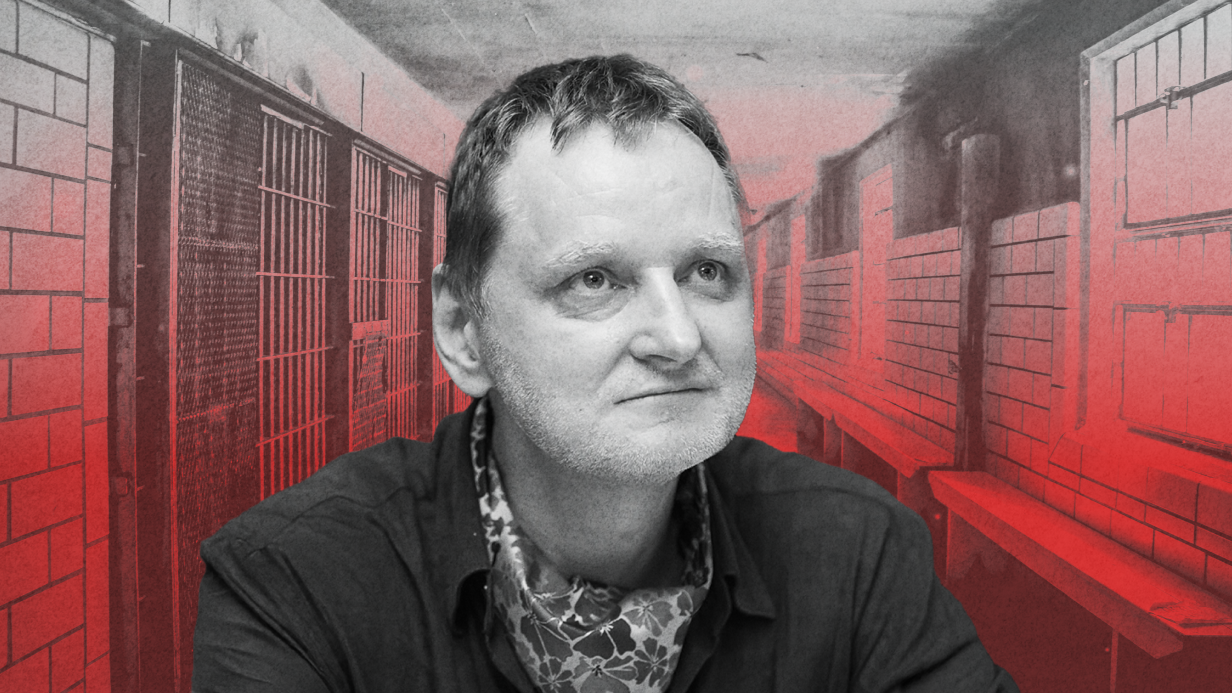
On December 19, Alexander Nesterenko — Candidate of Philosophical Sciences and associate professor at Bauman Moscow State Technical University — was sentenced to three years in prison for Ukrainian songs included in his playlist in the VKontakte social network. T-invariant reports how exactly the philosophy department lecturer and amateur historian reacted to his verdict, what he said in his final statement, and what his wife — whom he met at rockabilly jive dance classes shortly before his arrest and married while already in pretrial detention — now plans to do.
Top news on scientists’ work and experiences during the war, along with videos and infographics — subscribe to the T-invariant Telegram channel to stay up to date.
On December 19, the Lyublinsky District Court in Moscow handed down a verdict to 62-year-old former philosophy lecturer and associate professor at Bauman Moscow State Technical University, Alexander Nesterenko, who is also known for his 2006 book Alexander Nevsky. Who Won the Battle on the Ice. Since September 2024, he had been held in Moscow’s SIZO-4 “Medved” pretrial detention center. Nesterenko was charged with “incitement of hatred or enmity” and “calls for extremist activity” for having once stored on his public VKontakte page the music video We Are Growing («Ми ростем») by the Ukrainian rock band Vopli Vidopliassova (VV), as well as the songs Our Father Bandera, Ukraine is our Mother («Батько наш – Бандера, Україна – Мати!»), We Were Born in a Great Hour («Зродились ми великої години»), and others.
Experts engaged by investigators found in these materials “elements of incitement to commit violent acts against Russians as a group defined by nationality,” as well as to “the annihilation of Russians as a military adversary.”
During the trial, the prosecution withdrew the charge of inciting hatred or enmity, explaining that it was “redundant,” and requested a sentence of four years’ imprisonment to be served in a general-regime penal colony solely under the charge of calls for extremist activity. The defendant pleaded not guilty — a position he reiterated in his final statement.
“I hope this is only my last word in this particular courtroom. First of all, Merry Christmas to everyone! May we all have expectations of a miracle, of change. On this subject, Brodsky’s lines: ‘If only Herod had known that the stronger he became, the more certain and inevitable the miracle would be.’ Let us hope for it.
If, back in the late 1980s or the 1990s, someone had told me that Russia would once again have political prisoners and that people would receive longer sentences for words than for murder, I would have thought I was talking to a madman. Yet here I am, already in my second year behind bars, simply because among the four hundred songs in various languages of the world in my VKontakte playlist there are a few in Ukrainian.
This was the basis for my arrest under the article ‘Incitement of hatred or enmity…’ [under paragraph ‘a’ of part 2 of Article 282 of the Criminal Code of the Russian Federation, Nesterenko faced 3–6 years — T-invariant]. I was allegedly inciting hatred and enmity against Russians — ethnic groups other than Russian are by default considered second-class citizens by the prosecution, not even worthy of mention. Who exactly I was inciting to hate Russians was not specified for some reason, but it is not hard to guess: those who speak Ukrainian.
At the last moment, without any explanation, the prosecution drops this charge, under which, let me remind you, I was held behind bars for two years as a terrorist and extremist. It turns out that dozens of security officers wasted their time pretending to carry out busywork, conducting investigative measures, examinations, and investigative actions in my case instead of protecting citizens from real terrorists. Now I am charged only with ‘[Public] calls [to carry out] extremist activities’ [part 2 of Article 280 of the Criminal Code, up to 5 years — T-invariant].
Moreover, both songs mentioned in the accusation (there was no third one in my playlist and there still isn’t) are set to lyrics that are a hundred years old and have no relation whatsoever to the Russian Federation, to Russians, or to the current world situation. I am neither the author nor the performer. I did not post them online; they are not recognized as extremist, not included in any “banned” lists, and not blocked by social networks. They are present on other VKontakte users’ pages, from where I borrowed them to add to my own playlist for further study in the context of my scholarly interests. If anyone is interested, I study imagined communities, historical narratives, collective identity, and so on.
Thus, the accusation under this article of the Criminal Code does not correspond to the circumstances of the case and is also unlawful.
What is happening to me and to other political prisoners clearly demonstrates the true nature of this regime, which rests on lies and violence. Its goal is to turn us into sheep marching in lockstep to a drum they themselves have skinned. But despite merciless repression, Russia has had and still has people who have not renounced their ideals of truth, because only truth is worthy of devoting one’s life to. It is a great honor for me that fate has placed me in the same ranks as these remarkable people.
I fully admit that, in order to preserve its power, you will commit any crime. [I admit] that I am guilty of not having been among those heroes who were the first to end up in dungeons for loyalty to their ideals. Because, unlike them, I — like many of us — could not find an answer to the question: what can I do? Now I know the answer, and I hope I have the moral right to say it.
First — however banal it may sound: do not be afraid. They want to frighten us because any government fears its own people most of all. But it is impossible to imprison half the country. If we stop being afraid, then even a cough will not prevent us from shouting the truth that the emperor has no clothes.
Second, no one can force us to follow criminal orders — we follow them out of our own free will, always finding justifications for our own cowardice instead of courageously and honestly fulfilling the duty of conscience. The only way to resist moral slavery is to remain free in one’s own soul. After all, freedom is not outside us — it is within us. And while in confinement, I have become freer, because in prison the true freedom — freedom of spirit — is felt more acutely.
In conclusion, I want to recall the wonderful stories that give us rays of hope in the darkness that has engulfed us: Evgeny Schwartz’s ‘The Dragon,’ Korney Chukovsky’s ‘The Monster Cockroach,’ Tamara Gabbe’s ‘The Town of Masters,’ Gianni Rodari’s ‘The Adventures of Cipollino,’ Tolkien’s ‘The Lord of the Rings.’ I would not be surprised if tomorrow, following yet another denunciation by some Gríma Wormtongue or Sergeant Prishibeyev, their authors are added to the notorious list of extremists and terrorists, which I, fortunately, have already joined.
And I will add: in any circumstances, do not forget that our fate and our future lie only in our own hands. And it depends solely on us what we turn our life into: mere vegetation or a moral victory. Thank you for your attention.”
Before the hearing began, while speaking with journalists, Alexander Nesterenko admitted that he had been very nervous while composing his final statement in his detention cell and had rewritten it three times. “A real philosophical speech!” one of the listeners commented on the final version. “Thank you!” the defendant replied joyfully. “We’ll hear you again at the appeal! It’s better with you than without you!” people encouraged him.
Alexander Nesterenko’s final statement took five minutes to read. The judge, Irina Krasova, needed exactly the same amount of time to reach her decision. Nesterenko was sentenced to three years’ imprisonment to be served in a general-regime penal colony. After serving the sentence, he will also be prohibited for two and a half years from administering internet resources, according to the verdict.
Several dozen people came to support the former Bauman professor — they barely fit into one of the smallest courtrooms at Lyublinsky District Court. Among them was the defendant’s wife, Irina Nesterenko, a primary school teacher at one of Moscow’s schools. She told T-invariant that she and Alexander met in February 2023 at rockabilly jive dance classes. They married in August 2025 — already inside the pretrial detention center.
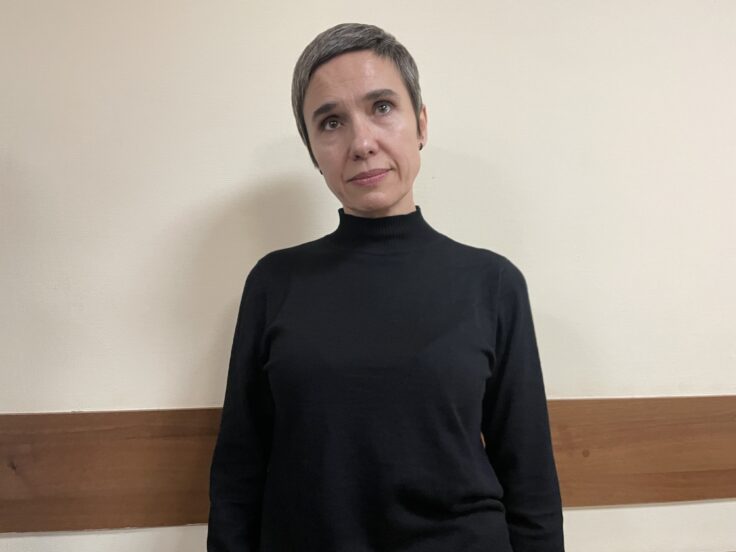
“We got married both for love and for practical reasons: now I will be able to visit him on long-term family visits and request that his sentence be served in a colony closer to his native Moscow — that is, in one of the regions of central Russia,” says Irina Nesterenko. “Both Sasha and I already have adult children from previous marriages. They would also like to be here right now — to support him, looking him straight in the eyes, since we all have wonderful relationships and consider all the children our own. But Sasha’s son is abroad, and both of my daughters could not miss work and studies today just for the hearing.”
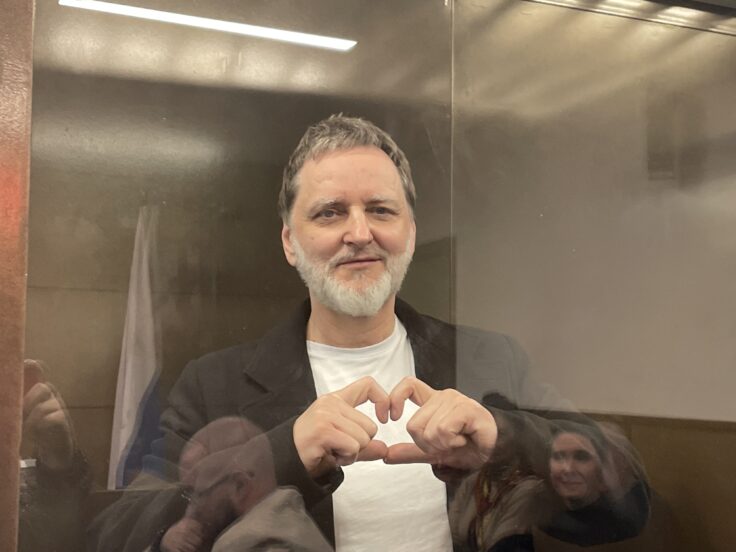
If they had managed to come, Alexander Nesterenko would certainly have shown them a heart shape with his hands — the way he did for everyone who came to support him, both before and after his final statement. After the verdict was announced, however, he could no longer do so: his hands were handcuffed behind his back, making such tender gestures impossible. Instead, Nesterenko smiled kindly and repeated on camera — specially for T-invariant readers — a fragment from his speech: Brodsky’s quote about expecting Christmas and the “more inevitable the miracle.”