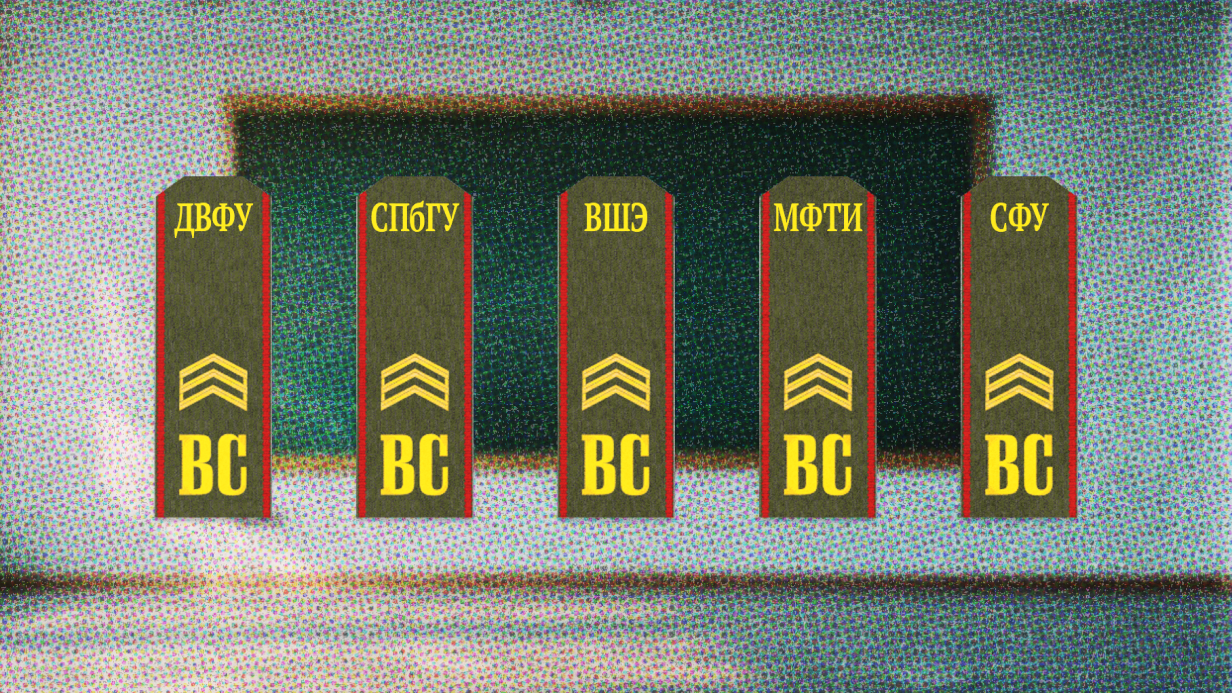
A new way to recruit students into the Unmanned Systems Troops is by encouraging volunteers through the example of their peers. T-invariant reviewed university and college websites and social media pages, along with regional media reports, and compiled the most telling cases. The most active rector, apparently eager to showcase his mobilization zeal, has been Viktor Blazheev, head of the O.E. Kutafin Moscow State Law University (MSAL). University rectors are required to report on their results at regular meetings with Russian Deputy Prime Minister Dmitry Chernyshenko and Minister of Science and Higher Education Valery Falkov. But the quota for each institution – at least 2% of the total student body – is hard to meet.
Top news on scientists’ work and experiences during the war, along with videos and infographics — subscribe to the T-invariant Telegram channel to stay updated.
A Send-Off with Banket — and a Banquet
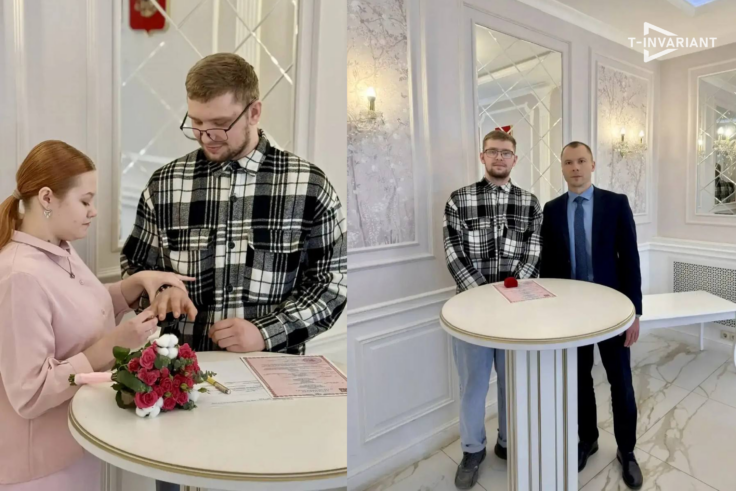
On March 19, third-year student Aleksandr Kononenko from Omsk had what was described as a “special double celebration.”
“He made two major decisions: he got married and, on the same day, signed a one-year special contract to serve in the Russian Armed Forces’ Unmanned Systems Troops. To congratulate Aleksandr on these important events and see him off on behalf of the SibADI rector, institute director Mikhail Banket came in person,” the Siberian State Automobile and Highway University reported.
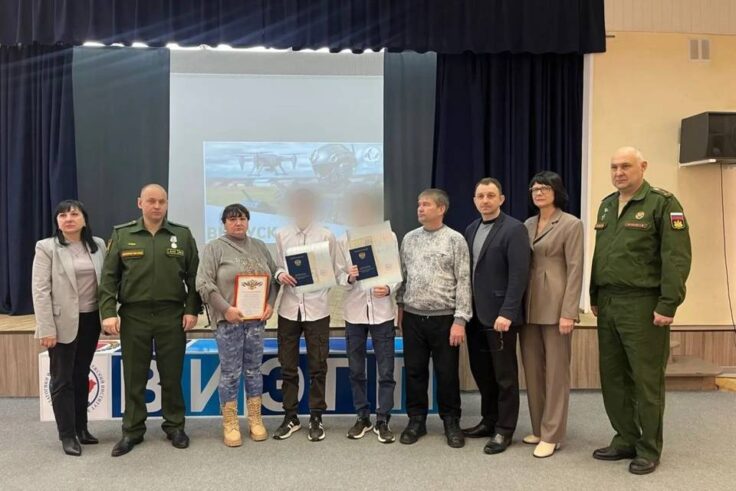
Meanwhile, in the city of Volzhsky (Volgograd Region), diplomas were ceremonially presented at the Institute of Economics, Pedagogy and Law (VIEPP) to brothers Vladislav and Rostislav. Local media report that they completed their studies ahead of schedule and signed contracts to serve in the Unmanned Systems Troops.
The defining feature of this new phase of the recruitment drive into the Unmanned Systems Troops is persuasion by example, with students themselves held up as models for others. The practice began to take shape at regional universities as early as February. The pattern is standard: quotes from rectors, mayors, or other officials; quotes from volunteers; photos and videos (sometimes with blurred faces or shot from behind, though more often the students pose openly); and reports in local media. There are exceptions as well – sometimes the students’ parents speak on their behalf.
“We reacted positively to our sons’ decision to sign a contract: someone has to do it, especially given the current situation in the country. If not us, then who – that’s how I see it. Among our close relatives, two have been killed in the special military operation zone, one has been seriously wounded, and one is there now, in the Unmanned Systems Troops. So this was not a spontaneous decision for our sons,” says Andrei Aleksandrovich, the father of Vladislav and Rostislav.
“Every Day I Wondered Why I Was Here”
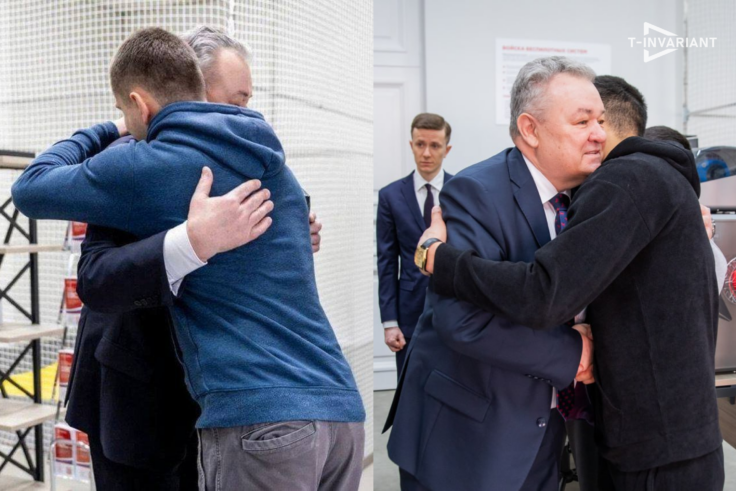
The leader in the number of publicly showcased student recruits was the O.E. Kutafin Moscow State Law University (MSAL). Both the university and its rector, Viktor Blazheev, reported sending at least six students to the Unmanned Systems Troops. Blazheev personally saw each of them off, and the university’s social media accounts published around two dozen photographs showing the rector embracing and addressing the young men. Photos of the first two appeared on February 25, 2026, and since then the university has published 14 posts about recruiting students.
“From the very start of the special military operation, I wanted to defend my country and our interests. Every day I wondered why I was here and not there. The chance to go and serve through the University became the decisive factor. It is an honor to be among the first to go from the University. We will do everything we can to justify the trust placed in us,” the MSAL Telegram channel quotes the student as saying.
On March 13, 2026, Viktor Blazheev’s Telegram channel published a post saying that three students – “professional wrestlers” – had signed contracts. The following quote was attributed to them: “We learned that two of our fellow students had signed contracts to serve in the Unmanned Systems Troops, and we decided to follow their example. We compete and win in tournaments. We will not let down the University, our sport, or our beloved country in this either.” In addition to Blazheev, Mikhail Mamiashvili, president of the Russian Wrestling Federation, came to embrace the volunteers and see them off. The sixth recruited student, by contrast, was presented without triumphant quotes, staged embrace photos, or invited guests.
MSAL clearly intends to become a leader in proactive militarization this academic year. T-invariant has previously reported that the university was among the first to announce the creation of its own “branded” unmanned unit and that, for at least a month and a half, it organized screenings in all of its academic buildings and dormitories of the film Betrayal and other films glorifying the “special military operation.” It is worth noting that Blazheev is a long-serving rector: he has headed the university for almost twenty years.
Esports Players Get Preferential Treatment
On March 31, 2026, the Yugra TV channel reported that 21-year-old Aleksandr Shadrin, a student in the Faculty of Philology at Yugra State University, was set to sign a contract with the Defense Ministry.
“We understand that we are going there to do a job so that this infection does not spread any further. It has to be contained there, stopped, cut out, and this issue has to be ended once and for all,” the volunteer says in the report.
Another example of recruitment in the same city of Volzhsky comes from the local branch of the Moscow Power Engineering Institute. In the TV report, the camera lingers on the bewildered faces of gathered students and their parents as they listen to speeches by university leaders, city officials, and “veterans of the special military operation.” Newly contracted recruit Kirill, turning his back to the camera, says that he “took physics and math, so I chose this field; my parents supported me, and my girlfriend is waiting for me at home.”
The campaign is active in the region not only in small towns. In Volgograd itself, a student named Oleg says that his “decision was a conscious one.” Oleg was drawn by modern technology and the chance to apply his computer skills. His college supported him by allowing him to continue studying remotely, Volgogradskaya Pravda writes. Another Volgograd student, Viktor, emphasized the favorable contract terms: “The service lasts one year, includes training as a UAV operator, and comes with substantial payments. This makes it possible to solve financial problems, for example by buying a car.” The publication also stresses that recruiters are especially interested in young gamers.
Campaigning has also intensified in Tatarstan and Bashkortostan. Roman Gladkov (some media outlets failed to blur his face in the photo), after studying at one of Tatarstan’s universities, signed a contract with the Defense Ministry instead of doing compulsory military service. “Yes, like most people, I played computer games, and I’m very comfortable with a gamepad. I hope that experience will be useful in service. Mostly I played fighting games, racing games, and flight simulators,” he says.
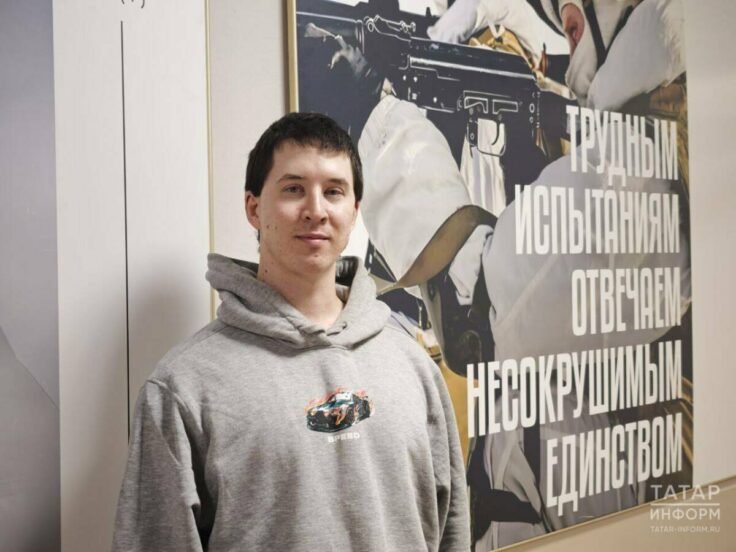
The outlet Tatar-inform reports that the family “tried to talk Roman out of it, but he told them he had already made up his mind.”
“I really want to join the Unmanned Systems Troops, and I’m fully motivated. I’m ready for the training too – it’s good when they teach you, isn’t it? When they don’t, I think it’s much worse. I studied at university for six years; I can certainly manage a few more months – I like studying,” the outlet quotes Roman as saying.
Tatar-inform publishes a daily chronicle of recruitment and campaigning. “We take esports players without competition” was the headline of an interview with one of the recruiters.
In an article titled “If Not Me, Then Who,” the outlet BashNews publishes a photo of a fighter with the call sign “Lis” (“Fox”), who “by 2025 had completed three years at the law faculty of Bashkir State University.”
Speaking about his motivation, Lis says, among other things: “I simply knew that my Motherland needed me, and the Motherland is first and foremost my parents (whom I now call more often).”
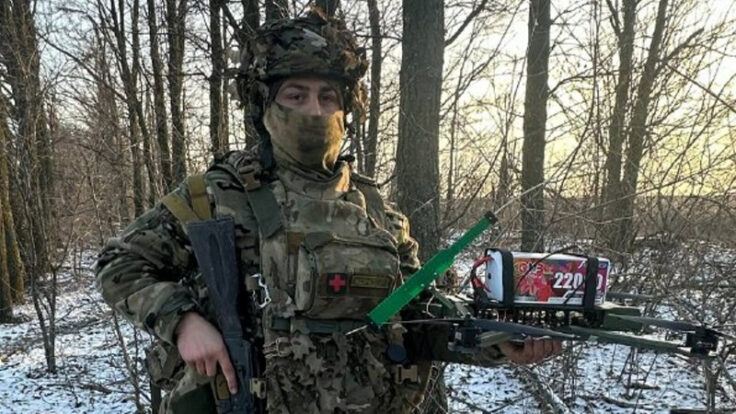
Molodyozhnaya Gazeta of the Republic of Bashkortostan reports that Malik G., a student in the Faculty of Aircraft Engines, Energy, and Transport at Ufa University of Science and Technology, signed a contract.
Tula media report on “the first two students from Tula to sign contracts with the elite Unmanned Systems Troops.”
“Mikhail is a final-year student at Tula State University, 21 years old, studying in a field related to radio electronics, so he began thinking about where his professional skills would be most useful,” journalists write. The second, 18-year-old Maksim Medvedev (a student at the Belev branch of the Tula College of Professional Technologies and Service), said that he followed a friend’s lead (the text does not make it clear whether that friend was Mikhail).
“I came across an advertisement and started thinking about it, and then a friend suggested we go together. I’m good with machinery, and I decided I had to go. I told my parents after I had already signed the contract,” says Maksim.
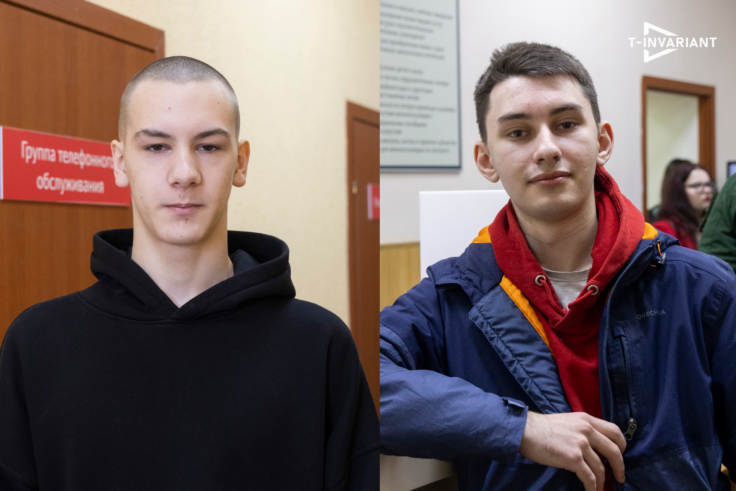
Astrakhan media report that 22-year-old Temur, a student at the Astrakhan Agrotechnical College, signed a contract. The website of Ulyanovsk State Technical University reports that a student in the mechanical engineering faculty signed a contract. Another Ulyanovsk student – 19-year-old Danil from the Ulyanovsk Institute of Civil Aviation – took academic leave and went as a volunteer to the Unmanned Systems Troops. Belgorod State University rector Yevgeniya Karlovskaya wrote on Telegram about the first student volunteer at her university, publishing his photo with the face blurred.
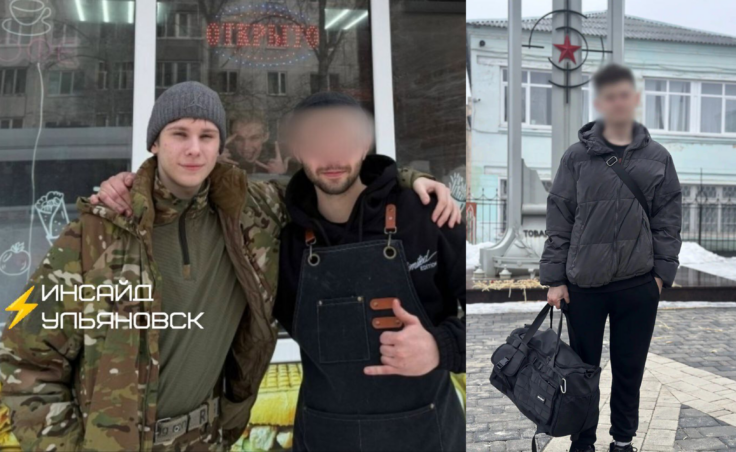
Regional media periodically delete or edit reports about students signing contracts with the Unmanned Systems Troops. For example, Fontanka.ru changed the text of its item “A student from St. Petersburg signed a contract to serve in UAV troops,” but the comment thread remains (more than 350 comments in total, mostly critical).
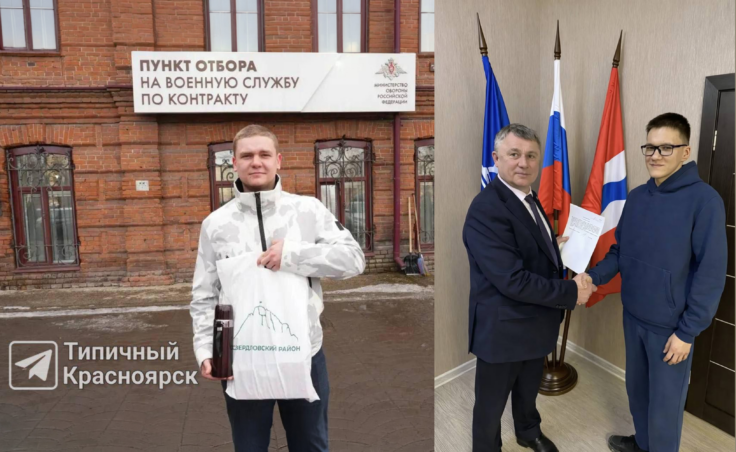
At the end of March 2026, Krasnoyarsk media reported that the first student in the region to sign a contract with the Defense Ministry and head to the Unmanned Systems Troops was Maksim Kovalev from the local Transport and Service Technical College. The report also emphasizes that the volunteer is no stranger to IT-related subjects: “I’ve always been interested in electronics, and then fighters from the front came to our college and explained how they work there.”
In February and March 2026, the Telegram channel of the aforementioned SibADI published daily calls urging students to join the Unmanned Systems Troops – and on March 13 the university reported its first recruited student: fourth-year student Nikita Afonin became a volunteer. On March 19, it reported a second one as well.
Quota for Each University: 0.5% to 2%
T-invariant previously reported that Russian universities had been given quotas for recruiting students. On April 1, a Telegram channel reported that Minister of Science and Higher Education Valery Falkov had informed rectors of Russia’s largest universities that at least 2% of students must sign contracts with the Defense Ministry. Two rectors confirmed this information to Faridaily. In mid-March, meanwhile, a Deutsche Welle (DW) source familiar with discussions inside universities said that university heads were being called to regular meetings with Russian Deputy Prime Minister Dmitry Chernyshenko, who oversees education and science.
“From what I have seen, a quota has been set for each university – between 0.5% and 2% of the total student body,” the outlet’s source says. If a university fails to meet these demands, its leadership may be suspected of disloyalty. “In that case, the rector or vice rector risks losing their post,” the DW source adds. At the same time, the number of failing grades at universities has risen sharply in recent months. “This did not happen before. Students are now being failed en masse on retakes: whereas previously there was one instructor and they could help a student through, now two examiners have been assigned,” the source says. Students facing expulsion are offered an alternative: either sign a contract with the Defense Ministry and serve in the Unmanned Systems Troops, or go into compulsory conscript service.
A T-invariant source who previously headed a major institute in Moscow confirmed that regular meetings on this issue were indeed being held with Chernyshenko. At the same time, pro-war Z bloggers have been writing en masse that the campaign to recruit students into the Unmanned Systems Troops is stalling: “there are very few willing to go.”