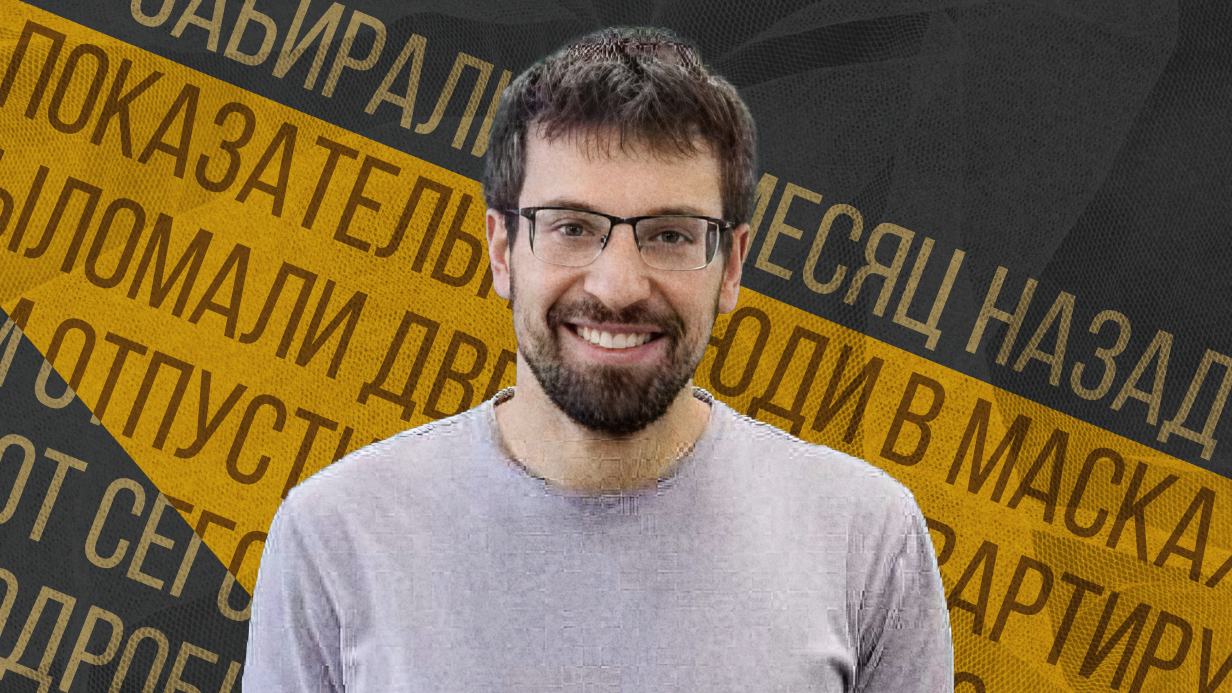
For the second time this month, a scientist has been convicted of donating to the Anti-Corruption Foundation. However, the two trials unfolded in vastly different ways. Mathematician Andrey Dymov was sentenced to three and a half years in a penal colony after just two hearings. Meanwhile, the case of physicist Evgeny Onishchenko dragged on for a considerable time and concluded with a sentence that is quite lenient by today’s standards: a year and a half of forced labor. Preliminary evidence suggests that authorities have decided to strip defense attorneys of the time needed to defend those who donated to Navalny’s Anti-Corruption Foundation (ACF).
Mathematician Andrey Dymov was tried for donating 3,500 rubles [less than $50 — T-invariant] to the ACF. The faculty member at the HSE University Department of Mathematics and the Steklov Mathematical Institute of the Russian Academy of Sciences (MIAN) was found guilty of financing extremism (Part 1 of Article 282.3 of the Criminal Code) — the case docket is available on the official portal of Moscow courts.
“They took him away about a month ago, and it was quite a spectacle: masked men broke down the door to his apartment. Later, he was released for a while under travel restrictions,” a source familiar with Dymov’s prosecution told T-invariant.
The case was initiated on April 30, 2026, and the sentence was handed down as early as May 25, with the scientist taken into custody right in the courtroom. “We were in shock, we didn’t expect him to be arrested immediately,” Dymov’s colleagues shared with T-invariant.
“I take Andrey Viktorovich’s probability theory class and emailed him a question just this Monday, but he didn’t reply. And then I saw the news on Tuesday morning. I am shocked. What is even going on? It’s horrible,” comments a student from the HSE University Faculty of Mathematics.
“It’s a high-speed train, a total express. Unusually fast,” a scientist who previously went through a similar criminal prosecution told T-invariant. His own case, however, lasted 20 times longer.
Judging by the mathematician’s profile on the HSE University website, Dymov had been with the institution since 2015 and possessed all the hallmarks of a highly successful academic career. Since 2018, he regularly received bonuses for publishing in peer-reviewed international journals, as well as for papers in List A journals, and was repeatedly named one of the university’s best teachers (in 2022, 2024, and 2025).
In his profile on the Math-Net portal, he listed non-equilibrium statistical mechanics and the theory of dynamical systems as his primary research interests. Shortly before his arrest, Dymov had presented at several scientific conferences.
Top news on scientists’ work and experiences in wartime, along with videos and infographics — subscribe to the T-invariant Telegram channel to stay updated.
Dymov made his last donation to the ACF back in 2021, one source told T-invariant. According to Mediazona, Dymov set up a recurring donation on August 5, 2021. His workplace provided positive character references. Mediazona also reports that Dymov had sent 5,000 rubles to the Pravmir fund [an Orthodox Christian charity — T-invariant] to help victims of a flood in Dagestan and 30,000 rubles to the “Children of Donbas” program.
Defense witnesses included Sergey Gorchinsky, Deputy Director for Research at MIAN, alongside several colleagues from the HSE University Faculty of Mathematics.
Dymov’s case moved so rapidly that his colleagues and department heads at HSE University and MIAN likely lacked the time to build a solid defense strategy or compile and submit a sufficient volume of character references in his favor. The case docket lists only two court sessions, one of which had to be postponed because witnesses failed to appear.
An analysis of cases involving donations to the ACF reveals that defendants usually face harsh sentences for modest contributions of just a few thousand rubles. At times, it appears as though there is an unwritten “rate”: one year in prison for every thousand rubles donated.
Yet there are exceptions. 54-year-old Evgeny Onishchenko, head of the Employees’ Union at the Lebedev Physical Institute of the Russian Academy of Sciences (FIAN), was sentenced to a year and a half of forced labor, despite the prosecution demanding four years in a penal colony. He was accused of transferring 5,000 rubles to the ACF in August 2021. Mediazona reported this on May 14.
Both scientists — Andrey Dymov and Evgeny Onishchenko — did not exclusively donate to “extremists” (according to Mediazona, Onishchenko had also transferred money to the Russian military). Among the theories explaining why the sentences turned out so differently, there is one theory (currently being verified by the T-invariant editorial team) that due to the overwhelming volume of cases opened regarding ACF donations (according to unconfirmed reports, there are currently about 16,000 criminal cases in Russia related to ACF donations), an unwritten directive was issued to fast-track investigations and judicial proceedings. Therefore, criminal cases initiated in previous years regarding ACF donations were investigated and tried longer, giving defense attorneys and defendants more opportunities to mount a defense. Today, there is simply no time left for the defense.
The swift prosecution of Dymov is not the first instance of mathematicians from HSE University being targeted. In December 2025, a treason case was opened against Leonid Kats, a research assistant at the HSE University Faculty of Mathematics’ Research and Educational Laboratory of Complex Networks, Hypergraphs and Their Applications. However, as T-invariant revealed, the FSB had been tracking Kats for a long time, whereas Dymov’s conviction is just another of the hundreds of cases involving ACF donations (the exact numbers vary; Mediazona reports 225 known convictions).