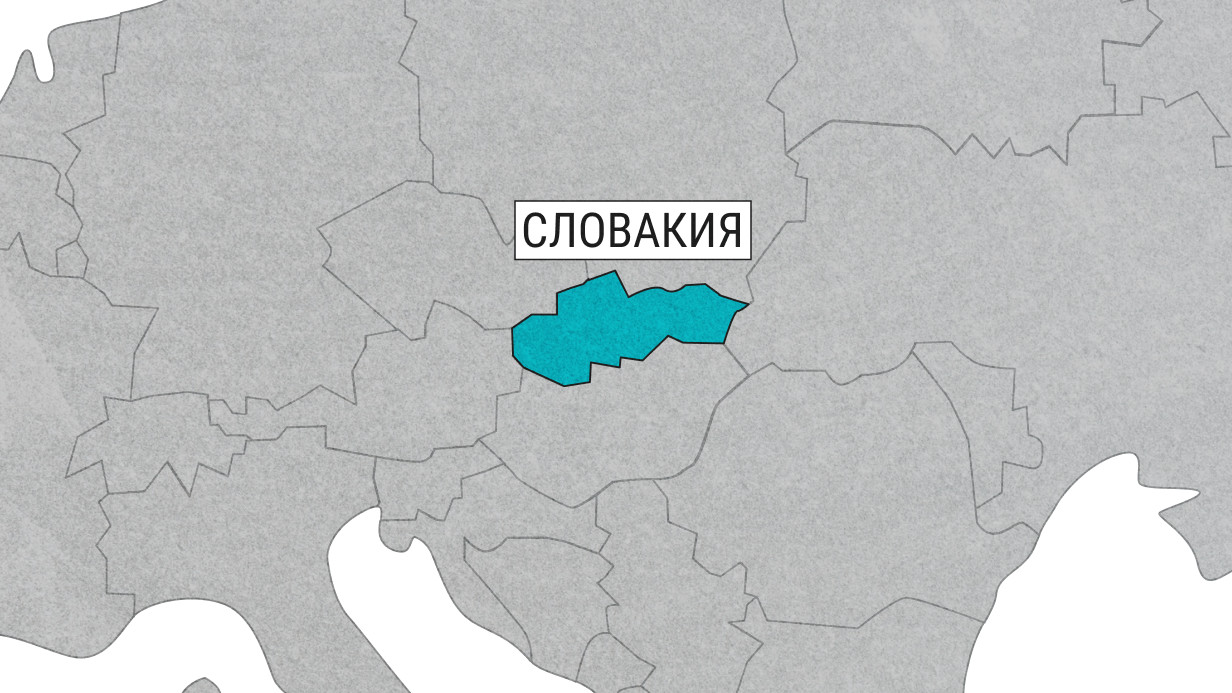
While Slovak politicians calmly keep their academic degrees for copied theses thanks to convenient loopholes in the law, far less visible violations are taking place inside the universities themselves. Dozens of scholars appear to be linked to purchased authorship, data manipulation, and publications in predatory journals. The Plagiat-Navigator project tried to determine how deeply academic fraud has penetrated Slovak science.
In recent years, Slovakia has faced a series of high-profile academic scandals, mostly connected with plagiarism in the dissertations of senior politicians and officials. In September 2025, a scandal broke out around Pavol Gaspar, director of the Slovak Information Service, the country’s main intelligence and counterintelligence agency. His master’s thesis on corruption, defended in 2011, turned out to have been copied by roughly two thirds from uncited sources. In response to the plagiarism allegations, Gaspar said that his work had passed all the required formal checks as part of the defense procedure, after which he was awarded a master’s degree. That same year, member of parliament Marian Kery, who had previously publicly accused other politicians of plagiarism, was himself caught in a similar violation. His 2004 master’s thesis, “The Image of Man in Pushkin’s Belkin Tales,” copies almost verbatim a thesis defended four years earlier by student Martina Brodnanova.
The main news about the lives of scholars during the war, videos, and infographics are available on T-invariant’s Telegram channel. Subscribe so you don’t miss anything.
In 2020, leading journalists from the newspaper Dennik N carried out a broad review of the theses of the country’s top officials. It turned out that plagiarism had been found in the works of several representatives of the ruling coalition’s upper ranks, including the education minister, the speaker of parliament, and the prime minister. The scandal led the Slovak parliament, at the end of 2020, to pass a law allowing academic degrees to be officially revoked for plagiarism. But a significant loophole remained in the law: it is not retroactive and applies only to works defended after 2020. As a result, all the senior officials whose work was found to contain plagiarism, including the intelligence chief Gaspar and MP Kery mentioned above, kept both their degrees and their positions.
Dissertation scandals involving the country’s first-tier officials and other senior figures are only the visible part of a much larger problem. These high-profile cases received broad public attention thanks to targeted journalistic investigations, but in their shadow remains a significant layer of violations of academic integrity among Slovak scholars, professors, and university lecturers.
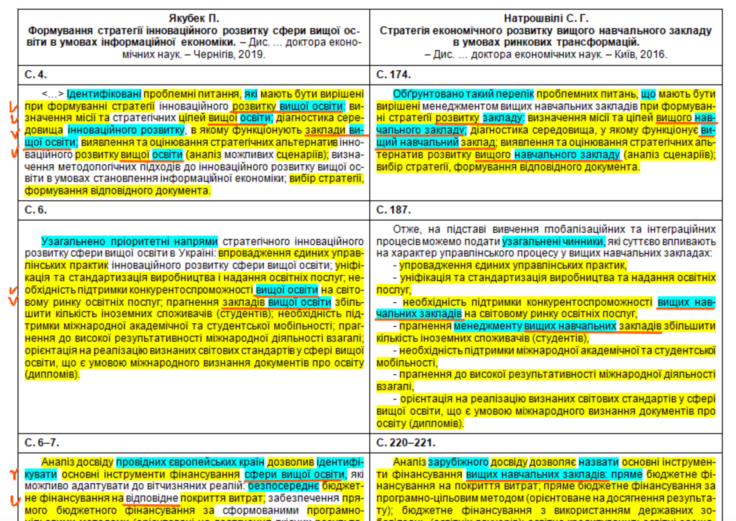
Here one should mention Petr Jakubek, a Doctor of Sciences in economics and a member of the governing board of DTI University (Dubnicky technologicky institut). In 2019, he received a Doctor of Sciences diploma after defending a dissertation at Chernihiv Technological University in Ukraine. As later became clear, a substantial part of Jakubek’s dissertation text coincides verbatim with the text of the dissertation of his opponent, Svetlana Natroshvili, defended in Kyiv in 2016. Below is an example of improper borrowing on one page of Jakubek’s dissertation.
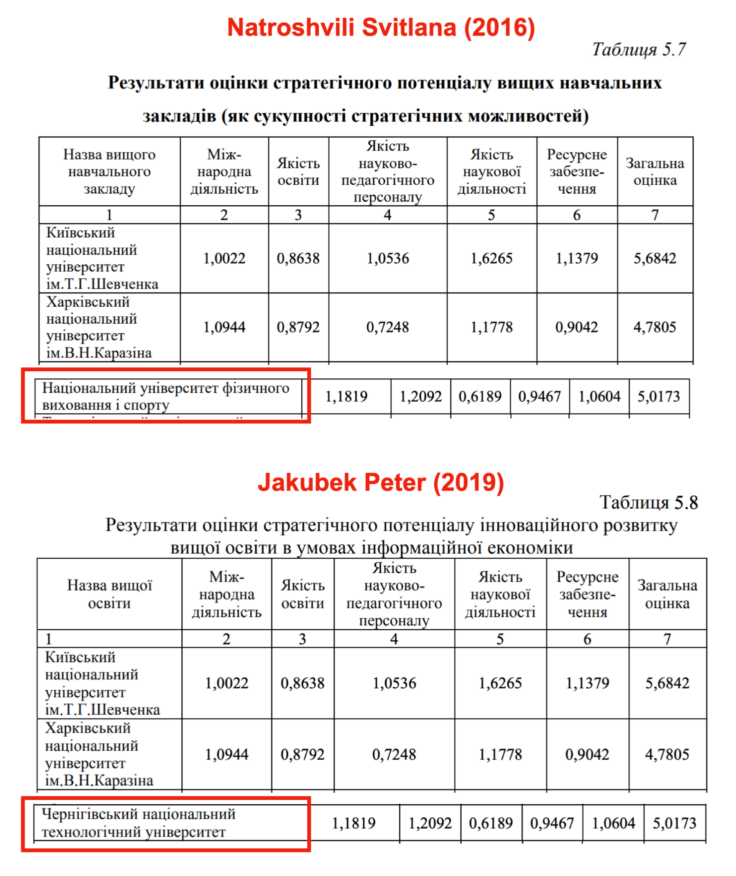
But the problem is not only the absence of citations: even if they had been present, they would not have resolved the issue. In the text, Jakubek mechanically replaced the National University of Physical Education and Sport of Ukraine, which appeared in Natroshvili’s work, with Chernihiv Technological University, while leaving all quantitative indicators unchanged.
The practice of defending a dissertation in another country and then having the diploma nostrified at home is widespread in Eastern Europe and across the post-Soviet space.
If dissertation plagiarism in Slovakia is at least partly documented and discussed by journalists, a much larger problem is developing outside public view. It is a system in which a scientific career can be built not on genuine research, but on purchased articles, fabricated data, and artificially inflated indicators.
In May 2026, the major academic online platform Research.com published lists of top researchers based on h-index and citation metrics. In the field of plant science and agronomy, Professor Marian Brestic, one of the highest-ranked Slovak researchers at the Slovak University of Agriculture in Nitra, placed 213th in the world. His colleague, Associate Professor Marek Zivcak, placed 1,511th globally, becoming Slovakia’s second-highest-ranked scientist in the field. As a result, the university took 253rd place worldwide in this scientific area and second place among the seven Slovak universities included in the ranking, losing the top national spot only to Comenius University in Bratislava.
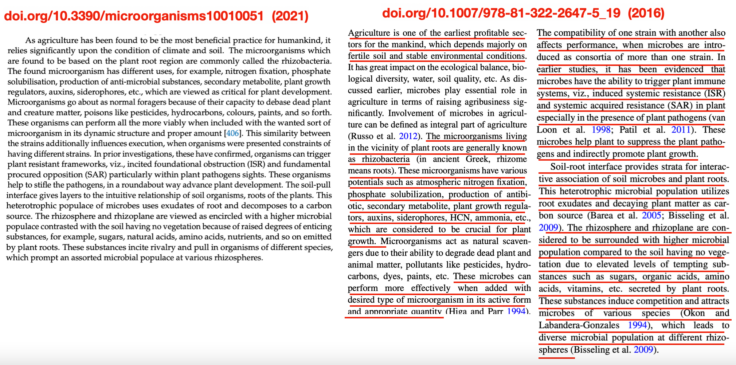
Yet back in 2022, Leonid Schneider, an independent science journalist known for his high-profile investigations into academic ethics, devoted an entire section of his For Better Science issue to Brestic and Zivcak. By that time, these Slovak authors, together with colleagues from Middle Eastern countries, had accumulated nine papers with negative reviews on the post-publication peer review platform PubPeer, some of which had already been retracted. Schneider links this to the purchase of co-authorship on the Asian market — a shadow industry where authorship is sold as a commodity. In some of these publications, experts found distorted phrases and terms, or “tortured phrases”: a characteristic trace of machine paraphrasing used to conceal plagiarism. The image below shows one such example in the journal Microorganisms, on the left, alongside an earlier source text by other authors, on the right, from which the “paraphrase” was made.
Since then, the number of problematic publications has grown. Today, PubPeer lists 34 publications by Professor Brestic with critical comments, some of them co-authored with Associate Professor Zivcak. The reasons for criticism, and in some cases for later retraction, included not only plagiarism or conflicts of interest, but also the substitution of authors at the final stage of publication, after all the reviewers’ questions had already been settled. Such substitutions are considered one of the characteristic signs of papers circulating on the purchased-authorship market.
These scandals, retractions, and exposés, however, have almost no effect on rankings. Even if all the disputed papers by Brestic and Zivcak are officially retracted, their citation counts and h-indexes will remain in the databases. These data are not recalculated retroactively after retractions. Formally, the scholars have already taken their places in the global tables, and no later revelations can dislodge them. A victory in the rankings obtained through paper mills and purchased citations formally remains a victory.
The mechanism of these rankings has a direct financial expression. Under the methodology of Slovakia’s Ministry of Education, every publication that falls within the top 1 percent of the world’s most cited papers automatically brings its author 3,000 euros from the state budget, and the same amount to the university. Thus, an artificially inflated citation index means not only a place in a prestigious ranking, but real money. In such a system, artificial citation inflation acquires a direct financial value: high bibliometric indicators affect not only academic status, but also the distribution of public funds. It is worth noting that Slovakia is not alone here: a similar system of monetary rewards for publications in high-ranking journals has long existed in Russia.
An equally telling case of image manipulation was documented in the work of an associate professor at Comenius University. In a joint 2024 publication in the journal Nano-Micro Letters, Dmitry Medvedev, a professor at Ural Federal University and Doctor of Chemical Sciences, and Martin Motola, an associate professor at Comenius University in Bratislava, together with co-authors from China, manually redrew the scale bar on images of nanoparticles obtained using a scanning electron microscope. The article claimed that the particles under study measured tens of nanometers. The microscope’s technical specifications, however, indicate that the real particle sizes were many times larger (see the image below).
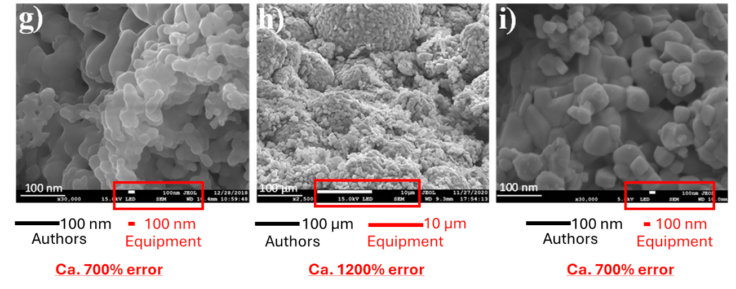
In other words, the scale in the images was simply adjusted to fit the desired result. But that was not the end of the matter. In the same article, experts on PubPeer raised well-founded concerns about other data as well, including graphs. This was not an isolated case: in recent years, experts have identified a whole series of Motola’s papers with problems in the data and in their graphical presentation. The regular appearance of such problems in Motola’s articles can hardly be attributed to simple inattention on the part of the authors.
Publications by scholars from Comenius University also contain direct borrowing of visual materials without references to the original source. A telling example is an article by Professor Peter Mikus and Veronika Mikusova on chitosan nanoparticles, in which some illustrations were copied from an earlier publication by Iranian authors.
In papers where experts identify gross violations of publication ethics, links to Asian paper mills can often be traced. These mills specialize in producing ready-made publications and then distributing them through online platforms.
On the shadow market of paper mills, authorship is not the only thing for sale. Another sought-after commodity is citations. References to one’s own work, like references to the work of others, have long since become a valuable asset. In June 2025, the editor of Chemical Engineering Journal retracted a publication by the aforementioned Associate Professor Motola and his university colleague Muhammad Hanif for artificial citation inflation. Between the original publication and the final version of the article, the number of references to Hanif’s work rose from 2 to 19, and references to Motola’s work from 2 to 10.
Current videos about science during the war, interviews, podcasts, and streams with prominent scholars are available on T-invariant’s YouTube channel. Become our subscriber!
Particular concern is raised by the rapidly spreading practice of publishing review articles under the names of fictitious scholars. The purpose of such works is to introduce numerous citations of articles by people who paid intermediaries on the shadow market for this service into the legitimate scientific record. Thus, the publication portfolio of Beata Gavurova, a professor at the Technical University of Kosice, has raised serious questions among the expert community. “More than 40 scientific articles a year — one every nine days — is a pace that defies rational explanation,” Leonid Schneider notes, following a journalistic investigation published by the Slovak online outlet Dennik N. According to him, dozens of Gavurova’s publications appeared in outlets deemed unreliable or predatory, and some of the journals in which she published have already been removed from scientific databases. At the same time, the researcher’s numerous co-authors represent various Asian countries, which, in the experts’ view, points to the purchase of authorship through networked paper mills.
According to Dennik N, up to one third of papers by Slovak scholars are published in dubious predatory journals.
Yet the external signs of questionable publication behavior are only part of the problem. Gavurova’s own papers contain inconsistencies between the text and graphical data, problems with chemical formulas, and dubious spectra with signals of unnatural shape. Some of these articles have received retracted status.
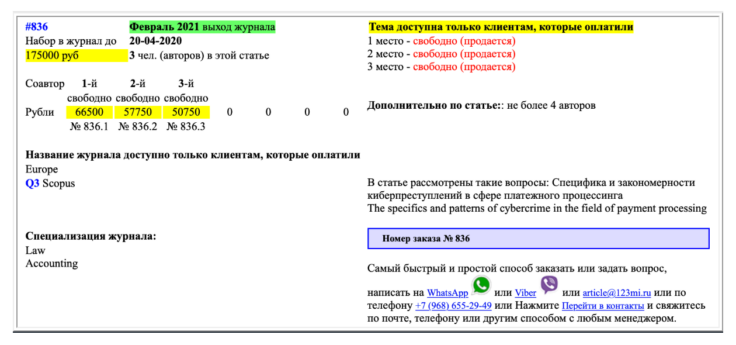
The next case provides direct evidence of purchased authorship in publications distributed by paper mills. Earlier, the Dissernet community drew attention to the interaction of Slovak researchers with a Moscow company that provided article placement services. A telling example is the case of Boris Sturc, an associate professor at the University of Economics and Business: a preliminary offer posted by this exchange was first documented (see the image below), and later a paper with the title listed in the offer appeared in the International Journal of Criminology and Sociology, with Sturc as first co-author. Analysis shows that this was not a one-off: Sturc’s publication list includes other commercially acquired works as well.
Over time, the shadow academic industry is transforming: centralized exchanges selling papers appear to be losing influence. Their place is being taken by decentralized private intermediaries — individual entrepreneurs, or “paper millers.” Technological progress is helping this shift along: modern AI tools make it possible to fabricate scientific texts in the shortest possible time, without involving large teams of specialists from different fields of science. Offers from “paper millers” are easy to find in open internet channels. Traces of this market can also be found in the publications of Slovak researchers. Below are specific episodes involving Slovak scholars in joint publications offered by “paper millers” from Germany, Ukraine, Montenegro, and Middle Eastern countries.
“Olga Golubnitschaja is the editor-in-chief of EPMA, the European Journal of Predictive, Preventive and Personalized Medicine, and at the same time a co-author of many articles in that journal, which is normal. What is surprising, however, is that for many articles in which she is a co-author, very little time passes between submission and acceptance. In some cases it is only a matter of three to five days. Below are several examples from the past year,” says a review of one article involving her. Such short timelines raise the question of whether full scientific peer review was possible — a process that usually includes selecting independent experts, preparing comments, revising the manuscript by the authors, and reassessing the changes made. Olga Golubnitschaja, a professor at the University of Bonn, often appears as a co-author of problematic papers by Russian and Slovak scholars; some of these works later became the subject of criticism for violations of publication norms.
An expert review of a joint article by authors from Slovakia and Ukraine revealed repeated sections in experimental spectra. Among the co-authors of the article, one figure stands out: Taras Kavetsky, an associate professor at Drohobych Pedagogical University in Ukraine, who was found to have used identical schemes of spectral-data fabrication in other scientific works as well.
Stanislav Dudic, a Doctor of Sciences at Comenius University and a specialist in international economics, industrial engineering, trade, and investment, appeared as a co-author of a publication that raised serious questions. The paper, written together with the Montenegrin co-author Velibor Spalevic, concerned a modified copper-containing metal-organic framework, and experts detected signs of artificial modification of experimental data. It is worth noting that a number of works by Spalevic himself, a professor at the University of Montenegro, have also been criticized on the PubPeer forum.
Professor Natalia Krivinska, head of the Department of Information Systems at the Faculty of Management of Comenius University, is a vivid example of how formal co-authorship with dubious partners can undermine trust in a scholar. Her article on combating DDoS attacks, prepared in co-authorship with Saudi colleagues through machine paraphrasing, was retracted. But Professor Krivinska’s problems are not limited to a single publication: in her works, experts have found a whole bouquet of tortured phrases, bibliographies unrelated to the subject of the paper, and even direct borrowing of illustrations, all of which calls into question the quality of her entire academic record.
Another case of questionable scientific practice involves the Institute of Construction and Architecture of the Slovak Academy of Sciences. Its employees, Professor Martin T. Palou and Associate Professor Taher Tawfik, were listed among the co-authors of an international paper with Egyptian and Iraqi colleagues, but a review showed that the images presented in the article had undergone impermissible processing, casting doubt on the reliability of the entire work.
The overwhelming majority of the episodes listed above led to no sanctions against the authors. Journalistic investigations and the volunteer work of experts on PubPeer help reveal problem after problem, but real institutional consequences in Slovakia’s academic sphere are barely visible. Retractions do not affect citation indices, and the law allowing academic degrees to be revoked for plagiarism does not apply to works defended before it came into force. As a result, buyers of authorship keep their positions in rankings and universities.
This is the central paradox. Under the Ministry of Education’s methodology, universities receive 50 percent of the state bonus for each highly ranked publication. This means that, in the race for rankings, the universities themselves become interested parties: the more “outstanding” publications their employees have — even if they were bought on the shadow market — the more public funding the university receives.
At the same time, Slovakia’s system of state funding for science, which generously rewards publications in top-percentile journals, effectively creates a “green corridor” for the shadow market. Cash payments to an author for an article they purchased on the shadow market are resources stolen from science. Public funds intended to develop research instead flow into the pockets of shadow intermediaries.
As long as the academic system continues to measure the quality of science primarily by the number of publications and citations, paper mills will be able to turn manipulation of these indicators into academic status and real money. In the age of AI, when producing texts that look scientific is becoming ever cheaper, the problem of how to evaluate scientific work is only becoming more acute.