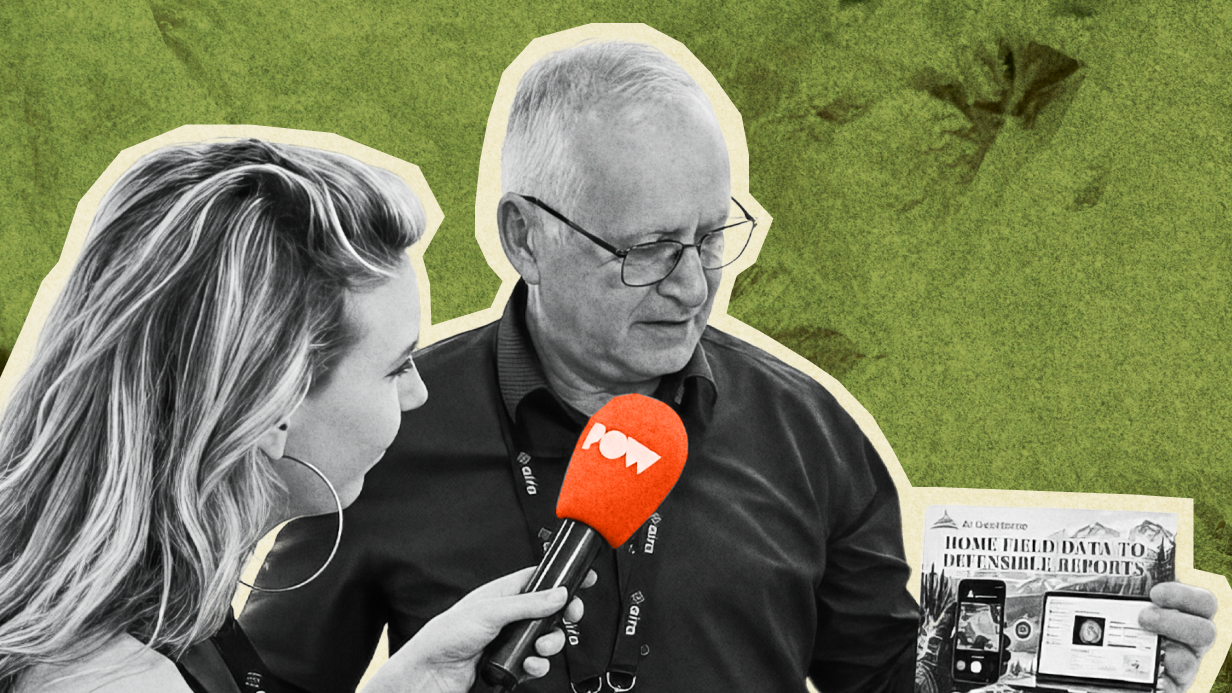
Israeli geologist Michael Spevak was invited to present his startup, AI-GeoHome, at an international congress of engineering geologists in the Netherlands. But 25 days later, the organizers told the company it could not take part in the exhibition, citing the mood in Dutch society and the tense geopolitical situation. Spevak’s scientific poster on the use of artificial intelligence in geology, however, remained on the congress program. T-invariant reviewed his correspondence with the organizers and documents from Delft University of Technology, the congress’s co-organizer, to piece together the circumstances of the rejection.
Top news on scientists’ work and experiences during the war, along with videos and infographics — subscribe to the T-invariant Telegram channel to stay updated.
On September 18, 2026, Spevak was informed that AI-GeoHome had been selected for the Startup Market at the World Congress of the International Association for Engineering Geology and the Environment (IAEG 2026) in Delft. Participation cost €1,850, which covered an exhibition booth with a banner and two passes to congress events. Spevak accepted the offer the same day and began sorting out the logistics. On September 28, congress chair Dominique Ngan-Tillard wrote to him that the AI-GeoHome logo would appear on the event website after registration.
Spevak had also submitted a paper on applying artificial intelligence in engineering geology to the congress’s scientific poster session. The poster was accepted and added to the program: the digital technologies session on November 4, poster No. 763.
AI-GeoHome is an artificial intelligence system that analyzes borehole logs, soil test results, and sample photographs, flags errors and inconsistencies, and helps prepare technical reports. It is designed for geologists, geotechnical engineers, laboratories, and engineering firms.
“It cuts down on manual work and helps improve the quality of the research. That’s exactly what we wanted to show our colleagues and potential partners,” Spevak explains.
But on October 13, Dominique Ngan-Tillard informed Spevak that the organizing committee was unable to accept his application to the Startup Market. As the reason, she cited “the sentiment currently prevailing in Dutch society and in our student community.” At the same time, she stressed that the decision was “in no way a reflection on AI-GeoHome, your team, or the quality of your work.”
In the 25 days since the invitation, neither the company nor its product had changed. Spevak’s scientific poster was still on the congress program.
Spevak requested an explanation of the criteria behind the rejection and asked point-blank whether the decision had to do with the company’s Israeli affiliation or with his nationality. On October 15, Ngan-Tillard replied that the poster had been accepted and that he could still attend the congress as a delegate. The rejection applied only to the Startup Market. To justify the decision, she pointed to the IAEG 2026 Sponsor and Exhibitor Brochure, which, she said, allows the organizers to reject promotional materials at their own discretion, and to the “tense geopolitical situation.”
Spevak says he was never given this brochure. T-invariant tracked down the document and examined the terms of participation.
The congress website presents the Startup Market as a dedicated space for tech startups and young companies working in engineering geology and geotechnics. The public description contains no selection criteria related to a company’s country of registration or its founders’ citizenship. AI-GeoHome fits the platform’s stated professional profile.
The sponsor and exhibitor brochure that Ngan-Tillard referred to does contain a caveat: “IAEG 2026 reserves the right to reject any advertisement at its sole discretion.” In other words, the organizers reserve the right to turn down any promotional material as they see fit.
But this clause is specifically about promotional materials, not about barring a company from the Startup Market. Ngan-Tillard’s reply does not make clear why the organizing committee applied this provision to AI-GeoHome’s application.
“I was stunned that taking part in the Startup Market was suddenly being called advertising,” says Spevak. “I’m going to an international scientific congress to present a specific technology I’ve developed. My scientific poster has been accepted. So here’s the paradox: you can show the research, but not the technology built on it?”
Delft University of Technology (TU Delft), one of the congress’s co-organizers, had already changed its policy toward Israeli organizations back in June 2025. That month, the university’s Executive Board imposed a moratorium on new partnerships with them. Exceptions required the approval of a special internal body, the Moral Deliberation Chamber. It was made up of nine staff members from different faculties; the university does not disclose their names, citing the need “to protect independence and objectivity.” The moratorium was based on the chamber’s conclusion that there was “evidence of potential genocide” in Gaza.
In December 2025, the university pulled out of a European artificial intelligence research project involving the Israeli company Weebit Nano. The agreement had been signed before the moratorium was introduced. On the same day, December 3, the student group Delft Student Intifada occupied the roof of one of the university’s buildings.
TU Delft’s policy, then, affected not only new agreements with Israeli organizations but also at least one research project that was already underway.
On September 30, 2026, two weeks before Spevak was turned down, TU Delft announced the results of its review of 15 ongoing projects with Israeli participation. Thirteen of them would continue. The university explained this by pointing to the possible consequences of withdrawal for staff, research areas, and consortium partners. In addition, the statement noted, many of the projects serve important public purposes, particularly in sustainability and health care.
The university ended its participation in the other two projects. Both involved Israel Aerospace Industries, a company that, in TU Delft’s words, “claims close collaboration with the IDF.” Although there was no direct interaction between the company and the university within these projects, TU Delft’s leadership decided to withdraw in order to “send a clear signal.”
Congress chair Dominique Ngan-Tillard works at TU Delft, and she sent the rejection letter to Spevak from her university email address. Her wording about “the sentiment currently prevailing in Dutch society and in our student community” also echoes the rationale for the moratorium the university introduced in June 2025. Back then, TU Delft cited “mounting social tension and strong polarisation.”
Up-to-date videos on science during wartime, interviews, podcasts, and streams with prominent scientists — subscribe to the T-invariant YouTube channel!
One caveat: TU Delft’s moratorium formally covers only institutional academic partnerships. AI-GeoHome is a commercial startup that planned to take part in an exhibition, not an academic partner of the university. Official documents do not explain on what grounds this policy could have been extended to a commercial participant in the congress.
On October 20, Israel’s ambassador to the Netherlands, Zvi Aviner Vapni, sent a formal protest to congress chair Dominique Ngan-Tillard. Copies of the letter went to the Dutch Minister of Education, Culture and Science, Rianne Letschert, and to Ingrid Thijssen, President of the Executive Board of Delft University of Technology.
The ambassador called the rejection of AI-GeoHome unacceptable. In his view, since the organizers had given no professional or technical grounds for their decision, the company had been discriminated against because it is Israeli. He demanded that they explain the criteria for the rejection and reconsider the decision, allowing AI-GeoHome to take part in the congress on an equal footing with other companies.
On October 21, Israel’s trade mission informed Spevak that the matter had also been raised with the office of the Dutch education minister.
T-invariant asked the congress organizing committee to explain the reasons for the rejection and to clarify whether TU Delft’s policy on Israeli organizations applies to commercial participants in the Startup Market. We had not received a response by the time of publication.
“This is absurd, of course. And it hurts — I’m absolutely sure there’s demand for my work, and I’m sure of its quality,” says Spevak. “Or maybe they were afraid I’d be attacked? Well, I can stand up for myself just fine.”