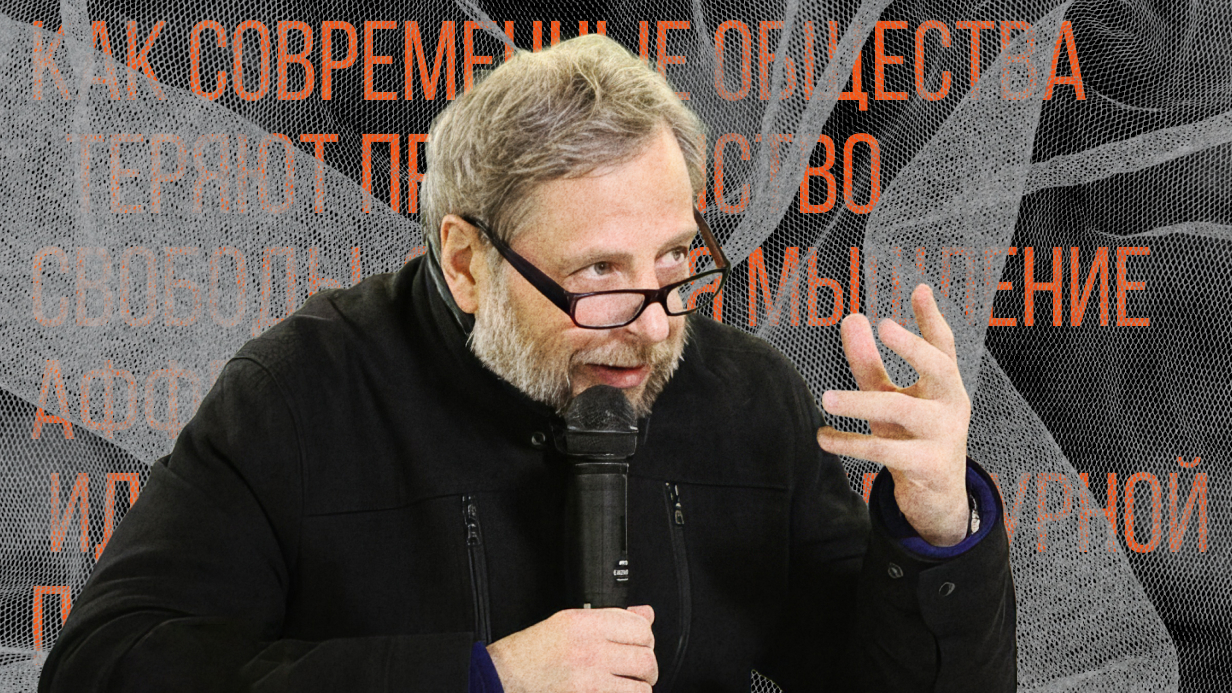
How did universities stop being spaces of freedom, politics turn into hatred, and art become a lifestyle? Why has everyone suddenly become obsessed with postcolonial studies, and what is AI still incapable of? And why, amid such tectonic shifts, write books about Ancient Greece? T-Invariant spoke with Mikhail Yampolsky, recipient of the George Gamow Award founded by the Russian American Science Association (RASA-America).
T-INVARIANT PROFILE
Mikhail Yampolsky
Born in 1949. Graduated from the Romano-Germanic Faculty of the Moscow State Pedagogical Institute (1971) and completed postgraduate studies at the Academy of Pedagogical Sciences of the USSR (1977). Worked at the Research Institute of Film Theory and History and at the Institute of Philosophy of the USSR Academy of Sciences; taught the course “Theoretical Analysis of Film” at VGIK. In 1991 he defended his doctoral dissertation on “The Problem of Intertextuality in Cinema” and in the same year moved to the United States. Since 1992 — Professor of Comparative Literature and Russian & Slavic Studies at New York University. Retired in 2024.
Top news on scientists’ work and experiences during the war, along with videos and infographics — subscribe to the T-invariant Telegram channel to stay updated.
T-invariant: This year you shared the award with Anna Krylova a professor at the University of Southern California. She is a chemist, and chemists regularly receive such awards. Philosophers do not, because it is a rather different way of understanding reality. Do you feel like a scientist at all? Or are you still more of a philosopher, cultural theorist, film scholar, literary scholar?
Mikhail Yampolsky: You know what pleased me most about this award? In the citation they wrote that they were honoring me for being someone who is impossible to pin down precisely — because I keep forging connections between everything and anything. For me that is a deeply valued acknowledgment. The norm has been to work within disciplines. A discipline regarded itself as having a clearly defined object. I have always believed that reality can never be reduced to such an object.
When I was young and worked for many years at the Institute of Film Studies, everyone thought I was a film scholar. Yet I left for America from the Institute of Philosophy. Here I spent more than thirty years at NYU in the Comparative Literature department. My colleagues — I heard this more than once — used to complain that ours was a deficient discipline without its own epistemology. But I have never wanted to fit into an immutable epistemology and thereby be a philosopher, or a film scholar, or a literary scholar. So to your question whether I am a scientist or not, I would say that I am just someone trying to think without pre-established boundaries and methods.
Top news on scientists’ work and experiences during the war, along with videos and infographics — subscribe to the T-invariant Telegram channel to stay updated.
T-i: You were also honored for your role in Russian and international intellectual life. What role do you actually play in the intellectual diaspora?
MY: I fit rather poorly into the academic community. I have never gone to those huge conferences that attract thousands of people. I have never belonged to any of the countless professional associations that exist in America. I have always had a strong desire to maintain distance from institutions. Institutions simultaneously grant you rights and impose responsibilities. You have to take part in these pre-reviews, dissertation defenses, and so on, which, of course, cannot be avoided. In a broader sense, the institution also engages in a kind of intellectual censorship.
“Democracy is a civil war that has been paused just before the battle begins”
T-i: The world is going through turbulent, frightening, terrible things, yet you are writing a book about Ancient Greece. Is this partly “consolation by philosophy,” or is it, on the contrary, the most important thing one can do right now?
MY: It’s both. On the one hand, I really want to write about what interests me. Yes, it is an escape from reality. On the other hand, it is a chance to see reality from a very great distance that suddenly throws light on it. I wrote this book about Greece because I felt it was necessary to understand how they thought about the human being and how they thought about society. I have always been fascinated by the fact that for several centuries the Greeks constantly fought against tyranny. It kept returning, and they kept trying to overthrow it repeatedly. All around them were Persian and Assyrian empires, pharaohs — not the slightest glimmer of democracy anywhere.
And the Greeks developed a completely paradoxical conception of democracy. The French scholar Nicole Loraux wrote a magnificent book about it titled Stasis. Literally meaning “civil war,” “strife.” Following Aristotle, Loraux refers to a certain law of Solon that stated that if strife breaks out in the city, every citizen must take one side or the other. If a person tries to remain neutral, he must be exiled and stripped of citizenship.
The law is very strange. But once you start thinking about it, you realize that they understood democracy as strife.
They say that democracy is a civil war that has been paused just before the battle begins. There is even a comparison: two armies stand opposed before the slaughter begins. Between them is an interval, a no-man’s-land that is frozen and prevents the battle from starting. And that is democracy. It is incredibly fragile because the slaughter can begin at any moment.
Another thing that is very important to me: they had a great many different institutions embedded in the polis — demes, phylai, phratries, gene. Thanks to this complex segmentation of society you begin to understand that without a multitude of institutions and a complex division of the social body, democracy is impossible. Amorphous, ill-defined communities are, alas, doomed to the disaster of tyranny. The Greeks thought differently from us, but they grasped certain things with incredible originality and depth. It is very important to have the optics of another culture in order to better understand the one we are living in now.
T-i: Then perhaps we should stop lamenting over the polarization of American, Israeli, or almost any other society? If strife is a prerequisite of democracy, the Greeks give us grounds for some optimism.
MY: What we are witnessing today is not Greek-style polarization at all. Democracy did not exist from the time of ancient Athens until practically the end of the 18th century. For two thousand years no one even remembered democracy. It re-emerges as a outcome of the Enlightenment and as a product of faith in reason. That is why parliament appears — a place where people can speak. Logos, realizing itself in parliament, can persuade someone, can persuade a person to side with the good and make the right decision. As early as the beginning of the 20th century the German-Italian sociologist Robert Michels wrote that parliament is the most meaningless place on earth. You cannot persuade anyone because parliament is split into two parties, and everyone votes according to the decision of the party bureaucracy.
But the problem is not only that the potential of Logos has been exhausted. The problem is that the world no longer fits into simple oppositions: bourgeoisie versus proletariat, or geopolitical blocs like the Triple Alliance and the Entente. We still try to think in binary categories, we still try to say there is China and there is America. The complexity of today’s situation is that all the parties that still formally exist more or less represent no one. I was looking at American polling data recently. Republicans are unpopular, yet marginally more popular than Democrats. When I arrived here thirty years ago, people would say “I’m a Democrat,” “I’m a Republican.” Today we simply opt for the lesser of two evils. In reality the picture of relations is far more complicated.
And the hatred you mention is not built on Logoi, on rational programs — which have almost completely disappeared. It is built on emotions. We are moving from political rationality to a structure in which social media plays an enormous role and in which hatred is constantly cultivated.
T-i: You recently wrote a column in which saying that one should not take sides in the dispute between those who left and those who stayed. Would the Athenians have deprived you of citizenship for that?
MY: No, I didn’t quite say that. I wrote that there are two communities of dissenters, each living by its own laws because they exist in completely different contexts. Those who left are doomed to life in the diaspora. Those who stayed cannot speak politically and occupy themselves with trying to preserve what has not yet been destroyed: the remaining remnants of conscience, honesty, uncompromising attitude, dignity, culture. Karl Jaspers once faced the same choice — he was fired from everywhere in Nazi Germany, his friends stopped speaking to him. Jaspers believed that if he left he would have to keep repeating the same things everyone else says in all diaspora protest media. If he stayed he would become a utterly outcast. The dilemma was agonizing, and he never left. Paradoxically, Jaspers left Germany for Switzerland only in 1948. He had been restored to all his positions, and everyone who had refused to speak to him for years suddenly rushed to embrace him and tell him how much they loved him. At that moment life in Germany became so unbearable for him that he emigrated.
“The humanities are in a state of chronic anxiety and a sort of inferiority complex”
T-i: These days you don’t even have to emigrate or stay to be ostracized. Thanks to social media we all seem to live in a world of total censorship and self-censorship.
MY: I completely agree. We live in an era of societal hypercensorship. And the university — sad to say — has also stopped being to be a place of free exchange. I retired a year ago, and that decision was dictated in part by this very change. When I arrived in America as a young man, I still caught the older generation of scholars — exceptionally well-educated and intellectually free people. Talking to them was incredibly interesting because they knew so much and thought so much. But gradually that generation died out, and people came who were less well educated and far less free in their thinking.
And this shift has unfortunately affected higher education everywhere in the world. And it is not necessarily only censorship. The institution imposes upon individuals a certain model of behavior and thought. And people quite sincerely say what is expected of them. It’s not that they are constantly checking themselves: you can’t say this, you must say that. No, they have already been shaped that way.
T-i: Why did this happen to universities?
MY: Even when I first arrived in America, the first question I was always asked was: are you a Lacanian, a Marxist, a Heideggerian, an existentialist? I was completely at a loss because I was none of those things. And I would mumble something like, well, I’m nobody. But it was considered that you had to belong to some sect. I was told that the American university was a place of free thought (which it was at the time), and if you didn’t join anyone, no one would do anything to you. You could go on sitting in your corner doing your research. You would simply be a complete marginal. You wouldn’t be invited anywhere, you wouldn’t advance your career.
T-i: And when did it become not enough to simply not join — when did it become mandatory to join the right group?
MY: It soon became clear to me in the U.S. that all the humanities disciplines were in a state of constant anxiety and some sort of inferiority complex — they were all looking for legitimation. If you look at how the humanities field is organized in America, you will see Italian, Spanish, English, French, German, and Slavic (primarily Russian) departments. They have divided the entire field among themselves as heirs of the great imperial nations that formed as nations earlier than others and were able to create their own cultural canon. The canon was absolutely necessary for the existence of those nations. To be French you had to share the French language with other French speakers, know French literature, and so on. The system unified the inhabitants of a large national territory on the basis of a common culture.
Up-to-date videos on science during wartime, interviews, podcasts, and streams with prominent scientists — subscribe to the T-invariant YouTube channel!
And then we come to the end of the 20th century, when the entire geopolitical situation changed dramatically. Yet the humanities disciplines continued to serve six, seven, perhaps eight European cultural blocs. And the academic representatives of each bloc began seeking for new legitimacy. Surely we are not here, drawing salaries, just to keep maintaining the cultural canon of the great empires of the 19th century? They seek legitimacy in postcolonial studies. Suddenly they need to study the cultures of the peoples who were conquered, whose culture was hybridized, devastated, transformed. So we should not so much study the cultural canon — Corneille, Racine, Molière — but rather Caribbean or African Francophone writers. And the university as a whole tries to adapt to the new geopolitical realities and find new legitimacy for itself. We are not just forcing students to learn this useless and even reactionary imperial trash — we are doing something meaningful.
I think this began somewhere in the 1980s, but at first it did not yet have such an all-pervasive character. I remember very well how postcolonial and gender studies were just one field among many. But gradually they took up more and more room.
T-i: And why did students and graduate students rush to study all this?
MY: It quickly became clear that the entire academic landscape was divided into subdisciplines that helped one build a career. For example, there is sociology or comparative literature. Inside them there are gender and postcolonial studies, which later grow into separate disciplines. There are always gurus who wield enormous power because they set the tone. And huge numbers of people flock there because they feel that this subdiscipline will help them get a job and advance. All that is required of them is conformity. Moreover, these subdisciplines are painted in the appealing hues of the struggle against the obsolete and unjust systems.
T-i: Like going into Soviet “scientific communism” or dialectical materialism in the USSR? Sheer careerism?
MY: Not quite.
I vividly remember graduate students at the university being polled what kind of new professor they would like for the vacant position. And suddenly, to my astonishment, I hear: we would like someone in postcolonial studies. They already had half of their coursework in postcolonial studies. And I realize it’s because nothing else at all even occurs to them anymore. Because that is what they are taught, that is what everyone talks about, that is all the conferences are about. They don’t even recognize that other fields of culture exist.
T-i: I remember professors from Moscow State University who behaved similarly as their Western colleagues and then suddenly ended up at the“Philosophical Cathedral” in Donetsk. It turned out that people are remarkably adaptable.
MY: Exceedingly so. But you see, the situation that is unfolding in Russia is rife with temptations. A huge number of people have left, opening many vacancies. And suddenly career growth has opened up for people for whom it would have been impossible in a relatively normal Russia. I even know completely decent people who have done nothing underhand, written no denunciations, and suddenly they are invited everywhere, promoted, because there is no one left to work. They even feel awkward about it. But at the same time, you’re not going to turn down a promotion, a department chair position, are you? Or in theater — a director who previously wouldn’t have been given even a single theater now has two, maybe three.
“Art has been transformed into a generator of social relations and connections”
T-i: You recently had a piece in which you were struck by a new Russian production of The Queen of Spades with hundreds of extras. But if so much money is being poured into culture, might something worthwhile still grow out of it?
MY: That is a very complicated question; you cannot answer it without answering what art is today and what its role is. Art in the Western world has gone through different stages. First it served power: the monarch, the nobility, the church. The situation changed dramatically in the 19th century with the emergence of the market. For visual art this happened even earlier. In 17th-century Holland suddenly there appeared small, mass-produced, standardized pictures for bourgeois interiors that Dutch burghers bought and hung in their homes. That was a completely different mode of legitimation of art — not via the prince, king, or Pope, but through the market, that is, money. Russia essentially hardly ever knew this. If we look at history, we will see with surprise that all 19th-century Russian art was bought by a single merchant, Tretyakov. And the paintings he bought were completely unmarketable. No home could accommodate The Appearance of Christ to the People or Boyarynya Morozova.
I simply mean that market legitimation appeared in Russia only at the very end of the 19th century. And it lasted until the revolution — a mere 20 years. Then came the “state-patronage” era again, when artists were once more embedded in the same type of legitimation as under the tsar. Artists painted those pictures, and ROSIZO bought them. They did what was expected of them — huge canvases by Deineka, The Defense of Sevastopol. These were paintings not intended for private viewing. And when the Soviet Union began to fall apart and state structures stopped buying art, a different mode of its operation began, which we still understand very poorly. To a large extent art was transformed into a generator of social relations and networks.
T-i: What do you mean?
MY: Lots of premieres, lots of openings, lots of readings. People rush here, people rush there. You can hang out, go to a restaurant with friends after a reading, talk, it’s trendy. What, you haven’t been to Bogomolov’s theater yet? It all became part of what I call a lifestyle practice.
A friend of mine came from Israel and says: the cultural life in Israel is very limited. Nothing goes on there, unlike Moscow. I ask: all right, but is the quality of what you see in Moscow — all these productions, readings, presentations, openings — high? She answers indignantly (she really knows this world): who cares much about the quality? The feeling of the cultural intensity is what matters!
T-i: Isn’t art a part of the lifestyle everywhere else as well?
MY: It occurs everywhere. The problem is that in principle this is not market legitimation. It is legitimation through social stratification. If you belong to and identify with a certain cultural stratum, a certain income level, a certain milieu, you participate in it. That is, the life of certain communities crystallizes around these cultural events. I have always been struck by the fact that when even the most pathetic book is published in America, the author goes on tour. You have to create buzz, an aura of an event. Even the Metropolitan Museum, with its great collection and wonderful exhibitions, does the same thing. They throw gala events with celebrities walking down the red carpet in their gowns.
T-i: If the main thing is participation and lifestyle, then AI-generated art has great prospects.
MY: Yes, in the sphere of lifestyle AI can probably achieve quite a lot. But still, let’s agree that we would like something else as well. I recently went to an exhibition in New York of works generated with artificial intelligence. The curator was a friend of mine, which is why I went and talked to the artists. It left a unsettling impression. Everything bore the stamp of lifelessness. It is even more painful to watch AI-generated video clips that try to be funny. One feature that seems truly fundamental and very telling is AI’s complete inability to produce humor. And humor, I think, is not just some marginal feature of our consciousness. The German Romantics once spoke of jokes as the ability to connect the seemingly unconnectable. And that, it seems to me, reflects a fundamental capacity of the human mind. We can step beyond homogeneous analogical chains and suddenly bring together things that are completely unconnectable.
Artificial intelligence is still completely incapable of that. Maybe someday it will get there. Right now it is strong in the procedural tasks and the banal. For example, it helps me translate long passages. It does it better than I do; I only have to touch it up a little. Human participation in everything connected with routine protocol is gradually losing its meaning. A local doctor who prescribes you a pill for your sore throat is no longer needed because he works by protocol. He looks at your blood test, your temperature — here, take this pill.
Human thought is distinctive because it can link things that are difficult to join and see something in different things that lie in different planes and suddenly reveal a commonality. That is what Walter Benjamin called “profane illumination” — when a constellation suddenly arises that connects radically disparate “stars.” As you can see, we have come full circle in our conversation to where we began — to my desire not to fit into disciplinary protocols and to step beyond established boundaries.
The French philosopher Claude Romano once tried to describe what an event is. He says: imagine yourself walking through a dark forest along a path you can barely see. You cannot know what is around you, you don’t know that there are trees on the right, trees on the left — darkness everywhere. And suddenly a lightning flash lights up the clearing you are standing on, the trees standing there. That, he says, is an event in this sense. An event is something that reveals something you had not known and could not have imagine. I think the domain of the human still lies in the domain of events of that kind.