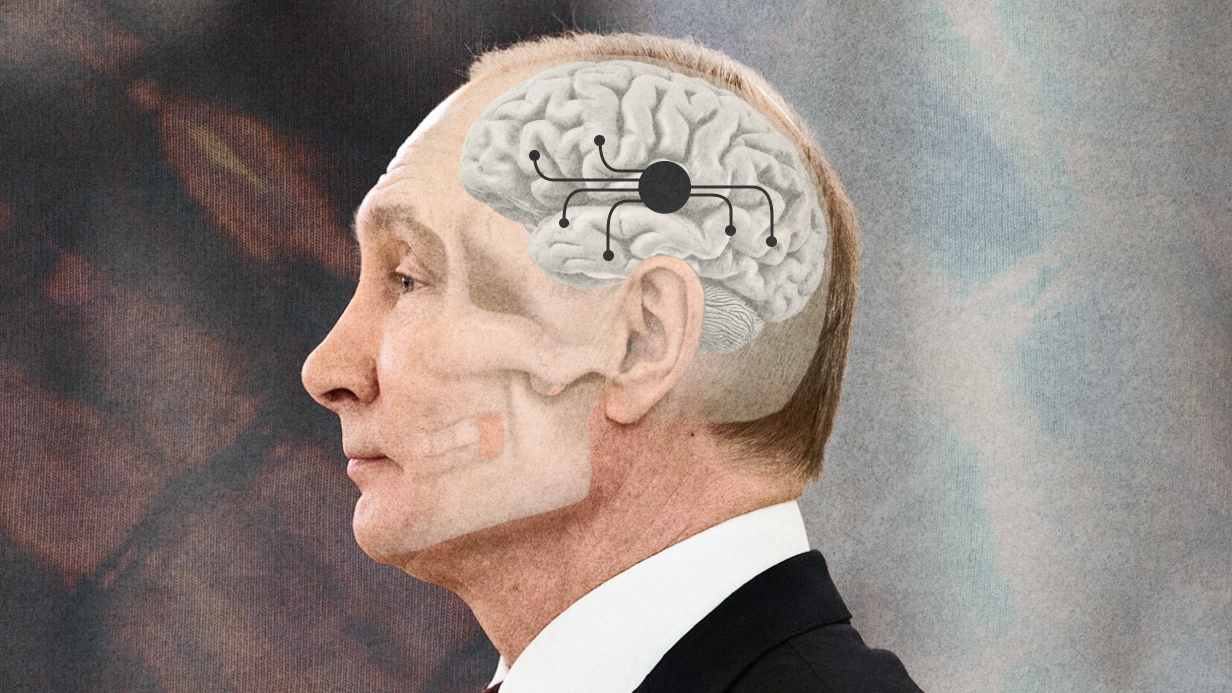
By the beginning of Vladimir Putin’s new presidential term in 2030, Russia’s fastest-growing neurotechnology company promises to begin developing solutions for maintaining mental health and cognitive function, as well as technologies for stimulating brain neuroplasticity and managing emotional states — specifically, “fear, happiness levels, and motivation.” Research and development are being handled by scientists at Moscow State University’s AI Research Institute, which is headed by Putin’s daughter, Katerina Tikhonova. Neiry Group already enjoys substantial support from both state development institutions and private investors, notably from billionaire Vladimir Potanin and other major Russian investors operating through closed-end mutual funds. What is at stake is extending life expectancy and improving quality of life in old age — a topic that deeply concerns the Russian President, though he is certainly not alone in this interest. With such positioning, Neiry expects to secure significantly more funding, according to T-invariant’s sources in the Russian venture capital market.
Top news on scientists’ work and wartime experiences, along with videos and infographics — subscribe to the T-invariant Telegram channel to stay updated.
From Rats to Humans
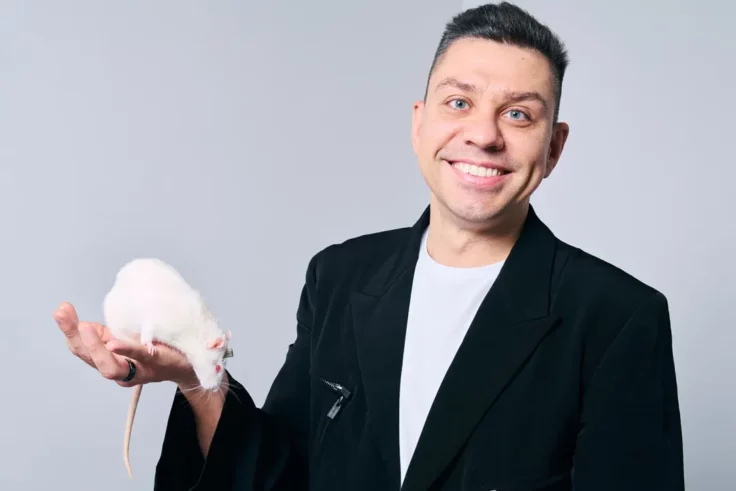
The MSU AI Research Institute has become a strategic partner for Neiry Group, which plans to move “from mass microchipping of animals to the first experimental human neurochip implant surgeries.” The institute houses an invasive neural interface development laboratory where joint research with Neiry is conducted. The company and its founder, Alexander Panov, participated actively in the recent St. Petersburg International Economic Forum (SPIEF). In the “Know Our Own” zone, as part of the “Minute of Techno-Glory,” Neiry’s booth operated alongside “The Welder Catherine,” Lapochka lemonade, Infomaximum, and other Russian brands. At the forum, the company announced a new funding round and even more ambitious plans than before (see previous T-invariant article on remote-controlled bio-drone pigeons and “conquering the world with neurotechnology”).
This new phase of active fundraising has shed light on the sources of funding used to consolidate Russian neurotechnology companies around Neiry. Meanwhile, an aggressive PR campaign has revealed what Neiry intends to do next.
“Just so you know, my co-founder of Neiry is Katerina Tikhonova, the idea for an AI-chipped rat came from Mikhail Kovalchuk, and our ambassador is Vladimir Putin!
*according to foreign agents, extremists, and Navalny’s idiots”From the Telegram channel of Neiry founder and CEO Alexander Panov
In its investor presentation on the Aurora platform, Neiry listed six organizations as investors: Interros holding company, the Voskhod Fund, the NTI Fund, JSС Mira AI Capital, SPEC Investment, and the Seed Investment Fund. However, in the presentation on its own website, Neiry has omitted Interros, owned by billionaire Vladimir Potanin. As a reminder, the holding company is under US and Canadian sanctions, while Potanin himself has been on the US sanctions list since 2018, and after 2022 was sanctioned by Canada, the UK, Australia, and New Zealand. The Voskhod Fund was created by Interros and was sanctioned by the US in 2023.
Neiry raised a significant portion of its capital from state development institutions. Judging by the presentation, the NTI Fund was its first public investor. Among the third-round investors is the Seed Investment Fund (Russian abbreviation$nbsp;— FPI), displaying the old logo of the Russian Venture Company (RVC). Yet back in 2019, RVC announced the closure of its subsidiary funds (including FPI), and in 2021 it was reported that RVC had been integrated into the Russian Direct Investment Fund (RDIF).
Meanwhile, FPI remains legally registered. This is likely due to the administrative peculiarities of RVC’s reorganization and the convoluted nature of winding up legal entities, especially of this type, according to a former RVC employee who spoke with T-invariant. There is no record of any substantive activity by FPI over the last 8–10 years — a fact confirmed to T-invariant by two former FPI employees.
Sources say it is difficult to explain why FPI appears in the “Neiry Group’s Capital” section of the investor presentation. “Perhaps it refers to some earlier investments in one of the neurotechnology companies that became part of Neiry, or maybe it’s somehow connected to RDIF, which now holds what used to be called RVC or was part of it,” suggests a former RVC employee. T-invariant sent an inquiry to Neiry Group to clarify this information, but no response has been received yet.
T-INVARIANT BACKGROUND INFO
The Russian Direct Investment Fund (RDIF) is a sovereign wealth fund established in 2011 by the Russian government to attract foreign capital into the Russian economy and co-invest in key projects. RDIF and its CEO, Kirill Dmitriev, were added to all major sanctions lists within days of the full-scale invasion of Ukraine (February 28, 2022, by the US; March 1, by the UK; and shortly after by the EU). Kirill Dmitriev has headed the fund since its founding. Today, he is one of the key Russian negotiators in economic and political dialogue with the US under the Trump administration.
During these active negotiations, a project for a tunnel across the Bering Strait (Chukotka–Alaska) was proposed. The fund and its founder have always been inclined toward mega-projects. In 2016, the fund invested in Hyperloop One, a company developing a high-speed vacuum train based on Elon Musk’s design. The deal’s value and terms remain unknown (though after the project collapsed, all investments were lost). In 2017, Kirill Dmitriev announced that RDIF would invest in the construction of Neom, the “city of the future” in Saudi Arabia. Dmitriev’s wife is Natalya Popova, a friend of Katerina Tikhonova and her deputy at Innopraktika (for more details, see the article “The ‘Single Perimeter’ State Corporation: How Putin’s Daughter and Her Fashion-Model Friend Decided to Turn Innopraktika into an Integrator for All High-Tech Companies”).
The remaining two public investors are JSC Mira AI Capital and SPEC Investment. These companies have not been included in sanctions lists. Alexey Mariza, the founder and former CEO of Mira AI Capital, also serves as the chief operating officer of Neuroroga. In 2025, during its third funding round, Neiry acquired a 50% + 1 share stake in Neuroroga. Consequently, Mira AI Capital’s investments now flow into both the parent company (Neiry) and its subsidiary (Neuroroga). The founder of SPEC Investment is the Minerva-Capital closed-end mutual fund with a 99.93% stake; this fund is managed by JSC AF Capital Management Company (known as JSC Veter Management until January 10, 2025).
The strategic partnership with Katerina Tikhonova’s institute serves as a signal of political priority and provides access to the largest pools of capital. Potanin’s funds provide financing, while VTB Bank — represented by its Deputy Chairman of the Management Board, Vadim Kulik — gives Neiry prominent visibility at the major Data Fusion conference (hosted by the state bank in collaboration with Tikhonova’s Innopraktika foundation) In 2025, Kulik personally moderated a panel titled “Neurotechnologies: The Race for the Future.” Judging by the list of participants, Neiry is the company driving this race — specifically, Neiry founder and CEO Alexander Panov, Chief Scientific Officer Mikhail Lebedev, and laboratory head Vasily Popkov (both scientists are key figures at the MSU AI Research Institute). Such high-level PR support is not even available to Russia’s largest and longest-established neurotechnology companies, such as Motorika, which specializes in functional cybernetic limb prostheses, neuroimplants, and medical device distribution (Motorika has received direct investment from RDIF and has completed a pre-IPO round).
“The development of neurotechnologies, which Neiry is engaged in, can be viewed as a tool of geopolitical competition, and the state’s current position regarding limited regulation of AI development allows for growth in all directions,” stated VTB Deputy Chairman Vadim Kulik.
The new, fourth funding round was split into two parts: a “public” round and one for professional investors. The round for retail investors ran from March 10 to April 24. The price per share was set at 5,250 rubles [~$70]. The minimum investment for retail investors was 152,250 rubles [~$2000], equivalent to purchasing 29 shares. On his Telegram channel, Panov said that over 200 individual investors became shareholders within three weeks of the campaign. In another post, he mentioned that Neiry “raised 100+ MILLION [~$1,3m] in funding” within five days of targeting individual investors — this is currently the only public information available on the financial results of the 2026 funding round. Looking ahead, he noted that from May through the end of 2026, participation in the round would be restricted “only to strategic partners and institutional funds with a minimum investment size of 100 million rubles [~$1,3m].”
Ultimately, according to the investor presentation, Neiry Group’s valuation is projected to reach 8 billion rubles [~$100m] by the end of 2026. Following that, an IPO is planned for 2028.
On-Demand Happiness
It is expected that 50% of the funds raised will be allocated toward accelerating research and developing invasive neural interfaces to treat neurological and psychiatric disorders, as well as enhancing cognitive abilities. This will culminate in the mass production of PUSIN — the “Personal Universal System of Invasive Stimulation.” Another 30% of the investment will be used to acquire other neurotechnology companies, with the remaining 20% dedicated to international market expansion, clinical trials, and related overhead costs.
The company’s website states that Neiry operates four proprietary surgical units, has performed over 500 successful animal surgeries, and is slated to begin human trials in 2026. The company has already announced recruitment for a study on deep brain stimulation (DBS) for patients with treatment-resistant depression and obsessive-compulsive disorder. This procedure involves implanting electrodes into specific brain regions to deliver stimulation, thereby mitigating symptoms. This is not a novel development — neuromodulation and neurostimulation techniques have long been used worldwide, for instance, in treating Parkinson’s disease. These routine procedures will likely serve as a “warm-up” for future, more invasive and complex devices — namely, brain-computer interfaces (BCIs).
Neiry’s flagship development is PUSIN. According to the company’s investor presentation, it will enable users to control gadgets using thoughts alone, as well as modulate their emotional state — for example, inducing feelings of happiness and improving sleep quality. Neiry expects practical applications of neurointerfaces to materialize around 2030–2035. During 2026–2027, the plan involves refining surgical procedures using Medtronic neurostimulators, for which proprietary clinics will be launched, alongside upgrading PUSIN following animal trials. The period between 2027 and 2030 will see the first human PUSIN neuroimplantation and technology optimization. Following this, the company plans to develop and roll out technologies for maintaining mental health and cognitive functions, alongside managing emotional states like fear, happiness, and motivation.
“Even though Neiry is probably ALREADY THE LARGEST PRIVATE PROJECT in the country by number of investors, valuation, and growth rate, I predict that our deep tech fan club will add several hundred more investors over the next three weeks. This means we will be able to do more, go deeper, and chip everyone even more aggressively, advancing our scientific, engineering, and product development all in the name of profit margins and saving human civilization.”
From Alexander Panov’s Telegram channel
Overall, according to Neiry’s strategy, the company’s primary focus areas include developing BCIs (such as PUSIN), invasive stimulators for psychiatric disorders, and non-invasive neurodiagnostic devices (wearable EEG units, psycho-emotional monitoring systems, etc.).
The company believes that neurotechnology development in Russia is hindered by numerous legislative loopholes, outdated regulations that require overhaul, an obsolete educational framework for training personnel, and rigid device testing requirements — arguing that special rules should be established for the development and testing of “breakthrough” devices.
On his channel and at other events (such as a strategy session NeuroNet — an industry association of neurotechnology companies) Panov’s rhetoric has become increasingly hardline. He argues that to outcompete the US and China, which currently lead the industry and can deploy massive capital, Russia needs to win on the regulatory front: “Designate a few regions in the country where ANY neuroimplantations are permitted based on an agreement with the patient/user. This simple fix would provide a massive boost to neuroscience and neurotechnology, and startups from all over the world would start moving here. Zero budget expenditure, massive benefits. We already have a huge list of clients ready to go.”
“We are making filthy money by cutting back on marketing, just because everyone writes about us (for free!)”
From Alexander Panov’s Telegram channel
Erection Subscriptions
While CEO Alexander Panov handles PR promotion personally, the entire team follows closely in his wake. Neiry initially began communicating its results by leaning into blatant clickbait. For instance, in 2024, a press release titled “Introducing a rat that is smarter than most people” circulated across media outlets. This referred to the presentation of the first results of Project Pythia — where scientists and developers claimed to have connected a rat’s brain to artificial intelligence “for the first time in the world.”
In a recent interview, Panov discusses another acquisition: the company Neuroroga. In his words, a cow is a milk-producing machine that should yield as much as possible, but this machine has its own agency — for instance, deciding when to eat. To yield more milk, a cow needs to eat more. The management of a dairy farm approached them with a request: design a button that forces the cow to start feeding when pressed. Panov calls this a “cow subscription” — the technology works on a subscription basis: the cow has a neuroimplant installed in its brain that remains active as long as the farm pays the subscription fee. When payments stop, the stimulator shuts off, and the cow reverts to being a normal cow.
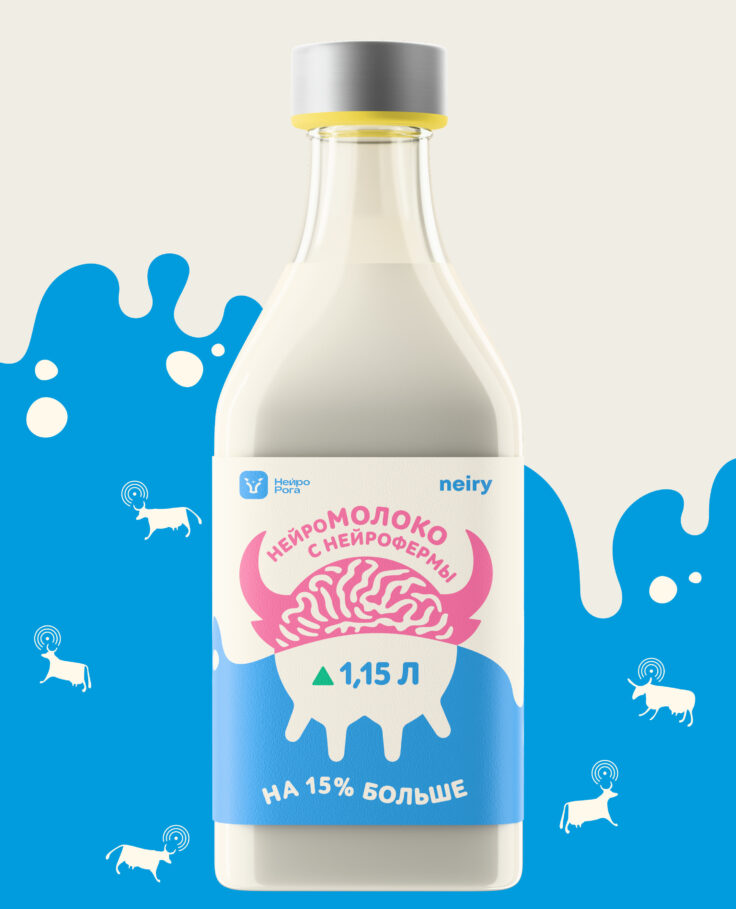
According to Panov’s speculation on his Telegram channel, these smart cows yield 15% more milk. Yet the same smart cows, featured in the investor presentation, are claimed to yield up to 30% more.
It is likely safer to rely on the 15% figure — as that was the percentage that ultimately ended up on the label of the milk bottle designed by Artemy Lebedev Studio.
In the spring of 2026, Neiry’s bio-drone pigeons generated such intense blowback that the company now refrains from mentioning the topic altogether; Panov did not breathe a single word about it even during his most extensive and detailed interview with the business outlet Inc. The “cow subscription” and spy pigeons have been left behind. The PR focus has shifted entirely to human enhancement. In the interview, Panov talks at length about how he intends to sell a “happiness subscription” and an “erection subscription.” The only thing left is to officially put that human’s name in the project roadmap.
In that same interview with Inc., Panov mentions — whether jokingly or seriously — that certain products of the company are vetted by an “assigned officer from the Russian Orthodox Church.” Whether the journalist is genuinely surprised or just playing along is unclear. Either way, the desired effect was achieved: The Edinorog [Unicorn], a Telegram channel covering business, is seriously seeking confirmation of this from investor companies and ROC officials.
“I want to emphasize something very important: the 21st century will be the century of neurotechnology. Globally, it will mirror how the 20th century was defined by nuclear tech. It will spark a similar scientific race. Nations will compete in neurotechnology to make their citizens’ lives longer, better, and more efficient. Initially, this will be a matter of safeguarding public health, not through pharmaceutical means, but electroceutical ones. It will assist individuals with treatment-resistant depression, Parkinsonism, epilepsy, and several other conditions… But soon after, states will begin competing to have more upgraded people… The world will witness a race for a new kind of human. We call it homo superior — a human integrated with computers on a fundamentally new level. Such individuals will have the capacity to interface with computers and artificial intelligence in real time,” Alexander Panov says, outlining these prospects in his interview.
Twenty years ago, using a similar line of reasoning, Mikhail Kovalchuk secured roughly 180 billion rubles [$2,4b] from Vladimir Putin to develop nanotechnology. The objective was clear — leapfrog the West through fast-paced nano development. The funds were spent on various needs with varying degrees of efficiency, yet a domestic nanotechnology industry never materialized in Russia. The new visionary, Panov, outlines a far more ambitious goal — outliving the West via neurotechnology. And, judging by how the PR campaign is unfolding, there is every indication that it will meet the same fate as the grand “nano-project.” That said, few experts surveyed by T-invariant expressed any regret over this, arriving at a consensus: “It’s better they blow money on a happiness button, an erection lever, flying cows, and milk-yielding pigeons than on the war.”
T-invariant was unable to find scientists willing to offer a substantive evaluation of Neiry’s prospective plans or its investor presentation. One typical reaction was: “There was a major neurotechnology science conference recently. Throughout the entire event, I didn’t hear a single soul discuss their developments or anything related to them,” an interlocutor told the editorial team. As T-invariant previously pointed out, no peer-reviewed scientific papers detailing the mechanisms of Neiry’s neuroimplants in either animals or humans have been published. In the most famous video of the trials, the bio-drone pigeons merely fly left or right upon receiving a command, and nothing more. Perhaps an “assigned ROC officer” has no need for verified data published in peer-reviewed journals, given that the R&D outcomes are evaluated not by venture capital experts, but the main patient himself and his inner circle.