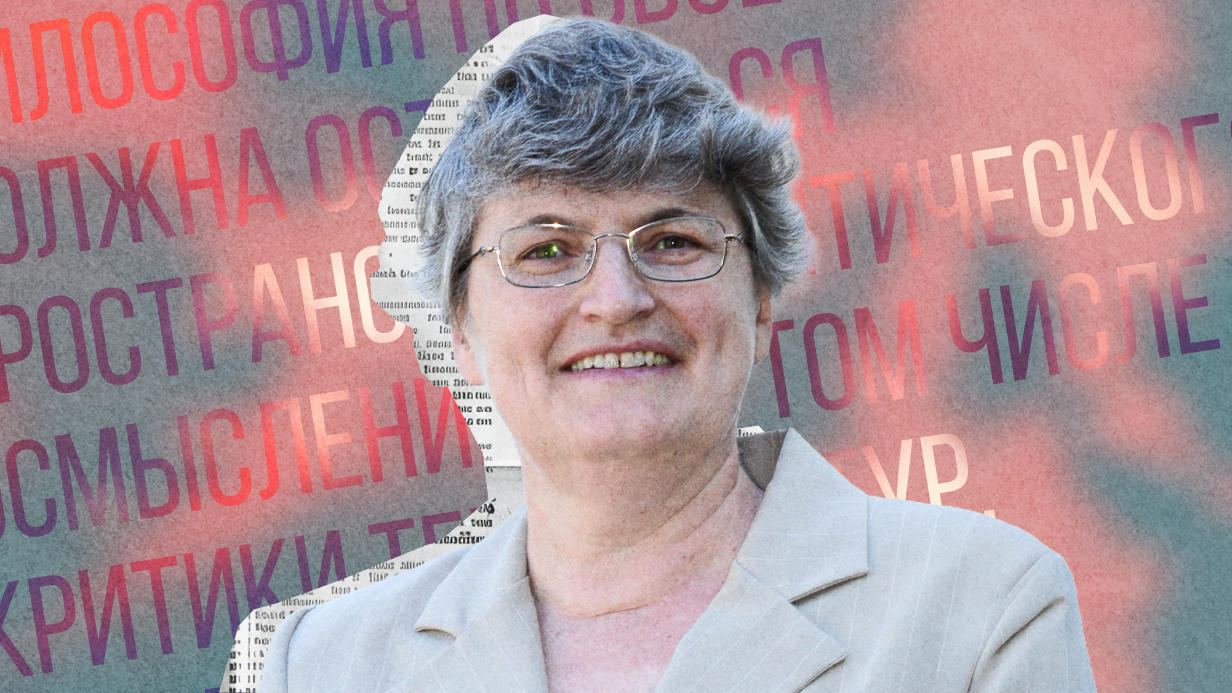
In 1993, Marina Bykova became the youngest scholar in the humanities in Russia to earn a Doctor of Sciences degree [Russia’s higher doctorate, awarded years after the Ph.D.-equivalent candidate’s degree — T-invariant]. Today she is a professor at an American university and editor-in-chief of the influential international journal Studies in East European Thought. For many years her professional life has been devoted to building and sustaining dialogue between the Russian philosophical tradition and the international academic community. It is a singular and often difficult mission — keeping intellectual bridges open at a time when political conflict is tearing apart the usual academic ties. In an interview with T-invariant, Marina Bykova reflects on why Russian academia has been paralyzed by fear, how the cultural project of the “Russian World” turned into a political ideology, what happens to philosophy when it loses its autonomy, and how the experience of the Soviet “sixties generation” of philosophers [shestidesyatniki, the reform-minded intellectuals who came of age during the post-Stalin Thaw — T-invariant] helps us understand the relationship between philosophy and power today.
Top news on scientists’ work and experiences during the war, along with videos and infographics — subscribe to the T-invariant Telegram channel to stay updated.
Science Under Sanctions
T-invariant: Let’s start with your work as a journal editor. Before you became editor-in-chief of Studies in East European Thought, you ran another journal devoted to philosophy in Russia, didn’t you?
Marina Bykova: Yes, before that I was editor-in-chief of Russian Studies in Philosophy; I was invited to take it over in January 2008. By then I had already guest-edited two thematic issues for it at the invitation of the editor at the time, Taras Zakydalsky, a well-known scholar of Russian and Ukrainian philosophy. After his death, the publisher asked me to take charge. The journal had a rather unusual format: it published thematic clusters of articles that had previously appeared in Russian and were then translated into English, mostly from journals such as Voprosy filosofii (Problems of Philosophy), Filosofskie nauki (Philosophical Sciences), and Vestnik MGU (the Moscow University Bulletin). I proposed expanding that model to include original research written specifically for the journal.
T-i: So the journal was a window through which Russian-language philosophy reached Western academia?
MB: Exactly. Most Western scholars had limited access to philosophical literature in Russian, and many of them found it hard to read Russian at all. So our job was to give Western readers a sense of what Russian philosophy was preoccupied with, which problems it was debating, and what intellectual discussions were unfolding inside it.
T-i: How did you manage to keep that format going?
MB: We put out thematic issues, for which Russian authors sent us their articles in Russian. Professional translators then turned the texts into English. But philosophical translation takes more than simply knowing the language; it requires a deep grasp of the subject, the terminology, the context. So I often had to edit the translations heavily, and sometimes essentially rebuild whole passages from scratch. What came out in the end were fully fledged scholarly articles that specialists still use today. The journal’s archive is available on the publisher’s website.
T-i: Why was the journal shut down?
MB: I’ll admit this is still a hard question for me to answer. That journal was bound up with many years of my life, and its closing was painful. But to understand the decision, I need to say a few words about the journal itself. It was part of a large series that originally ran to more than ten titles covering Russian scholarship across the humanities — history, literature, cultural studies, education, and other fields. These journals were founded back during the Cold War and at first served as an important source of material for Sovietology. After the Cold War ended, they retained their significance and continued to serve an important informational function for the Western academic community.
Originally the entire series was published by a small publishing house, M. E. Sharpe, but by the time I was editor-in-chief the titles had moved to Taylor & Francis, which had acquired M. E. Sharpe along with everything it published. In its final years, Russian Studies in Philosophy appeared under the Routledge imprint — one of the leading international humanities publishers — which raised its standing considerably. The journal was widely cited, scored well in the international databases, and consistently ranked highly in Scopus-based metrics, which in turn drew a large number of Russian authors.
BACKGROUND
M. E. Sharpe was an independent American academic publisher founded in the 1950s. It issued a series of journals under the general heading Russian Studies in…, which grew out of American academia’s interest in studying the USSR and Russia during the Cold War. The series included Russian Studies in Education, Russian Studies in History, Russian Studies in Literature, Russian Studies in Critical Thought, and Russian Studies in Philosophy. In the 2000s, a substantial part of M. E. Sharpe’s academic portfolio, the journals included, was acquired by the Taylor & Francis Group, which went on publishing them under the Routledge imprint.
After Russia launched its full-scale war against Ukraine, the publisher sent the editors of every journal in the series a notice that it had decided to discontinue them. Formally, this was presented as a business decision. I managed to win a one-year reprieve, since by that point we already had a fully prepared publishing plan of six issues. Simply abandoning material that authors and editors had worked on for years struck me as impossible. As a result, ours was the last journal in the series to go: it closed only in May 2023.
T-i: And do you think it really was a business decision, or…?
MB: No. My own experience, at any rate, convinces me otherwise. I believe it was first and foremost a politically motivated decision. In January 2019, nearly four years before Russian Studies in Philosophy closed, I had also been invited to head another journal, Studies in East European Thought (SEET), published by Springer. After the war began, representatives of the publisher approached me as editor-in-chief and proposed limiting submissions by authors with Russian institutional affiliations. I asked on what grounds such a measure was being proposed. I was told that the policy followed from the general sanctions regime and from political decisions taken in Europe and North America with respect to Russia. They also stressed that many Ukrainian colleagues categorically objected to publishing Russian authors.
But a scholarly publication is not in itself an expression of support for a state or its policies. I consistently distinguish between philosophical thought and state ideology: the first, by its very nature, presupposes critical thinking and autonomy, while the second seeks to use knowledge as an instrument of political ends. Judging philosophical work primarily through the lens of political affiliation inevitably undermines the very principle of academic freedom.
So my position was a matter of principle: the only criterion for publication in an academic journal should be the quality of the scholarship. I replied that the journal would go on accepting articles from researchers with Russian affiliations. My editorial board fully supported that stance. I also told Springer that if the publisher found this approach unacceptable, I was prepared to step down as editor-in-chief. After internal discussions, Springer decided not to interfere with the journal’s editorial policy. As a result, Studies in East European Thought remains one of the few international philosophy journals where Russian scholars can still publish on standard academic terms.
T-i: Isn’t that dangerous for the authors themselves right now?
MB: That’s a hard question. Situations vary. Some authors prefer to publish under pseudonyms or anonymously; others use their own names and even list their institutional affiliations. We try to take each author’s particular circumstances into account. At the same time, it should be understood that what we are dealing with here is scholarly work and scholarly publication. That said, we are certainly aware that for some Russian authors, publishing in a Western academic journal can itself look like a risky step today.
T-i: Which raises the obvious question: what makes that risk worth taking for them?
MB: For most of our Russian colleagues it is less about building a new reputation than about not vanishing from the international academic landscape. Many are afraid of being shut out of the global scholarly community altogether.
I was also struck by how closely Russian researchers still follow our journal. Although official access to many international databases is now restricted in Russia, scholars find ways to get the literature they need through personal contacts, professional networks, and other informal channels of academic exchange. Springer recently gave me download statistics for individual articles and full issues over the past three years. The largest number of downloads came from Russia and China.
T-i: Even though the journal comes out in English?
MB: Yes. And what is more, our journal is hardly politically neutral. We were one of the first academic publications to respond openly to Russia’s invasion of Ukraine — and not merely with a statement. In December 2022 we brought out a special issue, Russia’s War in Ukraine: When Barbarism Takes Over Civilization (SEET, vol. 74, issue 4). I edited it and wrote the introduction. It ran to 22 pieces, including research articles and the proceedings of a roundtable with young Russian scholars. As far as I know, it was one of the first collective — and genuinely international — responses to the war from the philosophical community. That issue mattered not only as an academic reaction to the war but as an attempt to preserve the critical function of philosophical language: the capacity to describe what is happening without substituting ideological formulas and euphemisms for analysis.
Just recently, in early 2026, we put together a special double issue, Aleksandr Dugin and Contemporary Russian Conservatism (SEET, vol. 78, issues 1–2), which I co-edited with my Canadian colleague Jeff Love. The contributors examine in detail the intellectual sources, ideological foundations, and political consequences of contemporary Russian conservatism, along with the role Aleksandr Dugin’s ideas played in shaping it. The issue was important because it analyzed not just Dugin as a public intellectual but the broader phenomenon of philosophical and pseudo-philosophical constructs being turned into instruments of political mobilization. We wanted to show how ideas, once they leave the academic context, can be reinterpreted and put to work in ideological projects with real historical consequences. And of course, in that issue we stated our own position on the Dugin phenomenon openly.
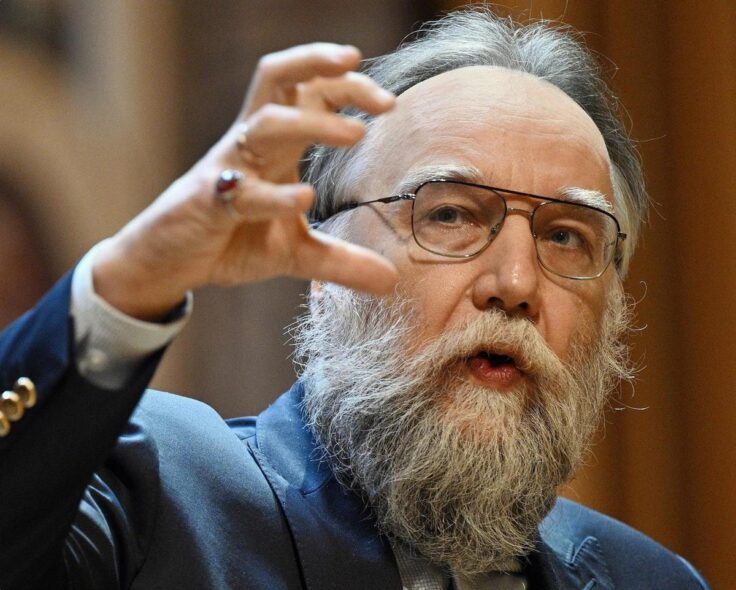
T-i: As far as I know, academics don’t regard him as an academic philosopher.
MB: That’s partly true. But in the West — and this is by no means a new tendency — Dugin is often seen as one of contemporary Russia’s leading intellectual figures, even as the chief architect of the Putin regime. He is frequently called “Putin’s brain,” on the assumption that the key to understanding Kremlin policy lies exclusively in his writings. To my mind, that is a serious oversimplification. The main goal of our special issue of Studies in East European Thought was to show that this picture does not hold up and to subject the Dugin phenomenon itself to critical analysis. We set out to show that Dugin is not an independent philosopher in the strict academic sense, still less a hidden architect of Russian policy, but a political ideologue and polemicist who uses philosophical terminology to construct a particular ideological worldview. Since in the post-Soviet space Dugin is sometimes presented as virtually the foremost authority on Martin Heidegger, we brought in leading Western specialists in Heidegger, the history of ideas, and intellectual history, among them such well-established authors as Mark Sedgwick. In the pages of that issue, researchers analyzed Dugin’s The Fourth Political Theory and his geopolitical concepts in detail, exposing their eclectic, ideologically driven character.
The analysis showed that behind the outward philosophical vocabulary there often lies an arbitrary assembly of disparate ideas, in which quotations from Heidegger, Max Weber, and Max Stirner, torn out of context, are mixed at will with radical traditionalism and far-right political concepts. Our special issue thus made an important contribution to the critical study of the Dugin phenomenon.
We aimed not merely to explain to the Western intellectual community who Dugin is as a political thinker, but to move the discussion out of sensationalist journalism and into the space of serious philosophical and intellectual-historical analysis.
From the “Russian World” to War
T-i: Do philosophers today — you among them — understand what is happening in Russia right now? Why did the war become possible in the first place?
MB: Whatever we do understand as researchers, we ought to be able to explain clearly. That, to me, is where the responsibility of philosophers and humanities scholars lies. I recently wrote an article on the genealogy of the “Russian World” ideology, because it is particularly important today to understand how this concept arose and why it acquired such destructive political potential. What matters to me above all is showing that ideas are rarely born in finished ideological form. They go through a long evolution, in the course of which their original cultural meaning can be radically reinterpreted and harnessed for political ends. That, in my view, is exactly what happened with the concept of the “Russian World.” The paradox is that the idea was originally neither narrowly nationalist nor aggressive. It emerged in the 1990s, during the period of democratic reform, and was largely conceived as a network of cultural centers meant to support the Russian language and Russian culture and to maintain ties with compatriots and Russian-speaking communities outside Russia. It took institutional shape in 2007 with the founding of the Russkiy Mir Foundation, charged with coordinating the promotion of Russian language and culture abroad. That was when the existing Russian Houses [Russian state-run cultural centers abroad — T-invariant], along with newly opened ones, were given fresh impetus, with an emphasis above all on cultural diplomacy, support for the diaspora, and the maintenance of cultural ties with it. There is nothing unique about institutions of cultural diplomacy. Many countries invest heavily in strengthening their cultural presence and deploying the instruments of soft power — China’s Confucius Institute, Germany’s Goethe-Institut, and the British Council, to name a few.
It is important to stress that the “Russian World” project was, in its formative stage, a matter of cultural policy, not political ideology. There is nothing exceptional or nationalist about wanting to support a language, a culture, and ties with a diaspora. Yet it was precisely in that period that the groundwork was laid for the ideological transformation that followed. Why did it happen? The answer, I think, has mainly to do with the crisis of national and cultural identity that Russian society went through after the collapse of the Soviet Union. Soviet identity was gone, and a new one had not yet taken shape. For the first time, Russian society faced the question: what does it mean to be Russian? Out of that situation came the idea of defining “Russianness” not through citizenship but through language, culture, historical memory, a shared cultural heritage, and historical traditions. That search for identity was not in itself nationalist, nor was it peculiar to Russia. Similar processes are typical of societies living through the breakup of states, a change of political system, or deep historical upheaval. What changed the situation was that this cultural concept gradually took on political content. Language and culture ceased to be a space of free communication and became a criterion of political belonging. If millions of people share the Russian language, Russian culture, and a common historical memory, then they can be portrayed as a single civilizational space bound together by a shared history and a special historical mission. An important role in this transformation was played by the Izborsky Club, founded in 2012, which brought together ideologues such as Alexander Prokhanov and Aleksandr Dugin. It was there that the attempt was made to formulate a new state ideology, to explain who the “Russian person” is and what Russia’s special historical mission consists of. And in the process, the notion of “Russianness” increasingly shifted from cultural self-identification and toward political loyalty.
Unlike classical nineteenth- and twentieth-century European nationalism, this concept rested not so much on the idea of common descent or “blood” as on a shared history, the Orthodox tradition, the legacy of Kievan Rus’, and the notion of a single civilizational space of the Eastern Slavs. It is in this context that Putin repeatedly spoke of Russians and Ukrainians as “one people.” In the West the phrase was often rendered as “one nation,” though in Russian narod (a people) and natsiya (a nation) are far from identical. That distinction is essential for grasping the underlying logic of the “Russian World” ideology.
Little by little, the circle of those counted as part of the “Russian World” widened. At first it meant the Russian-speaking population, then the Eastern Slavs, and eventually virtually all peoples historically tied to the Russian Empire and the Soviet Union. That is how a cultural concept finally turned into a geopolitical project. The result was a fundamental substitution. What began as a program to support the Russian language and culture gradually became an ideology of Russia’s historical exceptionalism, of a special civilizational path, and of political revisionism. This is why the “Russian World” today should be seen not as a cultural initiative but as an ideological project that legitimizes expansionism, rejects the universal principles of international law, and defines itself against the liberal-democratic world order.
T-i: Are there questions about Russia that you keep asking yourself without finding an answer?
MB: There are quite a few. The one that keeps haunting me is how such a destructive war could come to be seen by a substantial part of Russian society as historically necessary. Rationally, much of what is happening is hard to explain in the familiar categories of political or economic calculation.
In the first months of the war, it seemed to me that Russian society was largely hostage to the political regime and to a vast machinery of state propaganda. In other words, I assumed that support for the war was largely coerced. Over time, though, my understanding grew more complicated. Talking with colleagues in Russia, including people from the academic community, I increasingly ran into a different line of reasoning. Many of them do not welcome the war at all. Some say outright that they consider it a tragedy and, quite possibly, a historical mistake. And yet they are convinced that now that the war has begun, Russia cannot afford to lose it. Underlying that position is the belief that Russia’s defeat would mean not just a military setback but the end of the country as a great power — and perhaps a threat to the very existence of the Russian state. I do not share this view, but I think it is extremely important to understand the internal logic of such convictions. If we want to make sense of what is happening, it is not enough simply to declare these views irrational or propaganda-driven. We need to understand how they took shape and why they proved so persuasive to millions of people, including people in intellectual circles. That remains one of the hardest — and at the same time one of the most important — questions for me today.
T-i: What is happening today among Russian-speaking researchers, both those who left and those who stayed? What unites them, and what divides them?
MB: A serious split has opened up in the Russian-speaking academic community, above all between those who left Russia and those who remained. But that line does not map neatly onto attitudes toward the war: among those who left there are people with very different positions, and by no means all of them are willing to voice their disagreement openly. It seems to me that one of the key factors shaping the current situation is fear. And I mean not only political fear in the usual sense of the word, but a deeper, almost existential fear — fear for one’s own safety, for the future, for one’s loved ones. Many of those who emigrated still have ties to Russia. Elderly parents, relatives, property, professional contacts are all still there. On top of that, many are unsure whether their emigration will be temporary or permanent, and they want to keep the option of returning open. All of this creates a climate of self-censorship.
People may disagree with what is happening and still avoid saying so publicly, fearing the possible consequences — not only for themselves but for those close to them. It is this fear — which one might call a biological, instinctive drive toward self-preservation — that largely defines the state of the Russian-speaking academic world today. And what makes it especially paradoxical is that this holds equally for those who stayed in Russia and for those who ended up outside it.
T-i: Émigrés of the White movement also expected to return, yet they spoke and thought freely.
MB: Yes, many in that first wave of emigration [Russians who fled after the 1917 Revolution and the Civil War — T-invariant] also hoped to come back. But the historical situation was fundamentally different: after the Revolution and the Civil War, many of them were stripped of citizenship, of property, and of any possibility of return. The practice continued through the Soviet period: the state restricted freedom of movement and often turned departure into a forced separation from one’s homeland. The border was closed, and emigration effectively meant a final break with one’s former life. But at the same time, those who left gained the freedom to speak, write, and act openly in accordance with their views and convictions. I’m reminded here of a passage in Aleksandr Solzhenitsyn’s memoirs about his expulsion from the Soviet Union. He wrote that the moment the plane left Soviet airspace, he felt absolute freedom for the first time. He had lost his homeland, but he had gained the freedom to speak and think without fear.
The paradox of the present situation is that open borders have brought not only greater mobility but also a distinctive instrument of political leverage and pressure in the hands of the state. This, to my mind, is one of the most unusual features of the current Russian regime: a new form of political control based not on closing the borders but on maintaining controlled openness. People can leave the country, but the act of emigrating does not necessarily mean freedom from fear. Those who leave find themselves in an in-between state — between physical freedom of movement and a sense of constant vulnerability. Physically they leave Russia, but psychologically and socially they are not always entirely free of the system they left behind.
Self-Censorship Against Philosophy
T-i: What is happening inside the Russian philosophical community?
MB: To be honest, what troubles me today is not so much state censorship as the gradual transformation of the very culture of philosophical thinking. I don’t think what is going on can be explained by direct state pressure alone. Institutional constraints certainly exist, but self-censorship has become a far more serious problem. It is self-censorship that largely sets the intellectual climate today.
Let me give an example from my own experience. In 2022 the centenary of the famous “philosophers’ ships” was being marked [the 1922 expulsion from Soviet Russia of some two hundred intellectuals, most of them deported by steamship — T-invariant], and a major international conference was in preparation. I was invited onto the organizing committee as a representative of the academic community abroad. After the war began, the European participants had to withdraw from the committee, because their universities and government bodies prohibited official cooperation with Russian state institutions. In the end, the only foreign participants left were a retired French colleague and me — there were no such restrictions in the United States. I was asked to give a plenary talk over Zoom and then publish it in Voprosy filosofii. And this is where the mechanism of self-censorship became fully apparent. I was told the text was too critical, that publishing it could put the journal in the line of fire and create problems both for the editors and for the Institute of Philosophy, which publishes it. No one officially forbade printing my talk. The decision was made purely out of fear of possible consequences. That, to my mind, is the most alarming feature of the situation today.
Self-censorship is always more dangerous than censorship proper: censorship restricts what is said from the outside, whereas self-censorship gradually rebuilds and deforms thinking itself. That is why I see self-censorship not simply as a political phenomenon but as a philosophical problem. It changes not only what people say but what questions they are capable of putting to themselves. When a researcher rules out entire areas of reflection in advance as “dangerous” or “undesirable,” philosophy stops doing its central job — subjecting reality to critical scrutiny.
Self-censorship is essentially one of the most dangerous instruments of authoritarian power: it limits not only freedom of speech but freedom of thought, imperceptibly narrowing the very space of what can be asked. Every authoritarian regime seeks to control not only public expression but the conditions under which independent thinking becomes possible. And self-censorship turns out to be a remarkably effective tool of that control.
T-i: How does self-censorship show up in philosophical research?
MB: Self-censorship inevitably changes the intellectual agenda itself. Many researchers try to steer clear of topics that might be read as politically sensitive. That is part of why we are seeing a marked rise in interest in traditional values, in the history of Russian philosophy, in Eastern philosophy and religious thought. I certainly don’t mean that these subjects are unworthy of attention. On the contrary, they are important fields of study. The problem arises when the choice of topic is driven not by scholarly interest but by considerations of safety. The result is that philosophy stops asking uncomfortable questions and starts circling around long-familiar material.
One episode in particular stunned me. Talking with a colleague, I learned about plans for a summer school devoted to Kant’s essay Toward Perpetual Peace. Both the work itself and the subject it raises are exceptionally important — especially now, in the middle of a bloody war. I was excited, and I asked how they intended to discuss the text under present conditions, and how far the ongoing war would become a subject of reflection. What I heard shook me to the core. The plan, it turned out, was to discuss the essay “in purely theoretical terms,” without touching on current social and political realities. That answer became for me a symbol of where Russian philosophical scholarship, and philosophical discourse generally, stands today. And it is very sad, because philosophy exists precisely in order to connect ideas with reality. If philosophical concepts lose all connection to historical experience, they become a purely academic exercise. It would of course be unfair to claim that all Russian philosophers have abandoned this much-needed reflection and blindly support what is happening. They have not. I know many people who stayed in Russia and inwardly refuse to accept the war. But fear — for themselves, for their colleagues, for the institutions they work in — leads many of them to keep quiet, retreating into the internal emigration we know so well from the Soviet period.
Up-to-date videos on science during wartime, interviews, podcasts, and streams with prominent scientists — subscribe to the T-invariant YouTube channel!
T-i: And do philosophers in emigration discuss the current situation?
MB: Émigrés certainly discuss what is happening far more freely. But another problem arises here. An enormous number of texts about the war, about Russian society, about the Putin regime are being published now. Most of these, though, belong to the genre of opinion journalism or political commentary rather than to philosophical research in the strict sense. And that is entirely understandable. Philosophical reflection requires a certain historical distance. Philosophy does not simply record events; it tries to understand their inner logic, to identify the concepts and structures that become visible only with time. And we are still inside the event itself, which is not yet over. So many of today’s interpretations are inevitably preliminary and fragmentary. This does not mean philosophy is silent. Rather, it is in the process of making sense of what is happening and searching for an adequate language to describe it. I am convinced that the most significant philosophical work on this war and on the transformation of Russian society is still ahead of us.
T-i: But parallels can be drawn.
MB: Parallels are certainly possible, though they have to be handled with great care. History never repeats itself literally. Even so, it is parallels that occupy me most as a researcher today. My recent article is about philosophers of the shestidesyatniki generation and what lessons their experience can offer us now. The main resemblance, as I see it, lies not in the political circumstances as such but in the fact that the question of philosophy’s relationship to power has once again moved to the foreground. The shestidesyatniki, after all, also lived under conditions of limited freedom. During the Thaw there was a sense of intellectual liberation, but it very quickly became clear that this space of freedom had its limits. Philosophers were confronted with the question of how to preserve the autonomy of thought inside a system determined to subordinate intellectual life to itself. That question is still with us today. Present-day conditions are of course different from Soviet ones. But the problem of the relationship between philosophy and power, between independent thinking and institutional loyalty, has not gone anywhere.
What worries me most is that many academic structures today prefer not to resist outside pressure but to adjust to it in advance. This is not only about political restrictions; it is about a willingness to give up their own intellectual responsibility. When a university or a research institute stops deciding for itself what its curriculum contains or what its researchers work on, it risks losing its central function — being a space for the free pursuit of truth.
T-i: Why do the shestidesyatniki philosophers seem so important to you today? What lessons can we draw from their experience?
MB: The shestidesyatniki are often seen simply as a generation of liberals and reformers, but that reading oversimplifies things badly. For me, the shestidesyatniki movement in philosophy was not so much a generation as a distinct philosophical project aimed at restoring philosophy to its true purpose. Their main task was to reestablish philosophy as an independent form of thinking. It is no secret that by the early 1950s philosophy in the USSR had largely turned into an ideological discipline, reduced to commenting on and quoting the canonical texts of Marxism-Leninism. Philosophy had effectively lost its own voice. It was in this context that the famous “Theses on the Subject Matter of Philosophy,” written in 1954 by two junior lecturers in the philosophy faculty at Moscow State University, Evald Ilyenkov and Valentin Korovikov, became such an important event. It is worth stressing that this happened two years before the Twentieth Congress of the Communist Party, where Stalin’s cult of personality was criticized, along with its consequences — including for philosophy, which had been steadily drained of living thought. The authors of the “Theses” called into question the very understanding of philosophy as the handmaiden of ideology. They insisted that philosophy must have its own object of inquiry and its own criteria of truth. They paid dearly for it. They were harshly attacked, and both were forced to leave Moscow State University. But the significance of their intervention lay in more than the specific theses. In effect, these scholars asserted philosophy’s right to exist autonomously, to have its own object of study and its own independent thinking. In other words, this was not about reforming Soviet ideology but about restoring philosophy as an independent field of inquiry — which is impossible without giving philosophy back its principal subject: the human being as a thinking, autonomous subject. That, in my view, is the central philosophical achievement of the shestidesyatniki.
Stalinist intellectual culture was dominated by the language of collective historical forces, classes, parties, and state interests. The human being as a subject of philosophical thought had all but vanished from philosophical discourse. The shestidesyatniki put the real human being back at the center of philosophical analysis — his consciousness, his freedom, his responsibility. They returned to philosophy not merely the human being as an object of study but the human being as a thinking subject, capable of posing questions independently and answering for his own judgments. It is no accident that turning to the early Marx, and especially to the Economic and Philosophic Manuscripts of 1844, came to matter so much to them. In the young Marx they saw not a theorist of the state machine but a thinker of human emancipation. Many of them therefore set out to analyze not abstract historical laws but the concrete forms of alienation, bureaucratization, and dehumanization in social life.
T-i: And how was it in the sixties?
MB: This is exactly the question that interests me most today. As I said, it seems to me that the experience of philosophers of the shestidesyatniki generation holds two lessons — a positive one and a negative one. And what matters especially is that these lessons did not emerge at the same time. The positive one had to do with the fact that the shestidesyatniki managed to give philosophy back its autonomy and restore the right to think for oneself. The negative one became clear much later — during perestroika, when philosophers themselves encountered an entirely different relationship between philosophy and power for the first time. We know the achievements of the shestidesyatniki well. Far less attention goes to the limitations and internal contradictions of their project. The paradox is that a generation that had fought for philosophy’s autonomy turned out to be largely unprepared for the changes perestroika brought. Faced with a new historical situation, in which the intelligentsia — members of the philosophical intelligentsia included — gained access to political and administrative structures of power, many of them became an integral part of those power structures and lost their critical distance from them. Serving as deputies, advisers, and heads of academic institutes and universities made them active participants in the machinery of decision-making.
Let me stress that there is nothing objectionable in intellectuals taking part in public life as such. Quite the opposite: philosophy that genuinely does any work is never wholly detached from society. The problem arises when the necessary distance between philosophy and power disappears, when the philosopher becomes indistinguishable from those in power and loses the capacity to look critically at them and at their decisions.
This, in my view, is where one of the main negative lessons of the shestidesyatniki experience becomes visible. It has to do not with the mistakes of particular individuals or particular institutions but with a deeper structural danger that accompanies philosophy in every era: the temptation to gain influence, recognition, and institutional support at the cost of one’s own independence.
Kant warned long ago that the philosopher should not become the ruler. The state may turn to the philosopher for advice, but that advice must remain independent of the immediate interests of those in power. By its very nature, philosophy has to remain a space of critical reflection — including criticism of the structures that wield political power.
T-i: And the negative lessons?
MB: This is precisely why the phenomenon of the shestidesyatniki philosophers extends far beyond its own era: it is a distinctive philosophical experience that helps us understand the relationship between philosophy and power. That experience left us with two lessons — a lesson in resistance and a lesson in the seduction of power. The first shows that even under ideological pressure philosophy is able to preserve its autonomy and give people back the right to think in their own name. The second reminds us that the freedom of philosophical thought is threatened not only by censorship and repression but also by the lure of power, which gradually erodes the critical distance philosophy requires. It seems to me that the ability to maintain that distance is one of the most important professional and moral obligations of a philosopher. And in that sense the experience of the shestidesyatniki philosophers remains strikingly contemporary.