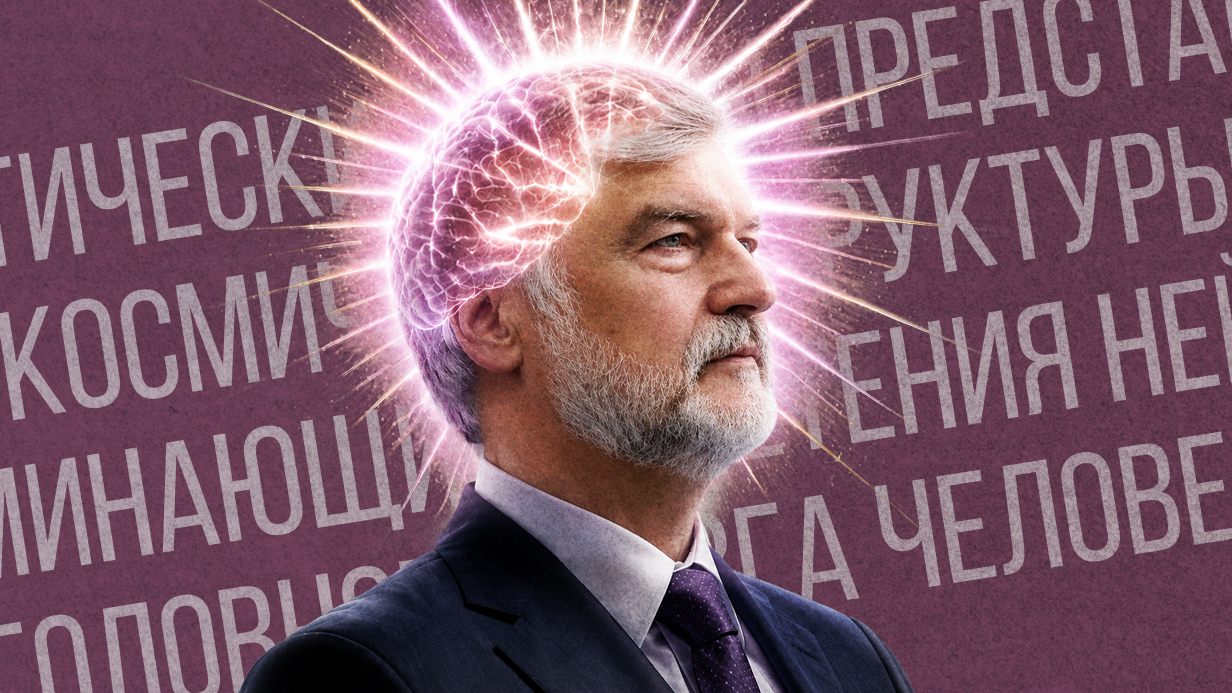
Andrei Klepach — one of Russia’s leading economists and a high-ranking economic official of the Vladimir Putin era — has published several academic works over the past six years that are packed with cosmist imagery. His drift into “energy-information cosmism” went unnoticed until Klepach was fired as chief economist of the state corporation VEB.RF — after he publicly offered a bleak assessment of Russia’s ability to compete with the West and with Ukraine. T-invariant traced the economist’s academic evolution into a cosmist and looked into the background of his mentor on the road “toward a cosmoplanetary civilization.” It also turned out that, even after Klepach’s dismissal, VEB.RF has no shortage of people developing alternative “theories of everything”: the “wave hypothesis of life,” the idea of a “Fifth Russia,” and a “noosphere economy.”
On the Way to Space-Planetary Civilization is the title [access to eLibrary requires free registration] of a monograph edited by Andrei Klepach and Vitaly Bushuev, who has been Klepach’s regular co-author for the past six years. Bushuev spent many years as a chief research fellow at the Joint Institute for High Temperatures of the Russian Academy of Sciences (JIHT RAS) and, in the 1990s, served as Russia’s deputy minister of energy.
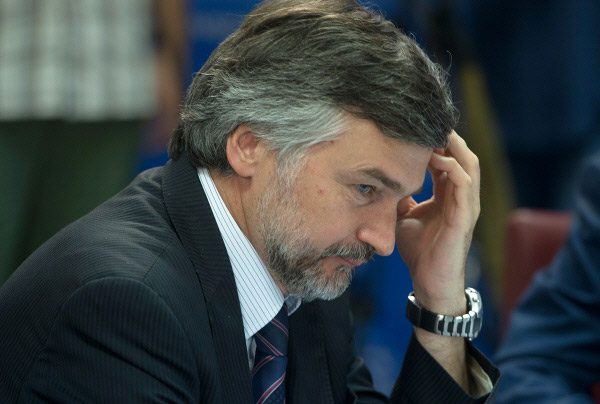
Research into the path toward a cosmoplanetary civilization, carried out by a team of authors from the VEB.RF Institute for Research and Expertise, leading institutes of the Russian Academy of Sciences, MGIMO University, and other respected academic institutions, may now be cut short: in August 2026, Andrei Klepach was fired from VEB.RF. According to media reports, Klepach was dismissed after a phone call from the Kremlin, following the uproar over a speech in which he described Russia as falling behind across the board. His words that spread most widely were:
We’re losing both the technological and the economic competition globally. And we’re losing it not just to China and the US — in some respects, we’re losing it to Ukraine, however unpleasant that is, even for me… In this war of attrition, we won’t win the competition…
After Klepach’s high-profile dismissal, many economists and business journalists recalled his professional expertise and his constant willingness to comment for the media. Soon, the outlet Sota pointed out that the economist and official, who from 2004 to 2014 served at the Ministry of Economic Development as a department director and then deputy minister, had put out publications speculating that life on Earth was brought by aliens.
After carefully studying Andrei Klepach’s publications, T-invariant concluded that once the COVID pandemic began, the economist — in parallel with his analysis of the structural and monetary factors of Russia’s economic growth, the sovereign economy, and macroeconomics — moved on to a broader level of generalization: together with a new circle of co-authors, he set out “to discern, beyond the current pandemic and military-political apocalypse, the future of our common cosmoplanetary civilization.”
The scale of the project becomes clear from the abstract of the 688-page monograph, published in 2023 by Energiya Publishing House — a now-defunct publisher co-owned by Bushuev, among others. Klepach himself wrote several chapters, the preface, and the conclusion. Two other employees of the VEB.RF Institute for Research and Expertise are also listed among the monograph’s 12 authors. Here is the abstract in full.
The collective monograph of the authors – representatives of various organizations, specialists in various fields of knowledge (economists and energy specialists, information scientists and sociologists) united a common desire to show that the general hype around global warming, the Covid-19 virological pandemic, and the world military – the political crisis in Ukraine, threatening to turn into the 3rd world war of the early 20s of the 21st century, is not an accidental phenomenon, not a “black swan”, but a natural transition from the former material dominant and the dominant of the unipolar world of social development to a new ideological models of eco-socio-humanitarian civilization. At the same time, the transition is considered as a certain regularity of the turbulent (wave) development of history. This periodicity connects cosmic phenomena, known in the ancient Vedic understanding of the world, with the cyclical nature of solar activity and its reflection in the socio-natural and political processes of human society. It is shown that the current reality also corresponds to the next 35th SA [solar activity] cycle, which, by analogy with the previous history, can be called the beginning of the formation of a “new thinking” and a new policy in the field of domestic and international problems of civilizational development. This new discourse is of particular importance for the formation of the pre-election programs of the leading world powers (USA, China and Russia) in the light of the expected renewal of their leadership.
The preface to the monograph was written by Andrei Klepach himself, as indicated in the “Authors” section. We quote it at length, with some cuts. It is the text of the preface that suggests Andrei Klepach at the very least shares all the core ideologemes of his new co-author, Vitaly Bushuev. These include not only Russian cosmism but also “ancient Aryan world-knowledge,” as well as the idea that life was brought to Earth by aliens from the constellation Ursa Major.
The authors, who include economists and energy experts, sociologists and political scientists, have attempted to solve (or at least to formulate in a well-grounded way) the foresight problem of a new post-COVID world of partnership and struggle between civilizations, using methods based on the turbulence of world history, the cyclicity of socio-natural processes and technological innovation, and the unity and commonality of the energy-information laws of the Earth and the Cosmos. The relationship between solar activity cycles and people’s social passionarity (activity) [a concept from Lev Gumilev’s theory of ethnogenesis — T-invariant] takes on special importance in our research… At the same time, we view Russia not as a crossroads between East and West, North and South of the earthly oikoumene, but as a bridge between the Earth and the Cosmos, from which we came and to which we are bound to return.
The structure of this collective monograph (and it is indeed a unified, coherent work rather than a collection of separate authors’ articles) encompasses both a statement of the global challenges facing humanity today on the eve of a new “apocalypse” and the grounding of a new metasystemic scientific and methodological approach to studying humanity’s natural habitat, as well as a figurative, goal-oriented vision of the new world that is being born before our eyes and will tomorrow become our common cosmoplanetary Home — Ecos (from the Greek oikos — house, dwelling place). Here we proceed from the premise that “Russian cosmism” is not our invention, nor even a philosophical term introduced by proponents of Eurasianism at the turn of the 19th–20th centuries, but our ancient Aryan world-knowledge, which has come down to us from the depths of the ages. The myths of many peoples of the world (not only the Slavs and the Aryans) have preserved the legend that people descended to Earth from various constellations of the firmament and brought into our world the common cosmic laws of existence that governed and still govern humanity.
We believe that the cause of the current crisis of human civilization may lie not on Earth but in the Cosmos. For man himself is a product of cosmic evolution, not earthly evolution. It is precisely by looking at our existence from cosmic heights that we can understand the true goals and essence of humanity’s development.
Honored Power Engineer, Energologist, Energy Cosmist
T-invariant analyzed Klepach’s profile on eLibrary and found that a lot has changed in the economist’s academic trajectory since 2020: first, Klepach developed an interest in “cosmoplanetary civilization” and the “energy-information cosmism of Russia”; second, he acquired a regular co-author — the aforementioned Vitaly Bushuev.
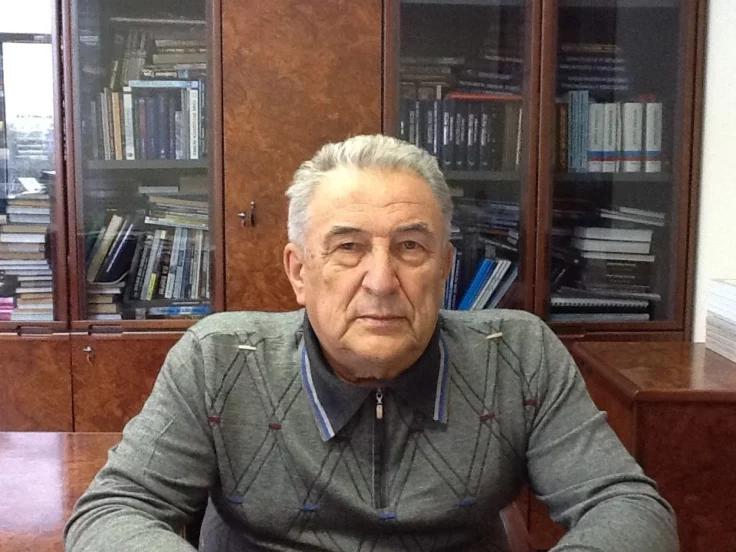
Bushuev is 86. He has more than 60 years of serious work in science and the energy sector behind him. He spent almost 40 years at the Siberian Research Institute of Power Engineering (SibNIIE) of the USSR Ministry of Energy and Electrification, was a People’s Deputy of the USSR serving in the Supreme Soviet, and in the 1990s built a career at the Russian Ministry of Fuel and Energy. Later, together with his former boss at the ministry, Yuri Shafranik, he founded a private company called the Institute for Energy Strategy. In addition, Bushuev worked for more than 10 years as a chief research fellow at the Joint Institute for High Temperatures (JIHT RAS).
Along the way, Bushuev also found his calling as a poet and writer. Back in 1998, the Moscow Power Engineering Institute (MPEI) published his book Energy Cosmism of Russia, which, in his words, “develops the finest traditions of the luminaries of Russian cosmism.” Over the nearly 30 years since, Bushuev came to the conclusion that his field of knowledge should be called “energology,” and he kept churning out texts on Russia’s energy cosmism, gradually shifting toward “cosmoplanetary development.”
In recent years, Bushuev has also taken up writing for children. His website, for example, features “WORLD-LORE (VEDAS FOR OLDER YOUTHS AND TEENAGERS),” later included in the short story collection The Olympiad of the All-Knowing. It was probably somewhere around this stage that the creative energies of Vitaly Bushuev and Andrei Klepach crossed paths. And Vedic themes, as it later turned out, surfaced in their joint works as well.
Top news on scientists’ work and experiences during the war, along with videos and infographics — subscribe to the T-invariant Telegram channel to stay updated.
2020. A New Noospheric World-System or a Break with Our Natural Cosmic Roots?
Klepach and Bushuev’s first joint paper was titled “Analysis and Forecast of the Cyclicity of Socio-Natural Phenomena in the First Half of the 21st Century.” According to the abstract, the authors, “drawing on statistics of anomalous socio-natural, political, and economic phenomena collected from various sources, treat all crisis events as manifestations of a certain cyclicity, largely driven by periodic processes of solar activity.” “In this article, the authors not only analyze the rhythm of these events in the past but also, using a specially developed neural model, forecast their cyclical manifestation for the coming period — up to 2030–2050,” the paper states.
The co-authors were Bushuev’s then-colleagues at JIHT RAS: Dmitry Solovyev and Vadim Sokotushchenko. The first pandemic year offered plenty of reasons to worry about the future, but the team of three power engineers turned “energologists” and one economist turned “energologist” also found grounds for optimism. Using cross-wavelet analysis and neural-network modeling (JIHT RAS has a supercomputer called Fisher for such tasks), the authors arrived at the following forecast: “The results of the comparative forecast of solar activity, temperature anomalies, and the US and Russian economies suggest that from 2020 to 2050 a calmer situation is expected both in economic dynamics and in the dynamics of climate change.”
The “Conclusions” section reveals that, at the time of writing, the planet was “at the end of the stagnant 24th cycle, which in 2020 is giving way to the new 25th solar activity cycle, with an expected predominance of a new political cycle in the development of world civilization.” And while the authors generally stuck to the scientific terminology customary for analyzing correlations between numerical series and for mathematical modeling, cosmological imagery creeps into the conclusions:
New global challenges are associated not only with the growth of the Earth’s natural energy activity, geopolitical confrontation, the “bubbles” of the virtual economy, and the transformation of the structure of global energy, but also with the growth of the Earth’s natural energy activity [sic], as well as the influence of the Cosmos, for which the Earth is a sentient grain of sand on the waves of the cosmic ocean. The overlapping and intensification of all these factors point to an impending change in the World-System in the medium term. To what extent is the human mind, embodied in machines, social ties, books, and now digital information systems, capable of adapting to these natural and cosmic changes? Will we create a new, renewed noospheric and cosmic World-System, or will modern civilization follow the path of a widening break with its natural cosmic roots? Finding the answers to these questions is the most important task facing humanity today and the key to its future.
2022. How the Star Ancestors of Russian Hyperborea “Fertilized” the Earth’s Film
The year 2022 disproved the forecast Klepach and his team had made in their 2020 paper about a relatively calm global situation in the new phase of solar activity. Russia launched its full-scale invasion of Ukraine, the confrontation between Russia and Europe, and the coalition of Western countries escalated, and new wars and conflicts broke out in various parts of the world.
In May 2022, Bushuev and Klepach released a text titled “Energy-Information Cosmism of Russia.” Russian civilization, the authors wrote, “occupies not only a special place in the history of Eurasia and the whole world, but also bears clearly pronounced features of a cosmoplanetary world. The hypothesis of the Aryan origin of many peoples of the northern continent (for all the debatable and controversial nature of various racial theories) confirms our special relationship with the cosmos as the ‘ancestral home’ of all russkie (by language) and all rossiyane (by spirit)” [ethnic Russians and citizens of Russia, respectively — T-invariant]. Bushuev and Klepach go on to quote Alexander Tulupov’s book The Clan of the North: Russian Hyperboreans, written in the genre of “Russian fantasy”: “Man traces his roots to his ancestors, but the roots of all that exists lie in the heavens”:
Nature (priroda), kinship unity (rodovoe edinstvo), homeland (rodina) — these are words sharing a common root, reflecting our deep essence, which goes back to the times of Arctida and Hyperborea… this is our earthly oikoumene, our habitat, our Eurasian home, “designed and built” according to cosmoplanetary laws and proportions. And Russia is what has come down to us as an inheritance both from the ancient cosmic settlers and from the pre-pagan tribes.
Another passage from the article is worth quoting — on how, in the authors’ view, this Eurasian Hyperborea came into being:
The earthly oikoumene… was settled by “migrants” from various star systems: the yellow race in Lemuria came from the constellation Leo, the black race in Africa from Sirius, and the white race in the polar expanses of Arctida from the Great Bear. It is no accident that this constellation (hyper — great; bor — bear) became our cosmic symbol, and the entire territory of the settled northern lands came to be called Hyperborea. These “migrants” did not fly to us on physical spaceships; they “fertilized” the Earth’s film holographically (in the form of plasma-like “angels”), giving rise here to a generation of intelligent Aryans. Representatives of the various races have preserved their original cosmic genes, inherited from their stellar progenitors.
Notably, this article was published in the journal Economic Strategies, issued by the autonomous nonprofit Institute for Economic Strategies, which is on the Higher Attestation Commission’s first-category list of peer-reviewed journals [the official Russian register of journals approved for publishing dissertation research — T-invariant]. By the time the article came out, Andrei Klepach had already been chief economist and deputy chairman of VEB.RF for eight years. He was also the academic director and chairman of the board of the VEB.RF Institute.
2025. Galactic Walls and Geotories in Space, Siberia, and the Far East
In recent years, Andrei Klepach has published several articles on the development of territories in Russia and, more broadly, in Eurasia. Among them was an entirely mainstream paper on spatial economics, “Space as a Factor of Economic Development,” which appeared in the Herald of the Russian Academy of Sciences in 2025. That same year, several publications came out on so-called “geotories” [a coinage from “geo” and “territory” — T-invariant] (see 1, 2). Klepach borrowed the term from his co-author Bushuev. To mark his 85th birthday, Bushuev released the six-volume series Energy of Russia (2025). In the sixth volume (Energy Cosmism of Russia), he published a chapter titled “Geotories as Earthly Analogues of Cosmic Structures,” in which he laid out a theory of how cosmic processes influence terrestrial phenomena, drawing on the works of the biophysicist and Russian cosmist Alexander Chizhevsky and the poet Velimir Khlebnikov (read it starting on page 393).
The cosmos and its objects, such as galaxies, stars, and planets, are characterized by vortex-like motions and structures. Galactic walls are cosmic structures resembling the interweaving of neurons in the human cerebral cortex. Vortices play an important role in the distribution of energy and matter in space, ensuring dynamic equilibrium and sustainable development. Spiral galaxies rotate in a vortex-like manner — for example, the galaxy M74 in the constellation Pisces, located approximately 30 million light-years (9.2 million parsecs) from Earth. Geotories can be viewed as “vortices” on the Earth’s surface, where natural resources and energy potentials are concentrated and redistributed. Like cosmic vortices, geotories ensure the cyclical use of energy and resources, supporting the economic and social development of the surrounding regions. Geotories play an important role in the infrastructural representation of Eurasia, since they are territories with special conditions for human life and activity. They are often remote and sparsely populated regions where access to energy, transport, and information links is limited.
From the Nooscope to the Noosphere Economy
At least two more people at the VEB.RF Institute for Research and Expertise took part in developing the theory of a “cosmoplanetary civilization.” What’s more, each of them has his own, probably competing, “theory of everything.” Both hold the title of advisor at the Institute.
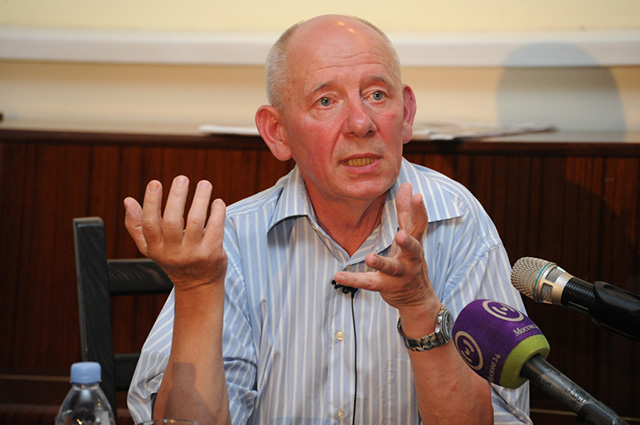
Oleg Dobrocheev, for one, has spent many years developing a “wave hypothesis of life,” and on top of that he offers his own concept of Russia’s development and a forecast of its future. The theory currently goes by the name “Fifth Russia,” and back in 2006 Dobrocheev published a book of the same title. On his website, Dobrocheev presents himself as a leading research fellow at the National Research Center Kurchatov Institute, lists numerous other titles, and makes a point of noting that he is the author of “seven books, a Calendar of Changes, and more than 200 articles on turbulence, history, and economics.” Most recently, he described his “wave” theory in an article in Nezavisimaya Gazeta in August 2026.
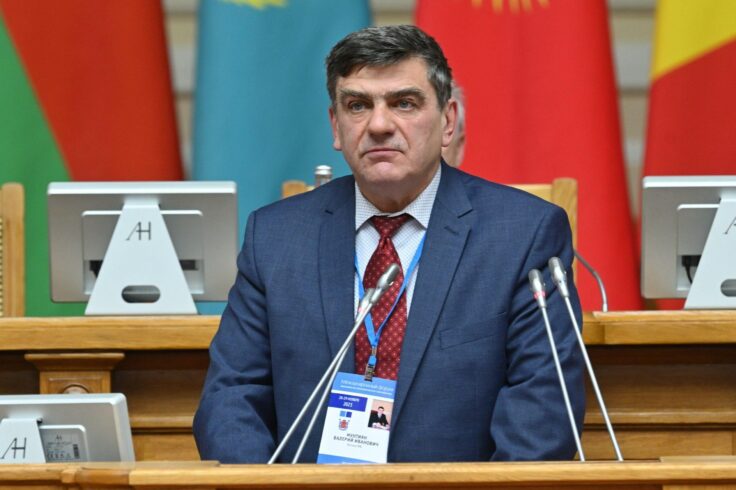
The other advisor, Valeriy Muntiyan, can’t match Dobrocheev in the scope of his theories but outdoes him in the scope of his career. Muntiyan is from Odesa and is even a corresponding member of the National Academy of Sciences of Ukraine. In Ukraine, he previously served as deputy minister of defense (December 2003–October 2004) and deputy minister of economy (2007–2009; his interview after stepping down can be read here). His main academic affiliation today is the Faculty of World Politics at Moscow State University, where he holds a professorship. In recent years, Muntiyan has been developing a theory of the noosphere economy; for example, two of his articles were included in a book published by Moscow State University in 2022.
The roles Dobrocheev and Muntiyan play at VEB.RF are unclear, whereas Andrei Klepach’s role in shaping Russia’s economic policy was far more visible for many years. In that sense, his drift toward alternative theories is genuinely a matter of public concern. That said, Putin’s entourage has traditionally included plenty of people who subscribe to pseudoscientific theories, among them Kremlin Chief of Staff Anton Vaino with his nooscope and Mikhail Kovalchuk, who has accused the West of creating “service people.”
Klepach (whose h-index in the RSCI core [the core collection of the Russian Science Citation Index — T-invariant] is 10) publishes articles and monographs featuring cosmist and “energological” theories alongside solid expert work in academic journals. And for at least six years, neither his colleagues in the academic community nor the leadership of Russia’s largest state corporation paid any attention to the economist’s drift into cosmism.
“Andrei Klepach belongs to the group of economists who, from the early 1990s, were critical of the liberal market reforms of that era. Unlike Soviet academicians (such as Leonid Abalkin and a few others), he didn’t try to argue with Yegor Gaidar and the other reformers in the media. He worked with numbers and tried to use data to talk to the people who were actually implementing economic policy,” says Andrei Yakovlev, a visiting researcher at the Free University of Berlin who served for many years as vice rector of HSE University, describing the economist. “In 1998, Klepach briefly became director of the Central Bank’s research department, and then, together with former Central Bank deputy chairman Sergei Aleksashenko, he founded the ‘Development Center’ economic research foundation. For a long time, it was an expert center independent of the state, including financially. It produced a huge amount of analysis that was in demand not only by the government but also by actual businesses. Aleksashenko was always a liberal, while Klepach leaned more toward dirigiste views, with a strong emphasis on structural and industrial policy, but he always considered the role of the private sector very important. And when Herman Gref invited him to the Ministry of Economic Development in 2004, arguing, ‘Well, you keep criticizing us — so come and try to implement your ideas here,’ Klepach joined the civil service precisely for that purpose — to do something for the country. As far as I know, he still commands great respect in industry, including the defense sector, because he really did try to do a lot of useful things. At the same time, he always argued with his bosses and said what he thought. Many people may not have liked that, but he was respected. He left government service in 2014 — the formal order was signed in June 2014, but, as was reported at the time, the decision had been made in March. I think it was connected with Crimea, since Klepach, who dealt extensively with the defense industry, was never a supporter of war. Nevertheless, VEB gave him a prestigious position as deputy chairman and board member. But he was always an awkward person to deal with: when something had to be decided, it was hard to ‘cut a deal’ with him, and so he was later shunted off to do research at the separately created VEB Institute. Klepach understood and spoke about the dead ends of the existing model a very long time ago — before the war and before COVID. And he raised them many times at internal government meetings, at the Nikitsky Club, and at similar expert forums — though never linking them personally to Putin. Still, he believed it was necessary to stay within the system in order to do something for the country — as was once the case with the ‘bourgeois specialists’ or ‘military specialists’ [prerevolutionary experts and former tsarist officers recruited by the Bolsheviks — T-invariant] in the 1920s, who worked for the Soviet government not for the sake of positions but for the sake of the country. It seems to me that his shift in worldview and his fascination with strange theories in recent years may be explained by the fact that understanding the dead ends of Putin’s system, together with the impossibility of doing or influencing anything, is exactly what led him to cosmism. It’s a purely psychological defense mechanism against being unable to change the reality around him.”
Up-to-date videos on science during wartime, interviews, podcasts, and streams with prominent scientists — subscribe to the T-invariant YouTube channel!
A T-invariant source who knows Klepach well and worked in the Russian government at the same time as he did, though in a different ministry, explains the transformation this way: “He’s basically a nerd, and has been since childhood. But in recent years, a lot of nerds have been stewing in their own juices — they’re not allowed into international [scientific] conferences. Nerds crave depth. But globally — they’re banned. So the nerds drift toward the fringe. The fringe, Dugin, and all that stuff — it becomes the only outlet for thinking people.”
“At the Ministry of Economic Development, Andrei Klepach was treated with respect. He had a reputation as someone willing to make sensible compromises but not willing to play the ‘yes, sir, whatever you say’ game,” recalls the head of one expert group who worked with Russia’s economic ministries for many years.
“How could such a drift have happened? Technocratic types, IT people, often lack a humanities culture. And the reverse is true too, by the way — humanities people may lack a mathematical culture. And technocrats like that sometimes don’t understand the simplest things in life. Every other one of them has these blind spots. Scratch a technocrat and you’ll find all sorts of surprises,” the T-invariant source reflects. “It’s just that Klepach is a public figure who has been speaking out for decades. Unfortunately, he was unlucky: he publicly waded into a subject he knows nothing about, and the result is fantastical nonsense. That makes you feel sorry both for him and for all of us, because our society hasn’t built barriers to keep such things from being published as ‘scientific findings’ at all, so that they stay in the inner worlds of people who lack competence in these areas and are uncritical about the limits of their own incompetence. It’s astonishing that people with intellect and professional expertise in their own field generate ideas and constructs based on primitive conspiracy theories and magical thinking. Outsiders who aren’t part of their circle can’t even imagine what delusional ideas often get voiced there. And if you express any doubt, they’re more likely to feel sorry for you: you don’t understand simple things — for example, that the cosmos rules us.”
In the source’s view, the Klepach phenomenon isn’t about his fascination with mythological cosmist ideas per se: “it could just as well have been conspiracy theories instead of harmless cosmos.”
“The phenomenon is that technocrats haven’t received a solid education and grounding in the humanities — and there’s no expert barrier to the spread of such texts and ‘ideas.’ Look at Western, especially American, higher education.
“At good universities, the liberal arts principle usually applies to undergraduate programs: students get their specialization but are also required to earn ‘credits’ outside their major. STEM students take humanities and social science courses, while humanities students take natural sciences and math. Klepach did study mathematics, of course, but a bit of critical thinking probably wouldn’t have hurt,” the T-invariant source believes.
What Do the Monograph’s Authors Themselves Say?
At the time of publication, T-invariant had not received comments from either Klepach or Bushuev, but did receive a brief comment from their regular co-author Dmitry Solovyev:
These publications were prepared at V. V. Bushuev’s request. My role was limited to designing the illustrations and technical editing of the text. The principal author of the concept and text of all these publications was V. V. Bushuev. As far as I know, these are popular science publications. Obviously, they are not used in the work of government bodies. I don’t know what A. N. Klepach’s role was; I don’t know him personally, but I think he is not the author of these works either. V. V. Bushuev included him among the co-authors for reasons of his own.
T-invariant has sent inquiries to the personal email addresses of Andrei Klepach and Vitaly Bushuev, as well as to the VEB.RF Institute and the press office of the state corporation VEB.RF, and is awaiting a response.
Update, October 9, 2026. The title and abstract of the monograph On the Way to Space-Planetary Civilization have been replaced with the authors’ own English translations.