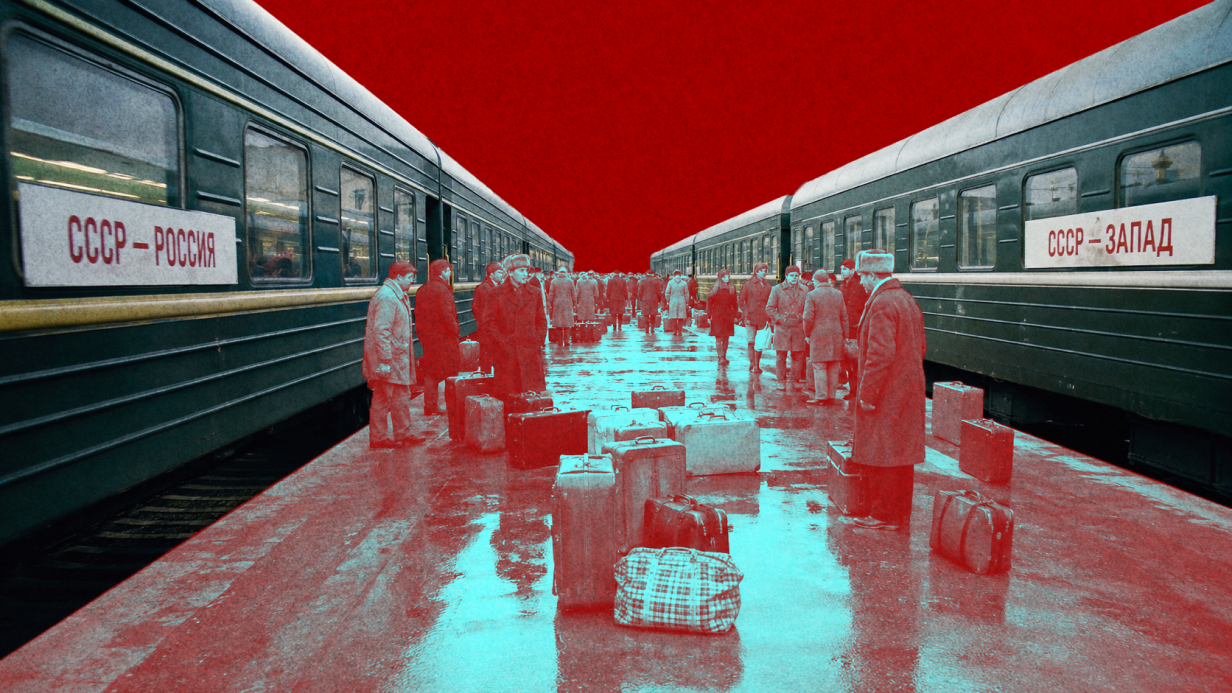
Exactly 35 years ago, on August 21, 1991, the coup attempt by the self-proclaimed State Committee on the State of Emergency collapsed. The Soviet Union itself had four more months to live, but after those three days in August, a completely different life began for millions of Soviet citizens. The changes touched everyone, but scientists were among those whose old lives fell apart especially fast — and on the ruins, new ones began to take shape. Institutes were left without money or staff, and entire fields of research lost their funding. Yet at the same time, the borders opened, and it became possible to work at universities and research centers abroad. Some left for a few months and never came back; others emigrated right away. How did these scientists discover the world of Western science? What did they have to go through? What did it cost them? And why did a temporary departure turn out to be permanent for so many of them? T-invariant presents the stories of how they left and the new lives they built.
How to avoid becoming a professor’s mistress, survive impostor syndrome despite your success, and bring Soros to Russia
As told by Tatiana Tatarinova, professor of computational biology at the University of La Verne. She is known for her work in plant genomics and genetics, as well as in medical and population genetics. She holds a black belt in karate and is also a scuba diver, poet, songwriter, and rescuer of stray dogs.
I graduated from MEPhI [Moscow Engineering Physics Institute — T-invariant] in the early ’90s. My mother worked in the defense industry, on radar systems for detecting missiles in flight. Her job was considered prestigious: a huge research institute and plant, NIIDAR, on Preobrazhenskaya Square. But in those years, almost the entire plant was leased out as warehouses and retail space. Out of the whole NIIDAR building, the scientists were left with exactly one floor, just so the institute wouldn’t formally lose its research status; everything else went to offices and banks. It was utter devastation: a hideous, filthy restroom with no water or toilet paper, a hellish stench, and three ladies on the verge of retirement who simply had nowhere else to go. That was the state of virtually all of Russian science back then. Some people, of course, managed to land European grants, but corruption was rampant. Through my work, I once came across a nuclear energy project. I was offered a side gig, and I took it. But they told me point-blank: “We’re putting you down for a salary of $1,000 a month, but you hand two hundred of it back to us in cash.” A kickback! The corruption was absolutely shameless. Naturally, I told them where to go, using every colorful word the Russian language has to offer. There’s no way I could have lived and worked in a system like that.
Back then, though, Western universities were happy to take Russian students: if you were from Russia, you weren’t even asked to take exams or prove your English. Nothing at all was required. You could show a clumsy translation of your diploma certified by the dean’s office, and that was enough to get a full scholarship. It was believed — and perhaps rightly so — that our education, at least at MEPhI and other strong universities, was very good. On top of that, we studied for six years, so when applying to grad school we were competing with people who had only a four-year bachelor’s degree behind them. Naturally, we knew a lot more. We were readily hired to lead recitation sections and lab classes and to grade homework: in terms of preparation, we were two years ahead of the local students. It wasn’t even that our education was “better” — it was just different. We didn’t have the Bologna system yet, and our programs didn’t include general education courses (as in the US) either.
So in our fifth year at MEPhI, a real craze took hold: practically our entire class was writing to American universities, getting several offers each, and picking the best ones. At the same time, I applied for a Soros Foundation fellowship and got it. The fellowship covered a plane ticket to the US and a year of health insurance. But then something pretty wild happened to me. By that time, people were buying passports for foreign travel left and right through shady outfits. I was afraid to do that, since I was a very law-abiding girl. So I went the official route, through MEPhI’s First Department [the security office found at every Soviet institution that handled classified work — T-invariant]. Back then, you needed permission to get an exit visa and a passport. And suddenly MEPhI tells me they won’t let me leave!
I went to the head of the First Department to sort it out. And he says to me: “How can we let you go? What if you start working as a prostitute over there?” I was offended to the core! My mother was an ordinary engineer, my parents had divorced when I was three, and my father had nothing to do with me. For all four years at the institute, I wore the same single pair of jeans and a sweater made of dog hair. And honestly, I reeked of dog, because my mom knitted those sweaters from the fur of our Newfoundland, and that dog was incredibly smelly. So there I am, standing in front of him in that sweater, and he’s holding forth on my “potential” as a prostitute!
Then I thought: What if I went somewhere other than America? I wrote to various places and got an invitation from South Africa. It seemed like a good option: the professor there was originally from Russia, and he wrote directly to our dean’s office asking them to send me to work with him. That did the trick. The First Department couldn’t do anything against a direct official request from a foreign university — they could hardly tell the university I was going to become a prostitute. But when I arrived in South Africa in 1992, it turned out that the professor and I had completely misunderstood each other. After a while, he told me flat out that what he needed wasn’t a Russian grad student but a Russian woman. Absolutely insane! In the end, I switched to another professor, but my entire stipend, which had been paid out of the lecherous professor’s funds, went up in smoke. I had to scrape by on a tiny salary for teaching lab sections, and in the evenings I moonlighted as a singer in a restaurant. I sang there for six months.
Meanwhile, I got in touch with the Soros Foundation, which had earlier given me the fellowship for the ticket to America. I asked whether my fellowship would be reinstated if I moved to the States. They assured me it would. I wrote to the American university in Salt Lake City that I had turned down before and honestly admitted: “I hope your department will take my word for it: I’ve suffered at the hands of an evil regime here and have decided to come to you.” They didn’t really believe me, of course, but they took me anyway.
That’s how I ended up in grad school at the University of Utah. We had a terrific group, including several people from Leningrad Polytechnic. And then I hit a crisis. It probably happens to almost every grad student: I was overwhelmed by impostor syndrome. I felt dumber than everyone around me. It didn’t even help that in my very first year, I managed to publish a paper in one of the most prestigious physics journals. I still considered myself talentless. I was comparing myself with people who had been in grad school for several years and, before that, had worked on the same topic in Russia. Naturally, they knew more than I did. Unfortunately, there was no one around back then to support me and explain this, and I fled back to Russia. I defended my master’s thesis in the US and left.
After returning to Moscow in 1995, I got a job on projects run by the CDC (the US Centers for Disease Control and Prevention) and the World Health Organization (WHO). I worked as their regional representative. I didn’t find that position right away: first, I spent several months as a secretary for a Turkish businessman. Then he sent me along with his pregnant mistress to see a gynecologist. I was supposed to make sure she got an abortion. I was mad as hell, but the girl simply needed someone to support her. While waiting for the appointment, I got talking with a young woman from an employment agency and told her I didn’t want to work for that a**hole anymore. She gave me her work number and asked me to call in a week. And a new job came through! I was one of the people who helped Alex Goldfarb during George Soros’s visit to Moscow and organized training programs for Russian scientists. We also brought over American research teams to teach our compatriots Western standards in biostatistics and modern disease reporting. There was a joint CDC–WHO project to study tuberculosis. The topic mattered a great deal to America as well. In the US, tuberculosis was found in high concentrations only in poor neighborhoods of New York. So the Americans looked for “Third World” countries where tuberculosis was rampant and studied it there. In Russia, especially in prisons and among the homeless, the epidemiological situation at the time was critical. That was the beginning of the notorious “biolabs” [a nod to the Russian propaganda narrative about secret US biological laboratories — T-invariant].
I organized those projects, but after a while I found myself desperately missing pure science. During one of my business trips to the US, I simply walked into the University of Southern California (USC). The Human Genome Project was underway, and USC scientists were among the pioneers of bioinformatics. I went to their math department and said straight out: “I really want to study with you — please take me.” To my utter astonishment, by the time I got back to Moscow, a letter was already waiting for me with an offer to join their PhD program on a full scholarship. Can you imagine? I just walked in off the street, had a conversation, and they took me. It was pure luck!
That’s where I earned my PhD in applied mathematics, and then I went to work, first at a biotech startup (Ceres, Inc.). When its funding ran out, I returned to academia. I worked at Loyola Marymount University first, then moved to the UK, to the University of South Wales (formerly the University of Glamorgan). After that, in 2012, I came back to the US, spent four years at USC, and then was invited to take an endowed chair at the University of La Verne. There’s practically no equivalent of this position in Russia. It’s when a major foundation earmarks money for a specific professor, and that money pays their salary and funds their research. I was offered the chance to head the Computational Biology Laboratory, which I’ve now been running for nine years. So that’s my path.
I never had much desire to return to Russia. I went back for conferences, and in the early 2000s I had the persistent feeling that Russian science was catastrophically behind. For example, I was once asked to give a lecture on “the latest in science” about a technology that at our American startup we considered routine — outdated, even. Funding was so meager that basic microarray gene expression analysis, which any second-rate university in the States could do, was something few in Russia could afford.
I saw how my colleagues who had stayed in Russia struggled: dreadful working conditions, professors without even their own lab benches, several people crammed into a single office. And how is an experimentalist supposed to work without money for reagents and equipment? Mathematicians can still write formulas at their dachas with nothing but pen and paper. But experimentalists constantly have to humble themselves, beg for pennies, and plead for permission to buy every single consumable.
Things started to improve during the “changing of the guard” between Putin and Medvedev. That’s when Skoltech [the Skolkovo Institute of Science and Technology, a research university near Moscow founded in 2011 in partnership with MIT — T-invariant] appeared. I was working at USC at the time, and Skoltech representatives came to us trying to persuade faculty to go work in Russia. I went. We organized an international conference on the human genome at Skolkovo, launched joint projects, and I genuinely loved it! I started getting invited on expeditions to study the small indigenous peoples of Siberia, and I began working closely with Russian universities and giving lectures. I became an associate professor at Siberian Federal University (SFU), supervised grad students at the Institute of General Genetics of the Russian Academy of Sciences and at SFU, and lectured and advised thesis students at MIPT [Moscow Institute of Physics and Technology — T-invariant]. It was all wonderful, because back then good money was being allocated under Project 5-100. Universities needed ideas, world-class advisors, and publications — and we delivered all of that. And this whole wonderful story ended in a single day, when the war began. I was fired from everywhere almost instantly, and quietly at that — no one even bothered to tell me. I never received any official paperwork. They just deleted a line on a website, and that was that.
It was actually pretty funny: I was lecturing at MIPT, and after the war started, I made a point of appearing on Zoom with a Ukrainian flag behind me. Word got around to SFU. For some reason, they decided I had been lecturing their students in front of that flag, even though I wasn’t teaching any classes at SFU that semester. Nevertheless, they cooked up a collective complaint on behalf of “offended students” who had supposedly been insulted by the Ukrainian flag in my background. A total circus. I found out I’d been fired by accident: they had been paying me some token base salary, and six months later I simply noticed that the transfers to my Russian bank account had stopped.
A couple of years ago, I went to Moldova and Romania to lecture, and there were lots of students from Ukraine there. They asked me point-blank: “Why did you keep going to Russia and lecturing after 2014?” I told them: “Guys, what kind of neighbor do you want next door? A wild, ignorant one who ‘charges’ water in front of the TV [a reference to late-Soviet televised faith healers who claimed they could imbue water with healing power through the screen — T-invariant], or an educated one who understands how the world works, doesn’t want any war, and shares basic humanist values?” They thought it over and agreed: “Yes, of course, we need educated and kind neighbors.”
That’s why I kept going. It was real, live human contact. Right now there’s an enormous amount of mutual misunderstanding, but I believe that we — the professors who came to Russia with ideas and lectures — simply didn’t finish the job. We should have stepped in sooner, spoken up louder, and pulled Russian education out of the hole it had fallen into. I don’t know whether we could have changed anything on a large scale. But if instead of a handful of enthusiasts there had been a whole army of scientists who cared, maybe no tanks would have rolled into Ukraine.
How to shed the sack in the sack race, bomb your first interview, and still land your dream job
As told by Eugene Koonin, senior investigator at the National Center for Biotechnology Information, part of the National Library of Medicine at the US National Institutes of Health. A renowned expert in evolutionary and computational biology, he has the highest h-index of any scientist of Russian origin: 256.
In the late 1980s, being a passive and not particularly brave person, I didn’t even think about leaving. It was too much hassle: the complicated exit paperwork, trips to district Communist Party committees, and so on. But once those barriers disappeared, conferences started happening right away, contacts emerged, and with them came the idea of going to work for a while somewhere real science was being done. My first serious trip abroad was to the International Congress of Virology in West Berlin in August 1990. It was an interesting time: the Wall was coming down, and you could walk up and chip off a piece as a souvenir. But far more important, I got to meet serious researchers from the US. Because my work involved computer analysis, we managed to do some joint research literally on the spot, without even leaving the poster stand at the congress.
As a result, I was invited to come work with them for four months. I spent the spring of 1991 in Texas, in the middle of nowhere, at a university right in the center of the state. Despite considerable everyday hardships and a lack of money, I liked it. There was meaningful, fairly serious work, cleanliness, order — and lots of good, varied food, which turned out to be affordable even given how poor I was at the time. All of this made a very strong impression on me. The mood around me was optimistic: the Gulf War had just ended in victory.
The access to information was striking, too. This was before the internet. In the Soviet Union, nothing came easy. It was a kind of “sack race”: you could accomplish a lot, but always late and only after overcoming obstacles. American science struck me as the same race, only without the “sack.” Everything happened on time and without needless obstacles. Submitting a paper to a journal was very easy, even though everything was still done the old way, on paper. It was no problem at all to read something published the day before, and your own manuscript could reach the editors the very next day.
Of course, contact with colleagues mattered too. Although on that first trip, my professional networking wasn’t going all that well yet. And not because I couldn’t speak English. As I said, this was the pre-internet era, and building connections beyond your own university wasn’t easy. Still, I got very lucky. During that trip, I came across an announcement in a scientific journal about the launch of a new center for computational biology. It was the National Center for Biotechnology Information (NCBI) at the NIH (the US National Institutes of Health). A little later, I read a full-fledged research paper — one of the first published by its staff. The paper was really good; I liked it a lot. And I thought the place seemed tailor-made for me. That impression proved decisive. I overcame my natural shyness and wrote to that very center. I asked some scientific questions, offered my services, and attached my CV. They were immediately interested and invited me for an interview. It went extremely badly for me, because I didn’t know how to give a talk. Had it gone well, they would have offered me a permanent position right away; instead, I got a two-year temporary contract. Still, that was enough to get started.
You can’t go back to the country I left — it simply doesn’t exist anymore. I don’t even consider crossing the Russian border (like other members of the Anti-War Committee, Eugene Koonin faces a criminal case opened against him in Russia. — T-invariant). And, forgive me, but why would I leave a place where I have rewarding, well-supported work and a normal life? For a while, the new Russian regime was relatively “vegetarian” [a Russian expression for a comparatively mild regime — T-invariant] and made some attempts to develop science. The situation during the “Medvedev thaw” wasn’t all bad or hopeless. The megagrants [a government program launched in 2010 to bring leading scientists to Russian universities — T-invariant], for all the system’s flaws, were a decent idea. But I never felt any desire to take part. After Medvedev, though, after that abomination that came to be known as the “castling” [the 2011 Putin–Medvedev job swap, named after the chess move — T-invariant], everything went to hell. Science and everything else.
How to split $1,000 among 30 employees, win a lawsuit against a corporation, and launch a scientific career in the US
As told by Alexander Kabanov, distinguished professor and director of the Center for Nanotechnology in Drug Delivery at the UNC Eshelman School of Pharmacy, University of North Carolina at Chapel Hill, and co-director of the Carolina Institute for Nanomedicine. He specializes in the delivery of drugs and other biologically active compounds using polymeric nanomaterials.
I graduated from the Faculty of Chemistry at Moscow State University (MSU) in 1984. By then, the war in Afghanistan was in full swing, and the Soviet Union was gradually heading toward collapse. But apart from Andrei Amalrik, who fifteen years earlier had written his prophetic (and therefore banned in the USSR) essay Will the Soviet Union Survive Until 1984?, few people realized it. I finished my Candidate of Sciences dissertation [the Soviet equivalent of a PhD — T-invariant] extremely fast: I had everything done in a year and a half, and a little over two years in I had already defended. My advisor, Karel Martinek, an outstanding physical chemist and Lenin Prize laureate who by then had already moved to Czechoslovakia, kept pushing me to hurry. After the defense, I wanted to stay at MSU. According to Karel, they were bound to keep me: I had been a Lenin Scholarship recipient both as an undergraduate and in grad school. So I was counting on a junior research fellow position in the Department of Chemical Enzymology, where I had studied.
Unfortunately, just a week before my defense, Ilya Berezin, a corresponding member of the Academy of Sciences who headed the department and was my main boss, died suddenly. I defended my dissertation successfully, but all of a sudden there was no chance of staying in the department as planned — there was no one left to go to bat for me. At the time, Moscow’s Communist Party boss was Boris Yeltsin, who had just launched an aggressive campaign against cronyism and nepotism. And my father, Viktor Kabanov, was a very well-known scientist who headed another department in the same Faculty of Chemistry. But he and I had firmly agreed that he wouldn’t intervene or put in a word for his son. So, thanks to Yeltsin — and I really should thank him for this — I started looking around, and that shaped the rest of my scientific life.
My father advised me to go see Evgeny Severin. He ran a large institute built partly on the ruins of Lev Piruzyan’s scientific empire. The institute reported to the USSR Ministry of Health and was overseen by the ministry’s Third Main Directorate [its classified division serving the defense and nuclear industries — T-invariant]. They did top-secret work there. It was a restricted-access facility, with KGB men carrying submachine guns at the entrance. But Severin was eager for scientific novelty and international recognition, and he tried to hire young, open-minded people. Interestingly, the KGB didn’t even bother vetting me. They said: “No point checking him out — we know everything about that family.” My father, on the other hand, really had been vetted at the very highest level because of his position and his security clearance. He didn’t work at that institute, but he and Academician Rem Petrov sat on the relevant national scientific council.
So I went to Severin, and he hired me on the spot as a lab head. It turned out that a talented young scientist from the Serbsky Institute [Moscow’s leading center for forensic psychiatry — T-invariant], Vladimir Chekhonin, later a full member of the Russian Academy of Sciences, had been using a technique from my undergraduate thesis in his own research. His work was built on a chemical modification of proteins (specifically, antibody fragments) that I had proposed, which allowed them to penetrate directly into the brain. At the time, this looked like a phenomenal breakthrough: delivering drugs across the blood–brain barrier. I didn’t even know about it, but Severin’s institute had already heard. That’s how I became the first — and nearly the only — employee at that institute without a security clearance. It was there that I met the man who would be my closest friend for many years (sadly, he has since passed away): Valera Alakhov.
Valera showed up to our first meeting pretty drunk and several hours late, while I waited patiently for him. I didn’t know then that he’d gotten married the day before — for the second time — which was why he was late. So there we sit: him rumpled and not entirely sober, me all dressed up in my only wool suit and a tie. At first we couldn’t stand each other, but eventually we started working together and became best friends. Valera played an important role in the story of how I left, and in my life in general. And I in his.
Soon, Yuri Kuzyakov, dean of the MSU Faculty of Chemistry, was told that I was leaving for Severin’s institute. Let me stress again that my father and I hadn’t asked for anything. But the faculty had known me since my student days — I was top of my class. With such a legendary father, I simply had no choice. In fact, in all my years of study I got only one B, in military training, because I forgot the words of the military oath. It meant absolutely nothing to me, so I started going around in circles repeating some phrases, and they slapped me with a B. The faculty leadership declared: “We can’t let him go. He was a Lenin Scholarship recipient as a student and in grad school — he’s our number one.” And they immediately created a junior research fellow position for me in the Department of Chemical Enzymology. After Martinek left, the lab was headed by Andrey Levashov (who at the time was still just a Candidate of Sciences). So I became, at the same time, a junior research fellow at the MSU Faculty of Chemistry, where I still had my own grad students, and a half-time lab head at the Institute of Applied Molecular Biology of the USSR Ministry of Health. There, I was immediately put in charge of several people.
The atmosphere at the Health Ministry institute was amazing. I was the youngest lab head; the next youngest, Kolya Porodenko, was only two years older. A whole constellation of talented young people had gathered there, mostly from MSU. They were tackling extremely hard problems, and I was basically told: “Well, go ahead, work on delivery.” So I started working on what would later be called nanomedicine and targeted drug delivery. For about two years, it was all very generously funded. We had all the cutting-edge equipment we could dream of. I had never worked closely with biologists and physicians before, and now they let me loose like a fox in the henhouse (in a good way): whenever an idea came up, we put it into practice right away.
Back then, we came up with things that shaped the field for decades. Nowadays, whenever I’m nominated for something, people always mention that it was in those years that I came up with the idea of using polymeric micelles to deliver drugs to the brain. We did that work together with that same scientist from the Serbsky Institute, Volodya Chekhonin, thanks to whom I ended up at Severin’s. I’m enormously grateful to him. Around the same time, by the way, my father and I came up with polyplexes — complexes of DNA with polycations. Shortly before us, several groups around the world had used a natural polycation, polylysine, linked to protein ligands, to deliver DNA into cells via cell receptors. Without yet knowing about that work, we showed that synthetic polycations can form nanocomplexes with DNA that deliver it into cells and allow it to be expressed there without any receptors at all. Today this is one of the most widely used approaches for delivering nucleic acids into cells, alongside the lipid nanoparticles that underlie modern RNA vaccines. Back then, in the late 1980s, we had a real explosion of discoveries. But because we lacked experience in modern biology and didn’t know how to publish internationally, we ended up in lower-tier journals than these results deserved. If we had been promoting this work in the US, with access to the top journals, it would have been a worldwide triumph. But it was still very cool.
I became head of a department and in 1990 defended my Doctor of Sciences dissertation [Russia’s higher postdoctoral degree — T-invariant], just three years after my Candidate of Sciences. That same year, I went to America for the first time and began traveling abroad in general: the Pasteur Institute in Paris, an AIDS conference in Switzerland, lectures and seminars in Germany… That’s when I realized that people in the West are a lot like us. As a product of the Soviet system, I used to think I could never survive in the capitalist world with its brutal laws of competition. But now I realized: I think I can.
It looked like a bright future lay ahead. I was a laureate of the Lenin Komsomol Prize [a prestigious Soviet award for young scientists — T-invariant], the youngest Doctor of Chemical Sciences in the USSR, and a welcome guest in many academic offices. But the system was coming apart at the seams. Until the very end, I believed I had a duty to stay in my homeland. By the time I defended my doctorate, absolutely everything had vanished from store shelves. In December 1991, the Soviet Union ceased to exist. And shortly before that, Valera Alakhov had gone to Canada on a research fellowship. I don’t know how on earth they let him out, with the pile of security clearances he had — but the security apparatus was already breaking down.
And in these hard times, I’m running the department Severin used to head. I have three labs under me, about thirty people in total. One day Severin and I are sitting there drinking tea, and he says, matter-of-factly: “Sasha, keep in mind: starting January 1, we won’t have any money at all.” At first I didn’t take it seriously, but sure enough, one day the thirty people working with me were left without a penny.
Shortly before that, in the fall of 1991, Valera wrote to me from Canada that a Canadian businessman of Russian origin named Oleg Romar was coming to Russia. He wanted to adopt two children from an orphanage — a brother and his little sister — and was looking for access to official channels and medical support through our institute. Those were murky times, and Oleg badly needed people he could trust. We met and instantly became friends (we’re still partners today). The first place he brought the adopted children was my apartment. The kids were miserable and frightened; they came from a family of alcoholics. They had been treated horribly since birth. It shook me to the core. Oleg and his wife, Isabella, made a deep impression on me too. They went on to raise the children safe and sound in Canada.
Of course, Oleg and I also talked about science and my work. Eventually, those conversations gave rise to the Moscow Institute of Biotechnology. Oleg sent money from Canada, and I distributed it among our staff as grants. In 1992, I was splitting roughly $1,000 a month among thirty people. That came to about $30 per person on average, but I weighted each share by the person’s contribution. In those hungry times, it was an incredible, lifesaving supplement to people’s salaries. The idea of attracting Western investment for our discoveries had come up even earlier. In December 1991, on my way home from New York, at Oleg’s insistence, I met with a leading biotech expert, Pradeep Banerjee, who was then working in Manhattan at Coopers & Lybrand Consulting. After talking with me for an hour, Pradeep gave Oleg a glowing assessment of our work. About me, he said: “This guy will find a job anywhere.” Oleg, Valera, and I decided to start a company in Canada. I was supposed to go to Canada for a year to help Valera set up a base lab, while the main research, as we planned at the time, would continue in Moscow.
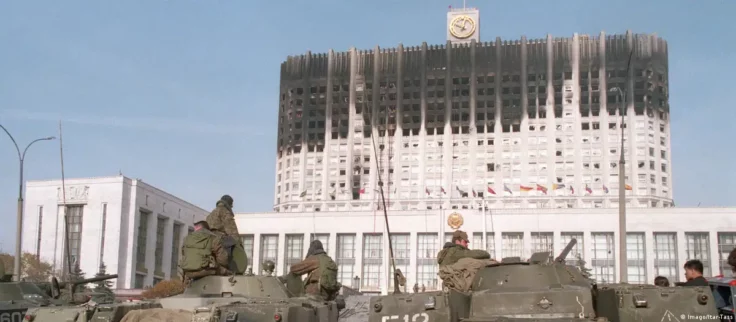
In the spring of 1993, just before I was due to leave, a severe political crisis erupted in Moscow. Khasbulatov [Ruslan Khasbulatov, then speaker of the Russian parliament — T-invariant] and Yeltsin were going at each other on television, and civil war was in the air. My wife, Tanya, was pregnant. Oleg called me: “Sasha, take Tanya and fly out right now. If she gives birth in Moscow, you won’t be going anywhere.” I walked around that eerie, seething Moscow, went to see my father, and said: “Dad, you know… I think I may never come back here.” My father was very upset, even hurt: “How can that be? We supported you and Valera in everything here, and now you’re not coming back?” Back then I had a silly, grandiose notion stuck in my head. After all, by birth and talent I had been given a great deal. And I believed that if I were going to leave, I had to be the last to go, after everyone else had been saved. But in the end, our daughter Dasha was born in Canada a month after we arrived.
We lived very modestly, on the edge of poverty. It turned out that the lab we were setting up had no real money. On top of that, a conflict broke out between Oleg and the board of directors of the Canadian medical association he chaired, which had originally invited us for the project. The conflict wasn’t about us: at its core was the sale of another company the association had created. Enormous sums were at stake, by the standards of that time and even today’s. They tried to use us. In the course of the conflict, representatives of the board came to Valera and me and asked us to testify against Oleg so they could accuse him of a conflict of interest — claiming he had illegally used his position as chairman of the association’s board. In exchange, they offered to hand over, at last, the million dollars that had long been promised for the lab’s work in Canada. We told them where to go. Politely but firmly. And after that, a real war against us began: they declared that everything we had invented belonged to them, tried to strip us of the rights to our own technologies, and tried to block us and Oleg from developing those technologies in North America. It was tough — our own lawyer was apparently working for them. We had no money. But we managed to find another lawyer who agreed to take our case on contingency. His name was Pierre Fournier. He was a tough guy, and when we told him our story, he said our rights had been violated. Within just a few months, he actually won an arbitration on one key issue. But the fight went on.
As things turned out, I was the one who took responsibility for our decisions in this fight. Of course, I consulted Valera on everything. It was a life-or-death battle. There I was with a baby, no salary, living on $100–200 a week in borrowed money. In October 1993, leaving my wife and six-month-old daughter in Montreal, I flew to Moscow on business, right in the middle of that October’s political crisis. I even wrote a poem about that time: “A strange specter is haunting the town, / While all Russia lies cowering, trembling; / Over crowds, a pretender self-crowned / Urges all to advance on the Kremlin.” [a reference to Alexander Rutskoi, whom the parliament had declared acting president — T-invariant]. I thought I wouldn’t be able to get back to Canada. I made it back.
A few months later, my father flies in to see me in Montreal. We’re sitting in the kitchen, we open a bottle of vodka, and I say: “Dad, I’ve made a decision. I’m not going back to Russia. I’m going to look for a professorship in the US.” I was bracing myself for his reaction. And my father exhales: “Sasha, what a relief… I didn’t know how to tell you that you must not, under any circumstances, come back to Russia.” In fact, my father understood where things were heading much earlier than I did, and he accurately predicted what Russia would become today, even though he’s been gone for twenty years now.
But back to the early ’90s. Soon we settled all the litigation, secured good funding, and founded our first pharmaceutical company, Supratek Pharma. It was the world’s first company to begin clinical use of polymeric micelles for delivering anticancer drugs. Valera became its vice president of research, and I became a consultant. Even earlier, I had landed a professorship at the University of Nebraska Medical Center in Omaha and begun my academic career in the US.
The early ’90s were the hardest period of our lives. The stress of the Canadian lawsuit gave me a stomach ulcer, which a few years later nearly killed me: I started bleeding heavily right on a plane over the Atlantic. For ten days I hovered between life and death in a New York hospital. But having gone through that hell — no money, in a foreign country, locked in a legal battle with the association — I realized that I now stood entirely on my own. After all, my father couldn’t help me in any way: not in a Canadian court, not in getting hired by an American university, not in my later career. That sense of independence meant a great deal to me.
After that, things took their natural course. I built a successful career in the US, created the country’s first nanomedicine research center, and organized the first international conference in the field, which has now been running for a quarter century. I’ve trained nearly a hundred grad students and postdocs, and more than twenty of them have become professors. I hope the best is yet to come.
How to make a KGB colonel stand at attention, change American law, and become the first US professor who was still a citizen of the “Evil Empire”
As told by Sergei Mirkin, biologist and endowed professor at Tufts University. He is known for his research on the structure and function of DNA, in particular on how genomic instability caused by repetitive DNA sequences and by collisions between transcription and replication contributes to human genetic diseases. He has received a number of prestigious scientific prizes and awards.
Truth be told, I should never have been allowed out of the Soviet Union. I was completely barred from traveling abroad. That lasted until 1988, when perestroika really picked up speed. And as luck would have it, just before that, Viktor Lyamichev, Maxim Frank-Kamenetskii, and I had discovered a new DNA structure called H-DNA — a form of DNA in which three oligonucleotide strands wind around one another to form a triple helix. We published two high-profile papers in Nature, in 1987 and 1988, and I was first author on one of them. At the time, I didn’t even fully grasp what it meant to be first author on a Nature paper. And at around the same time, thanks to the efforts of our Czech colleague Emil Paleček, I was allowed to go abroad for the first time — to Czechoslovakia.
I worked there at the Institute of Biophysics in Brno. An international conference was taking place at the same time, with lots of American scientists in attendance. It was the first time I’d ever seen Americans in the flesh. As I now realize, many of them were assistant or associate professors — roughly the equivalent of a docent in our system. In other words, they were still a long way from being luminaries of American science. And they all started telling me, “What are you fooling around for? Start looking for a job in America or Europe right now.” I was very surprised, because the Soviet system worked completely differently: a person was born, lived, and died in the same city, joined a lab, and worked there at least until their advisor died. And then, with any luck, they became lab head themselves.
One of these young scientists, Terumi Kohwi-Shigematsu, said, “Why don’t you come work in my lab for a little while and see how everything works?” She arranged an invitation for me through the National Institutes of Health (NIH). At the time, she was working at the La Jolla Cancer Research Foundation, in the northern San Diego suburb of La Jolla. She set up the invitation through the Fogarty International Center, which operated under the NIH umbrella. And in late 1988 or early 1989, the invitation arrived. Keep in mind, the Soviet Union still existed, with its entire bureaucracy intact. The NIH’s partner in the Soviet Union was the Ministry of Health. But I worked within the Academy of Sciences system, at the Institute of Molecular Genetics of the USSR Academy of Sciences. The two were completely separate worlds that had nothing to do with each other. The Ministry of Health minded its own business, and the Academy of Sciences minded its own. Still, I sent my paperwork to the Ministry of Health, asking for permission to travel. Naturally, it got stuck there for good. They must have been baffled: who is this guy, and why is he coming to us if he isn’t even one of ours?
Up-to-date videos on science during wartime, interviews, podcasts, and streams with prominent scientists — subscribe to the T-invariant YouTube channel!
The paperwork went off — and then silence. A month went by, then two, three, four — nothing. I figured that was that: I wasn’t going anywhere. And then, purely by chance, I ran into a colleague, Victor Koteliansky, at a party with friends. At the time, he was working at the All-Union Cardiology Research Center of the USSR Academy of Medical Sciences, headed by Academician Yevgeniy Chazov. The center included an institute devoted to basic, largely theoretical research, and that’s where Victor worked. In the course of our conversation, it came out that the director of his institute, Vladimir Smirnov, was collaborating with the director of my institute, Yevgeny Sverdlov. Victor suggested I talk to Sverdlov about my problem with the Ministry of Health. Sverdlov, in turn, advised me to come to the short joint lab meeting he held with Smirnov and bring it up with him there, as if by chance.
So that’s what I did. The whole thing was set up in a very interesting way: first came the talks, then a little tea — although, strictly speaking, what they were drinking wasn’t exactly tea. When it was over, our director, Sverdlov, said to Smirnov, “Vladimir Nikolaevich, here’s the thing — could you help Sergei out?” And Academician Smirnov, as it turned out, remembered me from the seminar run by the famous Soviet mathematician Israel Gelfand. On top of that, Sverdlov was now vouching for me.
It was around four o’clock on a Friday afternoon, and every Soviet office would soon be closing for the weekend. And Smirnov says, “Right, let’s go!” We drive to the ministry in his official car with a flashing light on the roof, and that’s where an incredible story begins — one that’s impossible to believe today. The building was a restricted-access facility, with a guard posted at the entrance.
Smirnov walks up to him and says, “I’m Academician Smirnov; my colleague is with me.” We get past the checkpoint and head straight for the Foreign Relations Department. And I, like every Soviet person, knew perfectly well which agency the people in the foreign departments of restricted institutions actually worked for. Smirnov opens the iron door without knocking. Inside sits a KGB colonel, who snaps to attention the moment he sees the academician. And when Smirnov asks why my paperwork isn’t being processed, the colonel, obviously a seasoned operator, replies, “What do you mean, not processing it? We’re processing it right now, as we speak!” He presses a button, and a lieutenant comes out of the next room. The colonel says to him, “Lieutenant So-and-so, what’s the holdup?” And Smirnov adds, “Hurry it up, because he has to fly to America — to save our country from AIDS!” And right then and there, literally in front of me, they process the paperwork!
That’s how I got permission from the Ministry of Health to go to America on a three-month exchange. This was September 1989. There were a few hiccups: there were hardly any direct flights, and tickets were impossible to get… But somehow I made it, someone met me at the airport, and I started working in Terumi’s lab, where I seriously honed my skills in chemical DNA footprinting. And everyone around me kept insisting, “Find a permanent job.” At first I had only three months; later I managed to extend my stay to six, but that was still far too little time to find a permanent university position. Thanks to Valery Soyfer, who had become a professor at Ohio State University after emigrating from the USSR, I was able to hang on for another four months in a temporary position in his lab.
So I started looking for an assistant professor position. And I had no idea how the American academic system worked — these days I know it inside out. Objectively, my chances weren’t great: I was a complete outsider, and a citizen of the “Evil Empire” to boot — that’s still how the USSR was seen back then. But I did have one advantage: at the time, America was enormously interested in the USSR and in people from there. For the first time, scientists of a normal working age were coming out of Russia, rather than gray-haired academicians. Everyone was insanely curious. I got a great deal of help in my search from Igor Roninson, who had been a year ahead of me in the MSU biology department. Igor emigrated from Russia right after graduating, finished grad school and worked at the Massachusetts Institute of Technology (MIT), and then landed a faculty position at the University of Illinois at Chicago. Without him, of course, everything would have been harder: he went to bat for me, and he was at the height of his fame at the time, having cloned the multidrug resistance gene from cancer cells, so his standing at the university was very high. The position I applied for was a standard one: there was an open search, I came in to give my seminar, other candidates came in… In the end, two candidates — me and Angela Tyner from Princeton — were offered positions at the University of Illinois at Chicago. To be fair, I also had an offer from Oklahoma State University, but Chicago seemed like a far more attractive place to build a life in America.
But then came the final twist in this detective story. I got the offer, the department head sent the paperwork up to the university administration, and it was approved. But this was a public university, and the position was tenure-track. The year was 1990. The USSR still existed. Because the university was public, every position at that level had to be approved by the Board of Trustees. And the board said, “Oh, but he’s a citizen of the ‘Evil Empire.’ We have no precedent for this, except for émigrés or political refugees.” But I hadn’t defected: I had left the country legally. In short, the Board of Trustees dug in its heels: we can’t give a position to a citizen of the Soviet Union. The department head, Richard Davidson — a major scientist, now retired — threw up his hands: “I don’t know what to do.” Davidson was a fairly wealthy man, which isn’t exactly typical for a scientist, and a serious art collector. He lived in a very upscale building in Chicago, right on the lakefront. And living in that same building was Illinois Senator Paul Simon.
So in the middle of all this uncertainty, Richard runs into Paul Simon in the elevator and says, “Listen, we’ve got a problem with a Russian scientist. Is there anything that can be done?” Remember, this was the summer of 1990 — budget season in America: the president sends his proposal to Congress, and that’s exactly when the votes on appropriations bills take place. It all happens amid complicated political bargaining, and senators and representatives tack their own amendments onto the bills, along the lines of “Okay, we’ll vote for this budget, but only on such-and-such a condition.” Simon heard Richard out and said, “No problem. If you vouch that he’s a good scientist and a decent person, I’ll write in an amendment.”
And he added it to the bill — I believe it was actually the defense budget. The amendment said that American universities were allowed to give faculty positions to citizens of the “Evil Empire.” The bill passed and became law. After that, my appointment was finally approved. On July 1, 1990, less than a year after arriving in America, I became an assistant professor at the University of Illinois. A couple of months later, my wife and daughter, whom I hadn’t seen for a whole year, joined me, and our new American life began.
So that’s the story, and both halves of it — the Russian and the American — are equally unbelievable. Just a year later, the Soviet Union collapsed, and hundreds of Russian scientists headed to America and Europe to look for positions. That no longer surprised anyone: the Cold War was over, and the legal obstacles were gone. But my case set a precedent. In 1990, if memory serves, only three people from the USSR got faculty positions in the United States: I became an assistant professor, and two outstanding theoretical physicists, Alexander Polyakov and Alexander Migdal, became full professors at Princeton. Princeton may be a private university, but even there, nobody had known until then whether it was allowed to hire people from the Soviet Union.
When I left, I was driven by two things. First, I wanted to understand what a truly democratic country was like. In that respect, America made a stunning impression on me, above all because people weren’t afraid to say what they thought. I had come from the Soviet Union, where people kept their mouths shut and never discussed anything important over the phone, even with close friends. Perestroika, of course, changed that radically, but my formative experience came from before perestroika. This turned out to be extremely important to me: I realized I wanted my children to grow up in that kind of environment, not in a place where you constantly have to watch what you say and how you say it. And here’s the irony: 36 years have passed. Just yesterday I was talking on WhatsApp with some good friends who stayed in Russia. And they said, “Oh, this isn’t something to discuss over the phone.” Once again, everyone is afraid of being listened to and getting into trouble. In that sense, Russia has come full circle: from wild freedom right back to total unfreedom. People are being jailed for nothing at all, just for talking.
The second reason I left and had no plans to return was that molecular biology in the Soviet Union had never been among the world leaders. This was a direct consequence of the destruction of genetics after the 1948 session of VASKhNIL [the Lenin All-Union Academy of Agricultural Sciences, where Trofim Lysenko’s pseudoscientific doctrine was declared official and genetics was effectively outlawed — T-invariant], from which Soviet biology never fully recovered. The blow came during the crucial years when molecular biology around the world was advancing at an incredible pace. In Russia, meanwhile, genetics was effectively banned for 20 years — roughly from 1948 to 1968. That gap was never closed. There was some outstanding work here and there, but overall the level simply couldn’t compare with America’s.
I was very curious to test myself: could I succeed in this global system? Which is better: to be a small fish in a very big pond, or a big fish in a very small pond? As it turned out, working in this system gave me a great deal. I built up a wide network of scientific contacts and collaborations. As a result, we did some truly excellent work that simply couldn’t have happened in 1990s Russia — both because of the lack of direct contact with Western colleagues and because Russian science simply had no money. Without false modesty, this was foundational work for a new field of science, and it made my name in America. It was published between 1992 and the early 2000s. And my lab, now at Tufts University, continues to actively develop this field. Over time, beyond science, I became Americanized in general, although I still speak English with a heavy accent. Of course, I haven’t forgotten my Russian, but my mentality has changed. I traveled to Russia many times while that was still possible; I still had both professional and personal ties there. But I never again felt any desire to go back to that life.
As for Putin’s 2000–2008 period, his first “reign,” a lot of things already worried me back then. I understood what was being done and why, because as a matter of principle I distrust people who come out of the KGB. From the very beginning, I thought nothing good was likely to come of it. But at some point it became obvious that Medvedev, although he held the office of president, wasn’t really running the country. And that’s exactly how it turned out: after a single four-year term, Putin returned, and from 2012 on, everything went downhill very fast.
Why did things turn out this way? I don’t know; I’m not a politician, I’m a molecular biologist. The simplest explanation is that perhaps the mentality of a large part of society didn’t measure up to the standards of freedom of the 1990s and early 2000s. On the other hand, I recently watched Pavel Talankin’s documentary Mr. Nobody Against Putin. What makes it so interesting is precisely that it doesn’t show Moscow or St. Petersburg: the filmmaker talks to all kinds of people in the provinces. And among them, there’s only one person who fiercely supports what’s happening in Russia today. The rest aren’t exactly against it — they’re more indifferent. It seems to me that this is the central cause of Russia’s tragedy. Decades of Soviet rule, especially the Stalin era, apparently beat out of people any belief that they could change anything on their own. There were brief flare-ups: the early days of perestroika, when people poured into the streets, at least in the big cities; Bolotnaya Square in 2012; Navalny’s movement. But none of it ever grew into a nationwide movement. Perestroika was driven largely from the top. Navalny’s movement was quickly crushed — also from the top.
I’ve lived in America for 37 years. I rarely go to Russia, and for the last 9–10 years I haven’t been there at all. Maybe all my reasoning is just the musings of an amateur. Here in America, we’re also going through a fairly difficult political period, tied to Trump and the elections. But the US has an independent judiciary that pushes back relatively effectively against his unlawful actions. Neither the Soviet Union nor present-day Russia has an independent judiciary. And without one, there’s nobody to challenge the decisions of the executive branch. Nor are there free elections, as was just demonstrated when the Yabloko party [a veteran liberal opposition party — T-invariant] was removed from the race. That’s a huge difference from the US, where I’m all but certain the upcoming midterms will bring a Democratic victory. How to change the grim situation in Russia, given the absence of democracy and the passivity of most of the population, is completely beyond me. I console myself with the thought that it’s no longer my business: let Russians sort it out themselves.
How to trade one PC for plane tickets to America for the whole family, avoid getting fired for “absenteeism,” and start a new life at a ripe old age
As told by Andrey Kalinichev, a chemical physicist and geochemist, professor, and group leader at Institut Mines-Télécom Atlantique (France). Until 2022, he was a chief research fellow at HSE University’s International Laboratory for Supercomputer Atomistic Modelling and Multi-scale Analysis. He is known for his work on atomistic computer modeling of the structure and properties of geochemical fluids and their interactions with mineral surfaces.
I was born in Orenburg and finished school there. I competed in academic olympiads, including one all-Union olympiad in math. After school, I went to Moscow to apply to MIPT. My entrance exam results weren’t brilliant, but they were perfectly respectable. To this day, I consider the A I got on the oral math exam one of my greatest intellectual achievements. Even so, MIPT didn’t take me. Instead, based on those scores, I was offered admission without any additional exams to the thermal physics department of the Odessa Technological Institute of the Refrigeration Industry. At first, I figured I’d study there for a year and then transfer or try for MIPT again. But in the end, I got my degree in thermal physics engineering in Odessa. People used to joke that engineers would look down on us because we’d never designed anything more complicated than a gearbox, and physicists would look down on us because we hadn’t studied and passed the whole Landau–Lifshitz course, only half of it.
After my fourth year, I landed an internship almost by chance at the Institute of Experimental Mineralogy (IEM) of the USSR Academy of Sciences in Chernogolovka [a science town near Moscow — T-invariant]. Based on how it went, they decided to hire me, which was fairly unusual at the time: I wasn’t from a university in the capital, and my field wasn’t even geology. Still, by the time of job assignments [under the Soviet system, graduates were assigned to mandatory jobs — T-invariant], the dean’s office had an official letter from the USSR Academy of Sciences: “We request that Andrey Kalinichev be assigned to the Institute of Experimental Mineralogy in Chernogolovka as a research trainee.” That’s how I ended up there in the fall of 1979.
I was one of only two or three physicists at our institute, working on what you might call the application of physical methods to geochemistry and experimental mineralogy. I modeled the properties of geochemical fluids at the extremely high temperatures and pressures found deep in the Earth’s crust and mantle.
I’d been fairly active in research since my first year of college. First I modeled heat and mass transfer in cooling systems for electronic equipment, then switched to the thermophysical properties of substances. That work, including my internship at IEM, produced a couple of papers before I even graduated. Within a year of graduating, I had published five papers in what would now be called VAK-listed journals [journals approved by Russia’s Higher Attestation Commission, which oversees academic degrees — T-invariant] — respectable Soviet academic journals that were also published in English translation. In principle, I could have written a dissertation and defended it right away.
But our institute was very small and had never had its own dissertation council. Our staff usually defended in Moscow, either at the MSU Faculty of Geology or at the Academy’s Institute of Geochemistry and Analytical Chemistry. There, however, I was told that my topic was too far removed from mainstream geology and geochemistry, and besides, I had no formal training in those fields. Chernogolovka also had the Institute of Chemical Physics, which in principle was very close to my area. They studied the properties of matter at high temperatures and pressures in combustion and explosions. But they, too, found my results outside their scope — for the opposite reason: too “geological,” with too little actual physics.
Chernogolovka, though, is a pretty small village where everybody knows everybody. My advisor had a friend, Vladimir Fortov, then a young Doctor of Sciences and later an academician and president of the Russian Academy of Sciences. In my very first year of grad school, at some conference at Medeu [a mountain resort near Alma-Ata, Kazakhstan — T-invariant], my advisor, Kirill Shmulovich, brought me over to Fortov: “Volodya, Andryusha here has such-and-such results on equations of state. Is that enough to defend in chemical physics?” Fortov gave me a skeptical look, scratched the back of his head, and said: “Well, let him calculate the structure and properties of water at high pressures and temperatures using the Monte Carlo method — that would be a solid new physics result, worthy of a defense.” I had never worked with the Monte Carlo method at all — I’d only used other people’s results in my approximations! And there was practically nobody in the USSR to learn it from, especially at a geology institute. I ended up spending another three years writing code from scratch and calculating the properties of what later became popularly known as supercritical water. At the time, I really was one of the first in the world to do this. Finally, in 1986, I defended my Candidate of Sciences dissertation in chemical physics in Chernogolovka. Ever since, I’ve been enormously grateful to Fortov for nudging me toward atomistic computer modeling of materials for all kinds of interesting applications, reaching far beyond purely geochemical ones.
Our institute was fairly advanced for its time. Even in the Soviet era, it had well-developed international academic ties — we corresponded with foreign colleagues and exchanged publications, though very few people could actually travel abroad. After my defense, colleagues advised me to apply for a Humboldt Research Fellowship in West Germany. One of our researchers had just spent a year there on this fellowship and strongly encouraged me to apply too. On top of that, our director was in charge of the Academy’s cooperation programs with West Germany at the time, and he also suggested I give it a try. That mattered back then: on my own, I might not have dared, at least not right away.
So I wrote a research proposal, got the necessary forms from the Academy’s Foreign Relations Department (UVS), filled them out, attached English translations of my papers, collected recommendation letters, and sent everything off to the Humboldt Foundation. Almost a year went by, and in the fall of 1987 I received an official letter from the foundation: my project had been approved, and I could go to West Germany. But by then I had just taken on the translation of a big book for Mir Publishers — a famous Soviet publishing house that put out translations of Western scientific books. A few colleagues and I had agreed to translate a very useful American monograph that had just come out — good for science, and a way to earn some money. I wrote to the Humboldt Foundation explaining the situation and asked them to postpone the start of my fellowship by a year because I had to finish the translation project I’d committed to. And they agreed!
Top news on scientists’ work and experiences during the war, along with videos and infographics — subscribe to the T-invariant Telegram channel to stay updated.
That turned out to be a stroke of luck, because 1988 was nowhere near as momentous as the year that followed. In August 1989, I finally turned in my part of the translation to the publisher, and in September I left for Germany. I took the train to East Berlin, crossed from East to West Berlin at Friedrichstraße, and spent the night at the famous “Berlin Zoo” station — Berlin Zoologischer Garten. The Berlin Wall fell just a month and a half after I arrived. And a year later, I even managed to chip off a couple of pieces of it myself.
First I spent two months at a language school at the Goethe-Institut in Mannheim, and then I worked in Mainz at the Max Planck Institute for Chemistry. Something funny happened back in Moscow while I was arranging the trip through the Academy of Sciences. The Humboldt Foundation offered to pay for four months of language courses followed by a year of research. Great! But the UVS told me flatly: “No, no, we don’t approve foreign assignments longer than a year for anyone. If you want four months of language, you’ll have only eight months left for science.” I agreed to a compromise: two months of language and ten months of research. Although, once I was in Germany, I asked the foundation to extend the fellowship by almost another year. That’s how my first “Western journey” began in 1989.
The work was fascinating — a dynamic international group, lots of new ideas and colleagues. And then the Berlin Wall came down (Andrey Kalinichev described his memories of that time in detail in the newspaper Troitsky Variant — Nauka. — T-invariant). It also so happened that 1989 was the first year Academy of Sciences employees were officially allowed to take long-term assignments together with their families, including in the West. Before that, the system was very rigid: even if you managed to go abroad for more than six months, either you could come home for a short vacation, or your wife was entitled to visit you for a week at the Academy’s expense — and bringing the children was out of the question. In 1989, Gorbachev lifted these restrictions, and we were able to go as a whole family — my wife, our two kids, and me. The kids were eight and three and a half at the time.
We had a wonderful two years in Germany as a family. Our older daughter had gone to school in Chernogolovka for a couple of years and then spent two years at a German elementary school. The younger one had just started daycare in Chernogolovka and then went to a local kindergarten in Germany. When the fellowship ended, we came back. We could have extended it, but I was already being called back to Chernogolovka. That was 1991. We returned at the very end of May — on the 31st, to be exact. We managed to spend a month’s vacation with relatives in Odessa and came back to Chernogolovka — and then came the coup by the self-proclaimed State Committee on the State of Emergency and everything that went with it.
Around that time, Chernogolovka was beginning to open up to foreigners, and I was asked to look after a Belgian visitor at our institute. Before that, foreigners hadn’t been allowed into Chernogolovka at all — not even into our perfectly peaceful mineralogy institute. Since I was practically the only person at the institute who could speak English more or less fluently, I helped him out and explained what was going on. Naturally, he was badly frightened by the declaration of a state of emergency and utterly bewildered by what was happening in the country, and I tried to calm him down. But on the third day of the coup, I couldn’t stand it anymore: I got myself together and headed to Moscow toward evening. Chernogolovka isn’t that far from Moscow — an hour by bus to Shchyolkovskaya station, then the metro. I naively expected to find people already celebrating the victory over the coup plotters. I got to the White House [the seat of the Russian parliament and the center of resistance to the coup — T-invariant], and they were announcing that it wasn’t over yet: another assault was feared that night, and they were asking everyone who could to stay and keep defending the White House. So I spent that entire third night standing in a fairly dense crowd, until at dawn they announced that Gorbachev had been flown back from Foros [his vacation residence in Crimea, where the plotters had held him under house arrest — T-invariant]. The coup plotters had surrendered. So I got to take part, at least a little.
While I was in Germany, I got to know another Humboldt fellow at the same institute in Mainz, an American from the University of Illinois Urbana-Champaign. He was a bit older than me, but our kids were about the same age. Our families spent time together, and we quickly discovered shared research interests. We even started discussing joint projects while we were both in Mainz but didn’t manage to get much done: I left in May, and he went back to the US in July. Then suddenly, after the coup, sometime in September, I got a long handwritten letter from him — there was no email yet — sent from Urbana to Chernogolovka. He wrote: “Andrey, I hear strange things are happening in the Soviet Union, everything’s falling apart. How are you doing? As it happens, I have some money freed up — my postdoc left early for another job. If you’re interested, you could come on what’s left of the grant. You could work here for a year and meanwhile write new joint proposals on the topic we came up with back in Germany.” I went to my director: “Vilen Andreyevich, I’ve been invited to America.” He threw up his hands: “What do you mean? You just got back from abroad! Let someone else go.” But I was the one being invited! Still, I didn’t want a conflict. The fall of 1991 went by, and the USSR was falling apart before our eyes. In December, the director convened the academic council. He had just returned from the Presidium of the Academy and told us that the Academy’s future was completely uncertain, there was no funding, and nobody knew how we would keep functioning over the next few months. After the meeting, I went up to him again: “Vilen Andreyevich, given the circumstances… I’m not asking for anything — they’re inviting me, and there’s a grant. If anything, my going will save money here.” And he agreed.
But back then, you couldn’t just go out and buy a ticket to America. First, exit visas had either not yet been abolished or were only just being phased out. Second, a private individual simply couldn’t buy tickets to America for rubles — it had to be paid by bank transfer between organizations. And obviously not at the Academy’s expense. All the Academy did was allow a US visa to be put in my official passport, the one we had recently used to travel to Germany. But we still had to get to Urbana, Illinois, somehow…
January 1992. The country had collapsed, but private business was beginning to emerge. Many academic colleagues left their institutes and went into business. They had nothing yet except boundless entrepreneurial enthusiasm. So we struck a deal with some of these former-colleagues-turned-entrepreneurs: I would give their company the computer I had just bought in Germany — a brand-new, fully loaded PC AT 386 — and their little company would pay by bank transfer for Moscow–New York–Moscow plane tickets for my whole family. On paper, it looked as if they were sending us on a yearlong business trip to do “market research.” Personal computers, especially good ones, were in terribly short supply back then and cost a fortune, so it was a perfectly fair deal that benefited both sides.
At the end of February, after two layovers, we finally landed in New York. From there, it took another full day on a Greyhound bus via Chicago to reach Urbana. I spent three productive years as a postdoc in Illinois. It was the only time in my life when I did serious physics experiments with my own hands — we measured the elastic properties of some rather exotic ferroelectric crystals. Meanwhile, on our second try, we got a grant for the project we had started developing back in Mainz. Things were falling into place!
But then Chernogolovka started calling me back again — this time to a different lab, an experimental one I had only collaborated with a little before. At IEM, I had done nothing but computation, molecular modeling. But my experimentalist colleagues in that lab were measuring the very structure of water at high pressures and temperatures that I had been trying to predict. Their setups were one of a kind, but their electronics were old and falling apart.
I should explain that the Humboldt Foundation allows its fellows, at the end of their stay in Germany, to request an additional equipment grant for their home institute so they can continue the research they began in Germany. Fifty thousand Deutsche marks was a pretty decent sum at the time. But for my computer modeling, I simply didn’t need that kind of money: I had bought myself a PC and planned to leave it at that. So I suggested that my experimentalist colleagues take advantage of the opportunity and use Humboldt money to order a new semiconductor detector for their X-ray setup to measure the structure of liquids. They placed the order, but by the time the German embassy and the foundation had approved and processed everything, I had already left for America. They took delivery of the detector themselves. And now the head of the experimental lab was writing to me in America that he’d had a serious falling-out with the director and the lab might be shut down altogether. The director was willing to keep it only if I came back and ran it. It sounded a bit like blackmail. I’m exaggerating and simplifying somewhat, but I still have all the correspondence, so the details could be reconstructed. The idea itself was perfectly sensible and appealing: to bring experimental research on the properties of geochemical fluids and their molecular modeling even closer together in a single lab.
This was 1994. There was no such thing as megagrants in Russia yet; the Soros Foundation was only just getting off the ground. But my wife and I talked it over and decided it was worth accepting the offer and going back. I first flew to Moscow and recruited two grad students to carry on in Urbana with the project that had finally received US funding. And we returned on October 11, 1994 — the very day that went down in history as “Black Tuesday,” when the ruble crashed. I had a knack for turning up at the most “entertaining” moments in history.
Remember my story about the translation fee from Mir Publishers? I turned in my translation in September 1989 and immediately left for Germany for two years. Under the rules, half of the fee was paid on submission and the other half when the book came out. By the time I got back in 1991, inflation had shrunk the first half, sitting in my Sberbank account, to pocket change. Meanwhile, economic hardship had delayed the printing, and by the time the book finally came out in 1993 — in a noticeably smaller print run than originally planned — I was already in America. The second half of the fee was duly transferred, but when I went to collect it in 1994, there was practically nothing left of that either. Still, the book proved useful, and as far as I know, it’s still used to teach students at the MSU Faculty of Geology.
So we were back. The kids went to school in Chernogolovka. All the time we were moving around Germany and America, we hadn’t actually planned to emigrate — these were just temporary contract jobs. Abroad, my wife kept up our older daughter’s Russian and math with Russian textbooks. Thanks to that, she barely fell behind. She rejoined her old classmates in Chernogolovka and four years later graduated with them. Our younger daughter, though, had to start one grade lower. She had already started school in the US and learned to read and write in English before Russian, so her written Russian was a bit shaky. But she caught up quickly.
During those four years in Chernogolovka, from 1994 to 1998, another memorable thing happened. The institute’s deputy director for research fell seriously ill, and an election for a new deputy director was scheduled for the spring of 1996. Two candidates were nominated: one was the institute’s scientific secretary, and the other was a senior research fellow who sometimes stood in for him. The ballots had already been printed, and both candidates had been discussed at length. Then, right before the vote, one of our grand old lab heads stood up and said: “Why are we choosing between only two candidates? Andrey here came back recently and is already a lab head — he’d make an excellent deputy director.” This came as a complete surprise to me, and probably to everyone else on the academic council, but people started seriously discussing the idea. Of course, people at the institute had known me for a long time and thought well of me, but still… Then the deputy director himself, the one stepping down due to illness, stood up and said: “You know, of all the candidates, I think I’d support Andrey too.” Next, one of the original candidates stood up and said: “I agree that Andrey should be added. I’d support him myself.” They literally wrote my name in by hand on the printed ballots — luckily, there weren’t too many of them. In the end, out of 26 council members, 12 unexpectedly voted for me, seven and six respectively voted for the other two candidates, and one ballot was spoiled. My colleagues started congratulating me: hooray, you’ve been elected!
And then — dead silence. One week went by, two, three — nothing happened. Our director was simultaneously the academician-secretary of the RAS Department of Earth Sciences in Moscow and also taught at MSU. He came to Chernogolovka maybe once a week, if that, usually on Mondays. About a month passed. I wasn’t angling for any position myself — they elected me, fine, so be it. I stopped by the director’s office about some routine lab matters during one of his visits to Chernogolovka. We went over the lab’s business, I was about to leave, and then he said: “Oh, Andrey, about the recent election…” And he delivered a line in classic impersonal Soviet bureaucratese: “A decision has been made that your appointment as deputy director is inadvisable.”
How grateful I am to him for that decision now! Though I only realized it many years later. At the time, I was pretty hurt. Not so much by the decision itself as by the fact that nobody had ever discussed it with me, anywhere, in any form whatsoever. Of course, I can only guess whose purposes my appointment was “inadvisable” for back then. But over time, it became perfectly clear to me that the appointment was inadvisable for me as well. Many years later, a member of the institute’s leadership told me that the director had said something along these lines: “Yes, of course, Andrey could have made a good deputy director. But then it would have been a different institute.”
If my appointment as deputy director had been approved, I would almost certainly have stayed in Chernogolovka for good and had less time for actual science. As it was, during the four years I headed the lab, from 1994 to 1998, my colleagues and I managed to win practically every research grant available at the time: two Soros grants, several from the Russian Foundation for Basic Research (RFBR), two INTAS grants, and a grant from the American foundation CRDF. By American — or, for that matter, any international — standards, which I knew well by then, these were very modest sums, but for Chernogolovka in those years it was huge money. We were able to supplement staff salaries by $200, which often multiplied their pay several times over! With that money we bought equipment, computers, printers, lasers, fixed things ourselves, and traveled abroad for work.
In 1997, I was invited to a conference in America, and afterward I stayed in Urbana for a week to finish a joint paper. That’s when another professor from the same department asked me to join his new project. He was also a good experimentalist, and his team needed a computer modeling specialist. “We haven’t advertised the position yet, but if you’re interested and willing to take it on, we won’t look for anyone else.” The topic was new to me but very interesting. No especially high temperatures or pressures, but very complex, poorly understood processes in the interactions of multicomponent solutions with mineral surfaces and inside mineral nanopores. And that covers an extremely wide range of both fundamental and applied problems — from basic geochemistry to technologies for radioactive waste disposal, water purification and desalination, the behavior of heavy metals in soil, and even the origin of life on Earth! Plus, working with brilliant experimentalists was, once again, a big bonus.
But there was a dilemma: our older daughter had just one year left before finishing school in Russia. Where she would go to college was still up in the air. I needed to talk it over with the family. I asked the Americans to push back the start of my contract by a year so she could finish school in peace. They agreed. My daughter spent the whole year running around to tutors, choosing between the MSU Faculty of Psychology and the Russian State University for the Humanities. But we decided that if we went to America, she could study at the university where I’d be working. Exactly two weeks after her graduation, we flew off to America again. The plan was for just a year at first. Things were going well at the Chernogolovka lab, and my idea was to come over, settle into the new project in Urbana, and then split my time 50/50 between Chernogolovka and Urbana, which had convenient access to much more powerful supercomputers — a big advantage for all the projects, on both sides.
But things didn’t go quite as planned. Our second departure for America came in July 1998. Just a month later, Russia defaulted. The university agreed to take our older daughter only on shaky, provisional terms. Although she had passed the TOEFL back in Moscow, at that point she was essentially just a foreigner with a Russian passport. And foreigners have to apply to a university at least a year before classes begin. As a result, during her first semester she attended classes simply as an auditor. But she did very well on all her exams, and since by then I was officially employed by the University of Illinois, she was allowed to enroll as a regular student, with in-state residency.
Our younger daughter went back to a local school. All in all, life in America was settling down, though I was still officially head of the Laboratory of Physical Research at IEM RAS in Chernogolovka. I regularly wrote plans and reports, managed the grants still running there, and coordinated the team remotely. A year later, my US colleagues and I received very substantial multiyear funding from the US Department of Energy to continue and expand the research I mentioned. After that, I finally asked to be relieved of my duties as head of the Chernogolovka lab and kept on simply as a leading research fellow on extended unpaid leave abroad. They kept me on as a senior research fellow instead, but that didn’t matter: I still sent my plans and reports to Chernogolovka every year, listed my IEM affiliation on all my publications, and took part in joint projects — luckily, computer modeling can be done remotely, from almost anywhere. Around the same time, we decided to apply for green cards after all. In June 2001, we put together and submitted all the paperwork, and two months later came the September 11 attacks, after which processing of all immigration applications in the US was frozen for a long time. Instead of the standard six months, the process dragged on for more than three years. Meanwhile, the grant work was going well, and we were gradually settling into life in Illinois — we even bought a house. But legally, I was still an IEM RAS employee on extended unpaid leave abroad, which I had to renew every year with official permission.
Then, around 2004–2005, the RAS launched yet another wave of dismissals of staff who had been working abroad for long periods — and with the humiliating wording “for absenteeism.” There had been talk like this before, but this time it all looked a little too serious. I found it extremely distasteful. IEM RAS was the only employer listed in my employment record book [the official document recording a person’s work history in Russia — T-invariant], and I absolutely didn’t want to be fired from there for supposed absenteeism. During my next vacation, I went to Chernogolovka and simply resigned of my own accord. That officially ended my career in the Academy of Sciences system.
By then, our entire research group had moved from the University of Illinois to Michigan State University. Our American life was going along as usual: our daughters had grown up, the younger one was finishing college, and the older one had long since started working. Our project with the Department of Energy had been going strong for more than ten years when, out of the blue, I received an offer from Nantes, from the École des Mines de Nantes. To be honest, I had never even considered France as a place to live and work: quite simply, I didn’t know French, and I still don’t speak it very well. But the terms were very tempting, and the problems to be tackled were perfectly tailored to my research interests and to exactly the experience I had built up over the previous 12 years in America. If I had set out to define my ideal research topic myself, I couldn’t have done it any better.
On top of that, several other favorable circumstances lined up. The kids were grown and living on their own. And a few months before the invitation, we had become US citizens. Before that, traveling the world on a Russian passport, even with a US green card, was incredibly difficult because of the endless visa procedures. In 2009, I made about five trips to Europe and Russia without any visa hurdles. Then, in November, I flew to Europe again, this time to Nantes. I gave a seminar talk there, discussed possible joint research with colleagues, and everything really did look, as they say, too good to be true.
My wife and I thought long and hard about the offer; we even flew to Nantes together once more to get a better sense of how we might set up our life in France. We decided it would be a sin to pass up such a rare opportunity. After all, if something in France didn’t work out the way we imagined, we could always just go back to America. So we sold everything we owned in America and flew to France with six suitcases. In our fifties, we started a completely new chapter of our lives. We’ve now been here for sixteen years and have never once regretted it, professionally or personally.
As for my “academic romance” with Russia, it turns out that in my lifetime I left twice and came back twice, but the third time I didn’t come back. At some point, Russia launched its megagrant program, and I was actively courted several times. But under the megagrant rules, a lab head had to spend at least three months a year in Russia. My job in France didn’t allow for that. Later, however, the Higher School of Economics set up international laboratories with more flexible terms as part of Project 5-100 [a government program to boost the global competitiveness of Russian universities — T-invariant]. These required only two months a year of on-site presence. That was still a bit much for me, but we found a solution that worked for everyone. Together with the colleagues who had invited me into the program, whom I had known for many years by then, we applied to set up one of these international labs at HSE and won the competition. And to meet the requirement for time spent in Russia, I agreed to split it evenly with a colleague — another Russian scientist working in the US.
So for five years starting in 2017, I once again had a Russian affiliation, as chief research fellow at the international lab at HSE. We were very productive: I had both master’s and PhD students there. I came to Moscow twice a year, and the rest of the time we talked by video. Fortunately, computer modeling makes that perfectly workable. But of course, after February 24, 2022, I resigned — this time for good, with no going back. We maintain good professional and personal relationships with former colleagues, keep discussing scientific questions, and are wrapping up projects we started earlier, but I no longer find any form of official cooperation with Russian institutions acceptable. You could say this was my third attempt to “return” to Russia, this time as a visiting Western professor. But it didn’t last either.
Do I want to go back to Russia? No, that’s impossible. And more to the point — why would I? The country has been heading into a dead end for many years. That was noticeable a quarter century ago. Back then, though, it seemed that different forces were pulling in different directions, that there was some kind of internal struggle, with the pendulum swinging one way and then the other.
I always followed the situation closely through independent Russian media, whose numbers have shrunk markedly over the years. For instance, I was, and still am, the only foreign-based member of the editorial board of the newspaper Troitsky Variant — Nauka, going back to its founding in 2008. I tried to write columns for it and helped however I could, though I never sought to lecture people working in Russia from abroad — I don’t think I have the right to impose my opinions and judgments on anyone, but I don’t see any point in hiding them, either. Today, that work has naturally shifted to the T-invariant project.
When I agreed in 2017 to take part in the international lab at HSE, it was already after “Krymnash” [“Crimea is ours,” the slogan celebrating Russia’s 2014 annexation of Crimea — T-invariant]. The events of 2014 were an unambiguous signal to me that the country was plunging into an abyss. It became absolutely clear to me that the point of no return had been passed and completely irreversible processes had been set in motion. Especially after the downing of Malaysia Airlines Flight 17 (MH17) and the way state propaganda started lying about it shamelessly and cynically. Until 2014, it still seemed possible to change things. After that, the slide toward catastrophe, deep internal division, and war began. Science simply can’t survive under such conditions. The priorities of the state and society inevitably shift toward basic survival, and science, especially fundamental science, becomes an unaffordable luxury and is the first to die. And science doesn’t just decline — it’s deliberately strangled. The so-called “RAS reform” of 2013 is a vivid example. And remember how, in 2015, Dmitry Zimin’s Dynasty Foundation was added to the register of “foreign agents”? That was an incredibly sad and shameful episode. From there, things only snowballed. The “foreign agents” list long ago passed the thousand mark, and many of those on it are researchers or faculty at leading universities, including HSE itself. And how many more have been imprisoned for alleged espionage and treason…
One of the reasons I got involved with the international lab at HSE in 2017 was that I wanted to try to push back against these processes myself. At the very least, I didn’t want to remain a bystander; I wanted to see it all with my own eyes. Before that, I had been coming to Russia at most once every couple of years for a week or two. I no longer had any long-term projects back home, and I had long since left my academic institute. I wanted to spend more time in Russia, more often, and to have whatever influence I could. From abroad, catastrophe had long seemed inevitable. In the end, I was only proven right. The disintegration was simply unfolding a bit more slowly than it looked from the outside. But the worst, I’m afraid, is yet to come. We haven’t even seen the worst-case scenario yet.
I remember flying in for a conference in Suzdal in the summer of 2018 and then spending the following week at HSE in Moscow. It was during the World Cup. I took the Lastochka express train from Kursky Station to Vladimir, and the car was packed with foreign fans heading to Nizhny Novgorod. Everywhere there was an atmosphere of tremendous celebration and unexpected international openness. It seemed that HSE was still creating new international labs, new foreign professors were arriving and even being officially hired, and an international supervisory board was up and running. It seemed that different tendencies were competing in the country, and I tried to support the ones I considered constructive and useful. Unfortunately, the people trying to preserve open science and an open society in Russia proved to be critically few. Since I could always compare the Russian news agenda with the American and French ones, I didn’t have many illusions. But there was still hope. It was clear that everything was heading toward the end. Of course, I couldn’t have predicted a full-scale war, but I understood that a profound internal crisis was inevitable. It hasn’t fully broken out yet, but I’m convinced it will very soon.
So I have nowhere to go back to, and no reason to. This fall I’m officially retiring in France, but I’ll keep doing science as a professor emeritus. I still have colleagues in Russia, and we’re finishing papers from earlier joint projects through personal channels. But actually working there… It’s not even a question of money or equipment, but of quality of life, the social environment, the ability to feel like a full-fledged member of society. I have nothing in common, and can have nothing in common, with the society that has taken shape in Russia today.
You know, while working in Germany and America, I kept coming back to Chernogolovka with ideas, projects, and the hope of doing something useful. For example, I proposed: let’s use our experimental institute as a base for small-batch production of unique laboratory equipment, export it, and put the proceeds toward funding fundamental science. I had seen how effectively this model works in the US. And I watched China go down this path in the 1990s. In the thirty-plus years I’ve been working in the West, China has made a fantastic leap — from a deeply backward, semi-artisanal state to a mighty industrial and scientific superpower that competes with America and Europe on equal terms today.
I was convinced that exactly the same scenario could play out in Russia. I would come to Chernogolovka and propose concrete steps, but I kept hitting a brick wall. People were suspicious of my initiatives: they thought I was trying to push someone out of their job or angling for some petty personal perks… And yet there was a time when our institute was even written up in Nature, and Western colleagues quite seriously suggested following our institute’s example (Keeping up with Russians)!
But even then it was obvious that nothing would work without a deep overhaul of how science as a whole is organized. I thought about this a lot back then, wrote articles, and gave interviews. My pieces appeared from the late 1990s through the 2000s in Moscow News, the RFBR Bulletin, and on science websites.
Admittedly, my proposals often seemed too radical and didn’t win broad support. For instance, I said openly that to build truly competitive, world-class science, the staff of inefficient research institutes had to be cut roughly fivefold, with the freed-up resources redirected to creating and supporting strong, globally competitive labs. A reform like that could have been carried out gently and humanely. But it needed to happen at least 20–30 years ago. In the end, it all happened by itself, without any reform — simply through years of the system’s decay. So today there’s no point in reopening that conversation, either scientifically or personally. I no longer see any future for Russia as a country or for Russian science. Not just no good, bright, wonderful future — no future at all. In 1991, I clearly saw a future and came back full of hope, even though the Soviet Union was falling apart before our eyes. In 1994, I also saw prospects — and came back despite hyperinflation, “Black Tuesday,” and all the other delights. Even after 2014, some hope still remained. But not anymore. I see nothing good ahead, and I’m afraid no one has the power to change that anymore. We can try to help and rescue individual people. And that absolutely has to be done! But the country, and the science in it, are beyond saving.
How to leave “until things get better at home,” teach philosophy in an unfamiliar language, and stay in America
As told by Marina Bykova, professor in the Department of Philosophy and Religious Studies at the College of Humanities and Social Sciences, North Carolina State University, a specialist in German idealism, and editor-in-chief of the international journal Studies in East European Thought; and Andrey Kuznetsov, professor in the Department of Mechanical and Aerospace Engineering at the same university’s College of Engineering, Fellow of the American Society of Mechanical Engineers (ASME), associate editor of the Journal of Porous Media, and a member of the editorial board of Proceedings of the Royal Society A.
Marina Bykova: I defended both of my dissertations at the Academy of Sciences’ Institute of Philosophy: my Candidate of Sciences dissertation in 1985 and my Doctor of Sciences dissertation in 1993, becoming the youngest Doctor of Sciences in the humanities in Russia. Both were devoted to Hegel: the first to the problem of thinking, the second to subjectivity. Before I left Moscow, where I worked at the Institute of Philosophy, I had published three books. Two of them grew out of my dissertations but were substantially reworked, and I co-authored the third, The Absolute Idea and the Absolute Spirit in Hegel’s Philosophy, with my colleague Andrey Krichevsky. That book was probably the most unusual of the three: the two of us read Hegel in completely different ways. My co-author’s interpretation was strictly theological: he understood the absolute spirit as God. Mine was grounded in a logical paradigm and saw the absolute spirit not as a transcendent God but as the result and highest expression of the inner self-development of the Hegelian concept.
My husband had also defended his Candidate of Sciences dissertation by then and was working at the Mechanical Engineering Research Institute of the Russian Academy of Sciences. In the nineties, the institute started cutting its employees’ salaries: first by sixty percent, and then it stopped paying them altogether. Officially, this was called a delay in wage payments; it dragged on for nine months. It got to the point where we started selling off our belongings, and that was hard.
Around the same time, the Institute of Philosophy launched a project to publish a bilingual edition of Kant’s works. Two teams were working on it: ours, led by Nelly Motroshilova, and a team in Marburg headed by Burkhard Tuschling. Since I knew Kant, spoke fluent German, and had a good sense of what my Moscow colleagues could do and what they needed, Professor Tuschling invited me to Marburg. There I was offered a university position and the job of coordinating the project; the choice, in essence, was obvious.
Besides, my husband and I could see that his institute’s situation was getting steadily worse: there wasn’t enough money for salaries, or for the equipment without which researchers in his field simply can’t work. I persuaded him to apply for a Humboldt Foundation fellowship. I had received one myself back in 1988 and, as I was told at the time, became the first humanities scholar from Russia in the program. That stay in Germany eventually grew into my Doctor of Sciences dissertation. Later, Andrey became a Humboldt fellow too, and we went to Marburg together: I took up my university position, while he spent four months there studying German, which was part of the fellowship program, and then moved to Bochum, where he worked on a grant. When we left, we had no intention of emigrating or staying in Europe — it felt like we were leaving only for a while, until things got better at home: we’d do some research abroad, get some more training, and come back.
Andrey Kuznetsov: In 1994, I received a postdoctoral fellowship at Ohio State University in Columbus, one of the largest universities in America. Our son was born there, but my position ended when he was two months old, so we went back to Moscow as a family of three.
Marina Bykova: We went back, though, already knowing that Vienna was waiting for us: while in the US, I had received a Lise Meitner Fellowship — the Austrian counterpart of the Humboldt — and Andrey had been invited to spend a year as a postdoc at the Vienna University of Technology. A year later, his contract was extended, while I, as a fellow, found a home at the University of Vienna’s Faculty of Philosophy and the Austrian Academy of Sciences. The money wasn’t much, but the position gave me access to the library and university resources and, most importantly, the chance to work in a German-speaking environment, which felt very comfortable to me after my time in Germany, first as a Humboldt fellow and then on the staff of the University of Marburg. My vocabulary was pretty good; I had written my Candidate of Sciences dissertation working from Hegel’s texts in the original German. And yet, when I first arrived in Germany on the Humboldt program, I couldn’t understand even simple announcements on the train. The passive knowledge of the language we’d been taught just wasn’t enough… But in Cologne, I was soon speaking freely. And naturally, by the time we got to Vienna, I had no language problems at all. We spent three years there, and all that time Andrey was already looking for a position in America.
Andrey Kuznetsov: My professorship in America began on January 1, 1998. Things never got better at home: the money never came back to the Mechanical Engineering Research Institute. What’s more, talented scientists started leaving the institute — some emigrated, while others went into industry and never came back.
Marina Bykova: In the meantime, we very nearly moved to Japan for three years: Andrey had received a prestigious postdoctoral fellowship from the Japan Society for the Promotion of Science, but it was clear there would be nothing for me to do there, since I didn’t know Japanese and had never worked on Eastern philosophy. So when Andrey was offered a professorship, we moved to America — again, with no thought of staying for good. We figured we’d work for a while and then go back, to Russia or to Europe, especially since we still feel European to this day.
The early days were tough: Andrey had a work visa, while I had a spousal visa, which let me stay in the country legally but didn’t give me the right to work, not even temporarily. Fortunately, a year and a half later, Andrey was granted outstanding researcher status, which qualified him for an expedited green card and allowed me to get a work permit as well. So I had a work permit — but no work.
But I got lucky: fellow philosophers who knew me from my publications helped me land a temporary adjunct faculty position at the University of North Carolina at Chapel Hill, teaching an introductory philosophy course. Chapel Hill is 25 miles from our home, and we have no relatives in America, so it wasn’t easy with a small child. But the biggest problem was English. As I mentioned, my first foreign language — and, until I came to the US, my only one — was German. In my first few years in America, I had, of course, picked up some basic English, but it was nowhere near enough to teach in. Imagine being handed a course to teach in, say, Japanese, a language you’ve never studied in your life, with the first lecture three days away. And philosophy isn’t engineering, where you can just write out a formula; it demands a high level of language proficiency.
I walked into every lecture as if I were going to the gallows. I knew what I wanted to say, but I knew it in Russian and German, not in English — the language was completely foreign to me, and for the first few weeks I literally memorized my lectures word for word. I have to give credit to the students, who were remarkably understanding. I warned them right away: “If you don’t understand something, stop me and correct me.” And they did: they corrected me and helped me with my pronunciation, and they were kind about it, but for me it was still torture. That’s how the semester went, and to my surprise, the students gave me the highest possible ratings in their course evaluations. To this day, I can’t understand how or why that happened. Although I did try very hard.
I started my second academic career as an assistant professor, even though by then I already held a Russian Doctor of Sciences degree. I was almost forty, and in effect I had to build my professional life all over again. But I got tenure not after the six years that are standard in the American academic system, but after just three, and three years after that I became a full professor. Andrey and I got tenure in the same year, and even on the same day: that meant not only a permanent position but also a promotion from assistant to associate professor. Our work had been recognized. And that’s when we realized we wouldn’t be going back to Russia: our professional lives were here.