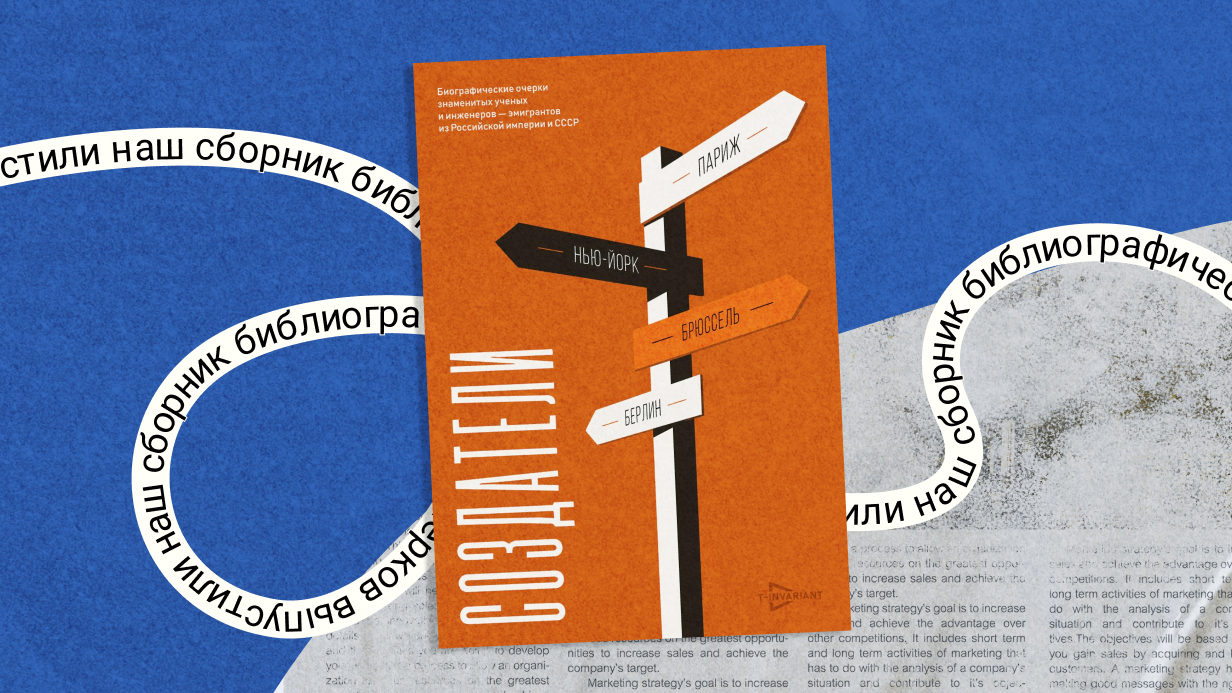
Vaccines against cholera and plague, streptomycin, helicopters, a new psychology, evolutionary theory, the atomic bomb, and particle physics. Behind all of these achievements were, among others, people born in the Russian Empire and the Soviet Union who were forced at some point to start their lives over in another country. T-invariant has brought together the stories of 18 scientists and engineers in Creators: Eighteen Émigré Scientists, Engineers, and Scholars Born in the Russian Empire Who Shaped the Modern World — a book about the people Russia lost and world science gained.
The print edition of Creators can be ordered here.
They left in the wake of revolutions, wars, and pogroms, fleeing persecution or the impossibility of working freely. Some left Crimea with the White Army; others made their way out through Murmansk, Vladivostok, or China. Some emigrated as established scientists, while others had to begin almost from scratch — in a foreign country, without money, connections, and often without the language. Vladimir Haffkine went on to create the first effective vaccines against cholera and plague; Igor Sikorsky built his helicopters; Selman Waksman discovered streptomycin; George Kistiakowsky took part in the Manhattan Project; and George Gamow became one of the founders of modern cosmology.
Creators is neither a pantheon of great names nor a collection of polished, ceremonial biographies. It is eighteen almost cinematic stories about how people rebuilt their lives after the world they knew had collapsed. The celebrated classical historian Mikhail Rostovtzeff begins teaching in Wisconsin in English so heavily accented that his students hear “goats” instead of the Goths who destroyed Rome. Three émigré psychologists — Maria Ovsiankina, Tamara Dembo, and Eugenia Hanfmann — switch from Russian to German and back again in the evenings without even noticing, and later help bring European and American schools of psychology together. Stephen Timoshenko, Sikorsky, Alexander de Seversky, and others become part of a vast network of people and ideas from which America’s engineering and scientific strength would emerge.
The timing of this book is no accident. A century later, history is rhyming with itself again: since 2022, thousands of scientists have once more left Russia, and many of them have had to find their place in global science from scratch. Creators tells the stories of predecessors who had already traveled this road. They did more than survive in emigration: they built laboratories and scientific schools, designed aircraft and ships, taught students, discovered medicines, and carried ideas across borders. Their lives are a reminder that a country can drive a scientist into exile, but it cannot necessarily destroy what that scientist is capable of creating.
Creators is the first book in the T-invariant Library series. It can be read as a history of the great scientific emigration of the twentieth century, as a collection of adventure-filled biographies, or as a book about the present day.