Major changes are underway in Russia’s private higher education sector. After several decades of complete or relative freedom in this field, the state is shifting toward a policy of total control and social engineering. The authorities are steering state-funded spots in engineering and technical programs with a defense-industry focus. Meanwhile, prospective students continue to choose paid education primarily in social science and economics majors. These are the findings of T-invariant, following an analysis of the ranking of Russia’s best schools, which is based on the number of students who successfully enroll in the country’s top universities.
In the 2026–2027 academic year, Russian universities intend to cut 45,000 paid spots (approximately 13% of the total). This was announced on December 22 by Valery Falkov, Minister of Science and Higher Education. Shortly before this, the Russian government approved rules for determining the maximum number of spots for paid enrollment in universities, as well as a list of majors and specialties where the number of such spots will be limited.
BACKGROUND
The list of majors where the number of paid spots will be limited includes 28 bachelor’s degree programs and 12 specialist degree programs [a five-year degree — T-invariant].
Bachelor’s degree majors:
Architecture; Architectural Environment Design; Design and Technological Support of Machinery Production; Oil and Gas Engineering; Psychology; Conflict Resolution; Economics; Management; Human Resources Management; State and Municipal Management; Business Informatics; Trade; Merchandising Technologies; Housing and Utilities Infrastructure; Law; Overseas Regional Studies; International Relations; Public Policy and Social Sciences; Advertising and Public Relations; Journalism; Publishing; Television; Media Communications; Service; Philology; Linguistics; Fundamental and Applied Linguistics; Applied Ethics.
Specialist degree majors:
Fire Safety; Mining; Oil and Gas Machinery and Technologies; Dentistry; Psychology of Service Activity; Economic Security; Customs; Legal Support of National Security; Law Enforcement; Forensic Science; Judicial and Prosecutorial Activity; Interpretation and Translation Studies.
These decisions not only change the economic foundation of the faculties in these specialties but also place the training of specialists under total control. “The state is effectively saying: ‘We know best how many people we need and in what fields,’ and the next step will be the introduction of mandatory job assignment [the ‘distribution’ system — T-invariant], as is already the case for medical students,” suggest T-invariant sources at HSE University.The consequences of this decision have yet to be fully realized by university administrations, applicants, or their parents. However, it is part of a broader shift in state policy regarding higher education — a reorientation of the entire market toward vocational training. The number of students in vocational schools [referred to as “colleges” in contemporary Russian terminology — T-invariant] has reached its highest level in 50 years. In 2025, the majority of Russian ninth-graders chose to study at colleges and technical schools: 63% of students enrolled there after finishing the ninth grade.
Top news on scientists’ work and experiences during the war, along with videos and infographics — subscribe to the T-invariant Telegram channel to stay updated.
T-invariant analyzed the ranking of Russia’s best schools, which is compiled annually by the RAEX rating group. Its full title is “TOP-300 Russian Schools by Graduate Competitiveness (2017–2025).” The study examined the performance of 1,192 schools from 2017 to 2025.
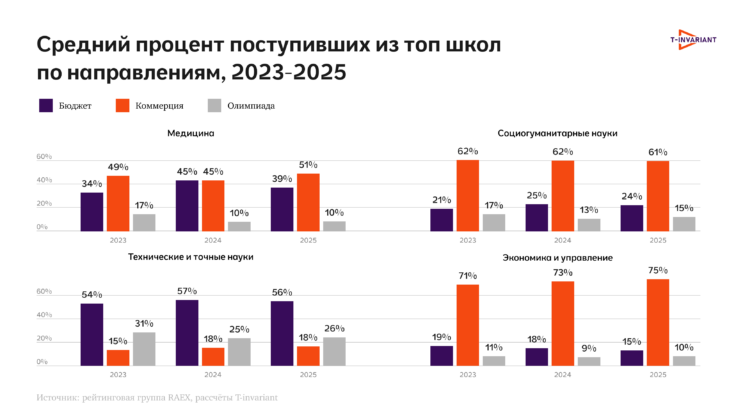
For at least the last three years, the share of those enrolling in fee-paying programs has exceeded the share of students receiving state funding. In 2017, the number of state-funded students among graduates of the best schools was 58%, while the number of self-funded students was 30%. By 2025, the situation had become nearly the opposite: 38% state-funded compared to 52% enrolled in paid spots. Only the share of those enrolling through academic competitions [the ‘Olympiad’ track — T-invariant] remains constant, fluctuating between 10%–14%.
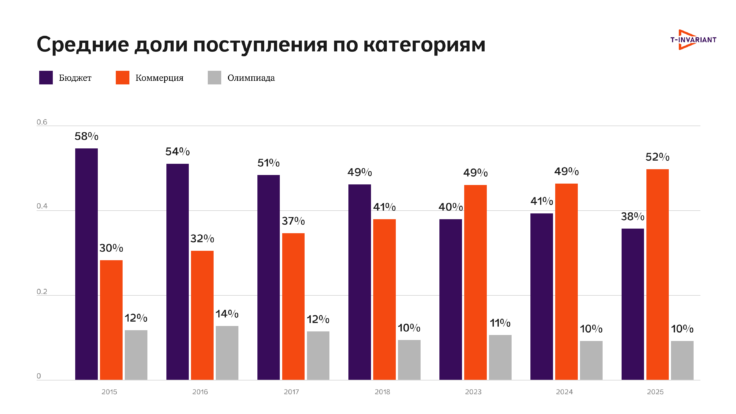
A broader picture emerges when schools are divided into thematic categories. The highest percentage of state-funded students comes from schools that prepare for enrollment in STEM disciplines (56%) and medicine (40%). The highest shares of self-funded students are found in economics-focused schools (75%) and humanities schools (61%).
According to an education expert, the reduction in state-funded spots is a natural trend. “Statistically, while 42% of first-graders once went on to university, that figure has now been cut in half. University capacity is shrinking, and for popular majors, the squeeze is even tighter as the state redirects funding toward engineering — a field many graduates, especially those from the Top 300 schools, are reluctant to pursue. The state is systematically reducing the accessibility of higher education, particularly in the social sciences and humanities,” one of Russia’s leading higher education scholars told T-invariant on condition of anonymity.
“Instead of making technical professions attractive and focusing on high-quality training for engineers, they are simply preventing people from pursuing other majors. The accessibility of higher education is indeed declining,” he added.
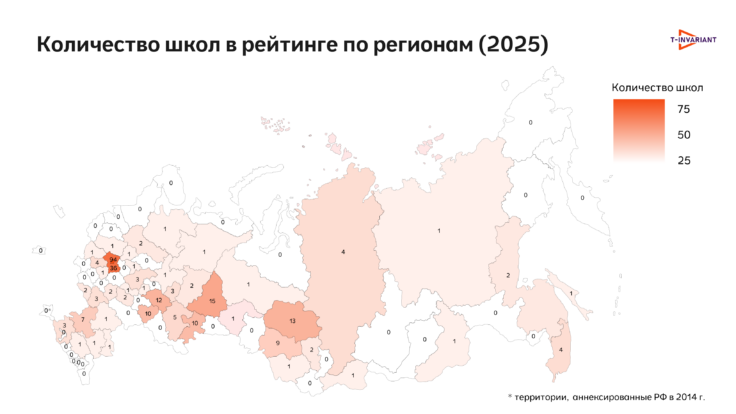
Nearly a third of the Top 300 schools in 2025 are located in Moscow (94 schools). Saint Petersburg and the Moscow Region lag far behind with 36 and 28 schools, respectively. Beyond these leaders, only the Tomsk and Sverdlovsk regions and the Republic of Tatarstan managed to break into double digits.
However, to gain a true sense of a region’s contribution, one must look beyond the sheer number of schools and consider their specific rank. To enable a fair comparison between regions, we adjusted the rankings by calculating a weighted average that accounts for each region’s proportional representation in the overall list. The graph shows that Moscow’s results, despite a strong lead over other regions, are constantly declining. Compared to 2017, the results of Moscow’s schools have worsened by 2.3 times. Other regions in the top 5 are also showing a gradual decline.
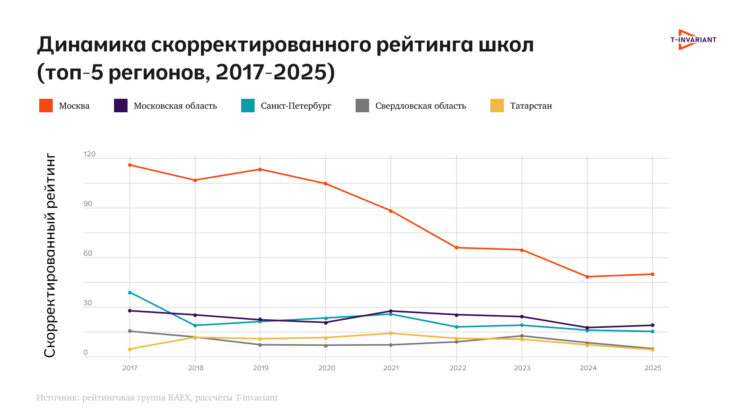
The decline in the rankings of Moscow schools began long before the full-scale invasion of Ukraine, but the results have also worsened compared to 2022. According to an anonymous school education expert, the trend likely reflects the large number of Moscow families that have left Russia.
“Moscow schools are slipping because parents ‘evacuated’ their children; many families have left. Based in cities like Tashkent, these families have opted for a dual-track approach, where children attend local schools while simultaneously maintaining their Russian education. Based on conversations with school principals, 10%–15% of their students have left. These departures weren’t impulsive; they were long-planned, which is why we are only now seeing the cumulative impact on enrollment figures. These are affluent people. Children fly to Moscow once every six months or a year to take school exams as external students. There are quite a few of them,” says the source, who now works in the education sector in Central Asia.
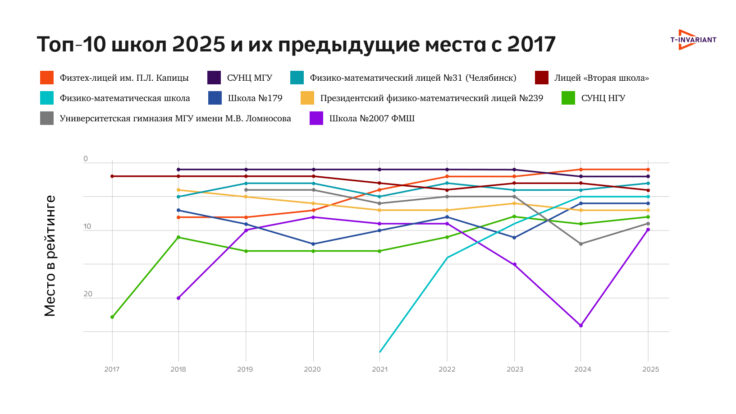
Top 10 Schools (2025)
1. Kapitsa Phystech-Lyceum (Moscow Region)
2. Kolmogorov School — Specialized Scientific and Educational Center of Lomonosov Moscow State University (Moscow)
3. Physics and Mathematics Lyceum No. 31 (Chelyabinsk)
4. Ovchinnikov Lyceum “Vtoraya Shkola” (Moscow)
5. Physics and Mathematics School (Tyumen Region)
6. School No. 179 (Moscow)
7. Presidential Physics and Mathematics Lyceum No. 239 (Saint Petersburg)
8. Specialized Scientific and Educational Center of Novosibirsk State University (Novosibirsk Region)
9. University Gymnasium of Lomonosov Moscow State University (Moscow)
10. Physics and Mathematics School No. 2007 (Moscow)
T-invariant has already noted that the freedom to pursue social science and economics disciplines — particularly those offering an international track — has become an exclusive privilege of the elite. This shift has been fueled by a combination of factors: new caps on fee-paying enrollment, Russia’s withdrawal from the Bologna Process, and the introduction of preferential admission to the best universities for ‘Special Military Operation’ [Russia’s official term for the war in Ukraine — T-invariant] participants and their family members. These domestic changes are compounded by the mounting obstacles Russians face when trying to enroll in Western universities. The Unified State Exam (first introduced in 2001 in some regions and nationwide since 2009) democratized the higher education system in the Russian Federation and truly served as a social elevator for many Russians. In contrast, since 2022, the Russian authorities have pivoted to social engineering, attempting to reshape society — and its youth in particular — by administrative decree. The “Unmanned” national project has introduced a hundred educational programs on UAVs. Young Russians are being funneled into ‘targeted enrollment’ programs that carry mandatory service obligations (as seen in medicine), while in fields like pedagogy, traditional state-funded spots are being restricted in favor of aggressive recruitment for these high-commitment tracks. However, high-scoring applicants are not backing down and continue to make their own choices — at the cost of moving to paid education.
The Gap in the Price of Higher Education in Russia Has Reached a 100-Fold Mark for the First Time
A two-tier higher education market has emerged in Russia, split between a mass segment of relatively affordable tuition and a premium tier where annual fees surpass one million rubles ($13,500). In 2025, lists of universities and their proposed educational programs with tuition costs appeared on the Gosuslugi (State Services) portal. T-invariant studied them and highlighted several important trends. Thirty-eight educational programs from 11 universities cost more than one million rubles this year. Of these, four universities with nine programs (six undergraduate and three graduate) surpassed the two-million-ruble mark. The price gap between different academic tracks has reached a staggering 100:1 ratio. For example, one can study business informatics at the Gorlovka Branch of the Automobile and Road Institute (Donetsk National Technical University) [located in the Russia-occupied part of the Donetsk region — T-invariant] for 18,720 rubles ($250), while at the Dubai (UAE) branch of the Plekhanov Russian Economic University, the cost is 2,048,000 rubles ($27,600).