September brought a flurry of developments in the use of AI in mathematics. The biggest, though far from the only one, was OpenAI’s publication of a solution to the Millennium Prize Problem concerning the Navier–Stokes equations. The announcement set off a heated debate about AI’s impact on the future of science. T-invariant looks at OpenAI’s result and the events that followed it (spoiler: mathematics has changed, and it was AI that changed it).
Top news on scientists’ work and experiences during the war, along with videos and infographics — subscribe to the T-invariant Telegram channel to stay updated.
On September 8, OpenAI published a press release titled “On the Navier–Stokes Millennium Prize Problem.” It announced that an internal company model (not yet released and more powerful than GPT-6 Astra) had solved one of the Millennium Prize Problems posed by the Clay Mathematics Institute in 2000. OpenAI’s proof was linked right below the headline: a paper in conventional mathematical notation and a formal proof in the Lean language. The company said it would not claim the Clay Institute’s $1 million prize.
The press release refers to work on the Euler equations (a problem closely related to the Navier–Stokes problem; more on it below) by mathematicians Levent Alpöge (an Anthropic employee) and Tristan Buckmaster (a professor of mathematics at New York University). OpenAI acknowledged that it turned its attention to the Navier–Stokes problem on September 1, after hearing rumors that two Millennium Problems had been solved. Building on a theory that mathematicians had developed over nearly two centuries, OpenAI then solved the Millennium Problem in 88 hours using 10,000 agents. Another 17 hours went into formalizing the proof in Lean, which confirmed that it was correct.
OpenAI’s result drew enormous attention, not only from mathematicians but from the broader public. Today, nearly every educated person has heard of the Clay Prize. That’s not because non-specialists have a deep grasp of the Millennium Problems, but because of the scandal surrounding the first problem on the Clay list to be solved (there are seven in all): the Poincaré conjecture. In 2010, the $1 million prize was awarded to Grigori Perelman, who turned it down. Perelman explained that he disagreed with the decision to give the award to him alone: in his view, the American mathematician Richard Hamilton had contributed just as much to the proof. So no one received the Clay Prize that time. It looks like no one will collect the prize for the second Millennium Problem either.
The other reason for the extraordinary buzz around OpenAI’s proof is far more topical. All sorts of people are asking: “If AI can really solve problems of incredible difficulty at the very frontier of mathematics, does that mean artificial intelligence has beaten humans — and that first programmers and now even top-tier mathematicians are no longer needed?” To begin answering that question, we need at least a rough idea of what the Navier–Stokes equations are and what kind of solution OpenAI found.
A Cup of Tea and the Navier–Stokes Equations
Picture an ordinary cup of tea. You pick up a teaspoon and start stirring. If you move the spoon in circles, a funnel (a vortex) forms in the cup. Stop stirring, and the funnel quickly smooths out. Let’s use this simple example to formulate the Navier–Stokes problem.
The spoon is an external force acting on the liquid. As long as you keep stirring (the external force is acting), the funnel holds; if you take the spoon out (the force drops to zero), the funnel keeps spinning for a while under its own momentum and then smooths out. What smooths it out is internal friction, or viscosity. Different liquids have different viscosities: water, for instance, is far less viscous than honey. In honey, it is harder to produce even a small funnel (you need to apply a large external force).
The Navier–Stokes equations are essentially Newton’s second law for an incompressible viscous fluid. The French mathematician Claude-Louis Navier proposed the first version of the equations back in 1822 — more than 200 years ago. The most convincing derivation was given by the British mathematician George Stokes in an 1845 paper. The Navier–Stokes equations worked beautifully, and they still do. But mathematicians are always interested in limits: when does a model start to break down? Newtonian mechanics, for example, starts to “glitch” in applications as familiar as the navigation app on your phone. The model has to be rebuilt, or GPS won’t work. Today’s navigation systems account for both the satellites’ velocity and the difference in gravity between the Earth’s surface and orbit; here, it is not Newton’s laws that apply, but relativity (both special and general).
For the Navier–Stokes equations, the limit of applicability is the possibility of a “blowup”: can the fluid’s velocity become “infinite” in finite time under a finite external force? That would mean the model breaks down under such conditions. This is the Millennium Problem.
OpenAI says: yes, it can. We’ll begin our discussion of the problem with the Euler equations. They describe an ideal incompressible fluid — that is, a fluid with no viscosity. If you stir such a fluid with a spoon, the funnel will never smooth out (here we ignore friction against the walls of the cup). There are two problems for the Euler equations: one with an external force and one without.
These problems ask the same question as the Navier–Stokes problem: can you stir the tea so cleverly that the funnel behaves in a completely unusual way — speeding up until its rotation becomes infinitely fast? It all began with a solution to the Euler equations with external forcing. Alpöge and Buckmaster reported that they had solved this problem. They showed that the force acting on an ideal fluid can be chosen so that the fluid “blows up”: the vortex reaches infinite speed even though both the applied force and the time are finite. Buckmaster used an internal Anthropic model to find the solution, but for the previous two months he had been working with OpenAI Codex. This is what raised suspicions that OpenAI had “peeked” at the solution, though the company insists nothing of the sort happened. But by the company’s own admission, the rumor that a solution to one of the open problems on the Clay Institute’s list (no one knew which) might have been found was what set things in motion: a huge multi-agent system was launched, with AI agents working intensively alongside a team of OpenAI mathematicians and engineers.
At first, the team tried to tackle every variant of every open Millennium Problem at once, along with simpler related problems. The first to give way was the Euler problem without external forcing. Can the initial conditions (the velocity distribution) be chosen so that even after we take the spoon out of the cup, the vortex keeps spinning up on its own until it reaches infinite speed? One group of agents solved this Euler problem: they found an ingenious initial velocity distribution such that, even after the external force stopped acting (we took the spoon out), the vortex spun up to infinite speed. Once this very hard problem was solved, all resources were thrown at the Navier–Stokes equations — which, unlike the Euler equations, describe a viscous fluid. Finding a force that, in finite time, produces a vortex with infinite speed in a viscous fluid is much harder: viscosity smooths the vortex out and damps it.
OpenAI was deliberately going after the Millennium Problem itself: the Navier–Stokes equations with an external force and viscosity. These are, in fact, perfectly normal physical conditions — but the solution it found was, to put it mildly, “abnormal.” OpenAI did solve the Millennium Problem, fair and square, but mathematicians had hoped for something different from the proof. They expected not an elaborate counterexample, but a deeper understanding of turbulence. Many were disappointed.
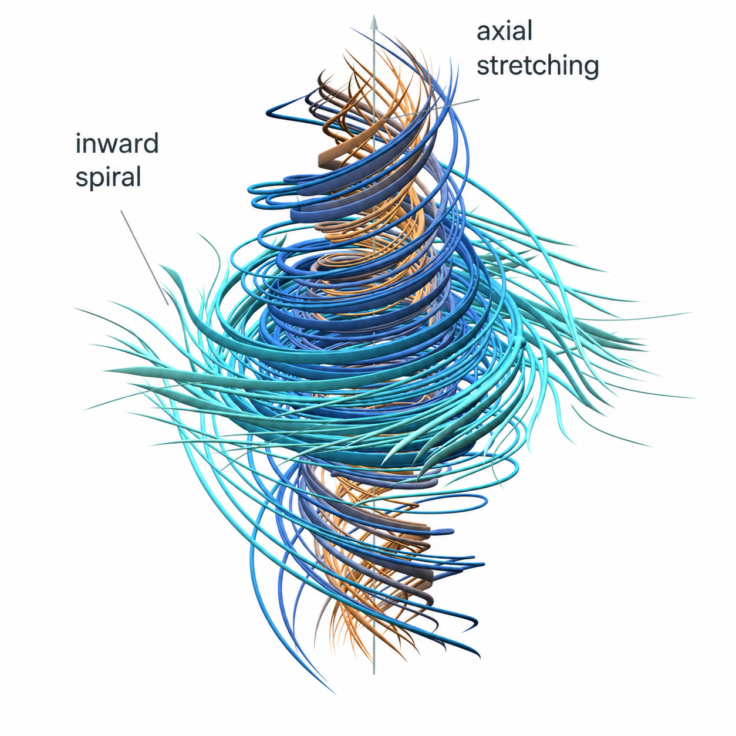
Under the terms of the Millennium Problem, the external force acting on the fluid must be “infinitely smooth” (the function itself and all its derivatives must be differentiable). OpenAI’s agents assembled this force literally piece by piece, like a jigsaw puzzle. The pieces were fitted together so precisely that they stretched and twisted the vortex; each piece depended on scale, and together they formed an infinitely smooth forcing. Mathematicians had tried many times to solve this problem, but no human can hold in their head, let alone write down, a vast number of different conditions that constantly have to be readjusted. The AI agents pulled it off.
But one more version of the Millennium Problem remains: the Navier–Stokes equations without an external force. What happens then? Can you set a viscous fluid spinning, take the spoon out, and simply watch the vortex accelerate to infinite speed? (Recall that for an ideal fluid, the AI agents did solve this problem.) Mathematicians expected the solution with external forcing to provide a clue to this even harder problem. But the unforced Navier–Stokes problem has held out. It remains open to this day.
The Fields Medalists’ Statement
On September 11 (three days after OpenAI’s press release), a group of Fields Medalists (the Fields Medal is the most prestigious award in mathematics) signed an open letter titled “A Severe Misalignment of AI in Mathematics.”. To date, 28 people have signed it. Among them are leading authorities from every generation: the patriarch Pierre Deligne (who received the medal in 1978), Terence Tao (2006), and rising stars Peter Scholze (2018) and Maryna Viazovska (2022). Six mathematicians trained in the Soviet and Russian mathematical school also signed: Vladimir Drinfeld, Maxim Kontsevich, Grigory Margulis, Andrei Okounkov, Stanislav Smirnov, and Efim Zelmanov (none of whom works in Russia today). The 28 signatories make up more than half of all living Fields Medalists. A collective statement like this is unprecedented.
What alarmed them? The laureates’ manifesto identifies several threats. The first and most important: AI companies are using famous problems as benchmarks. Their message is: look what we can do — buy our tokens, and you can do it too. But the goal of mathematics is not a “true/false” answer plus a thousand pages of unreadable proof code, even if that code is correct. Mathematics seeks to understand the world, and answers like these are more likely to close off paths than to deliver new understanding. Second, with results being published in such a rush, questions of authorship and plagiarism are bound to arise. The prospect of machines being trained on their conjectures and ideas is pushing mathematicians to hide their results: they are afraid to discuss ideas on social media and won’t even present unfinished work at conferences. And that is very bad: science is a collective enterprise. Third, mathematics lives through its students, who grow by solving hard problems. If a neural network does this quickly and incomprehensibly, the human chain of passing on knowledge and training new scientists will simply break.
But here’s the question: can this process be stopped, and should it be? Opinions differ.
On September 21, an advisory group on the use of AI in mathematics was set up at the Institute for Advanced Study in collaboration with OpenAI. It includes nine prominent mathematicians, among them Fields Medalists Timothy Gowers, Edward Witten, and — rather surprisingly — Martin Hairer, who had signed the “Severe Misalignment” letter along with his colleagues. In effect, there is no hard line between mathematicians who are betting on AI methods and those who hold more traditional views. Terence Tao is a vivid example: he is trying to slow AI companies down a little, while also making extensive use of AI methods in his own work.
How to Read 166 Pages of Unreadable Text Overnight
On September 4, Anthropic issued a press release announcing: “We are sharing the first complete computer-checked proof of Fermat’s Last Theorem. Claude worked largely autonomously over 11 days to write the proof in the Lean programming language.” Claude wrote Lean programs to check a proof that built on the Wiles–Taylor result. And Lean confirmed that the proof was correct. In fact, for mathematics, this result may be even more important than the puzzle OpenAI put together. You no longer have to take the author’s word for it, rely on authority and collective consensus, or check every step yourself. Let Lean do it.
Here’s a historical example. Vladimir Arnold recalled getting to know the eminent mathematician René Thom (Fields Medalist, 1958): “And indeed, in 1965 it was Thom I became closest friends with. The only trouble was that I simply could not understand his theorem from the paper ‘Topological Models in Biology,’ where he laid the foundations of catastrophe theory. For a couple of decades, Thom gave me the same perfectly clear answer to my questions about this theorem: ‘There will always be fools to find proofs for our theorems.’ In the end, I asked my graduate student B. A. Khesin to sort the matter out, and he discovered that the theorem Thom had announced many decades earlier was false. Specifically, Thom claimed that the number of ‘elementary catastrophes’ … is seven (for the four parameters of our space-time). It turned out, however, that this ‘number of Thom’s catastrophes’ cannot be less than 13 (and, what’s more, no one knows to this day whether their number is even finite, or whether there are infinitely many different catastrophes).”
For “a couple of decades,” no “fool” turned up to check René Thom’s result. And this is not an isolated case. Today, Lean could handle such a task — and it certainly wouldn’t need “a couple of decades.”
It would be completely unfair to say that OpenAI “didn’t do anything — it just unleashed a swarm of agents on the problem.” OpenAI’s mathematicians and engineers conducted a huge orchestra of AI agents that searched for those very puzzle pieces, formulated hypotheses, checked them with Lean, discarded the false ones, used the correct ones — and all the while communicated both with each other and with humans. Setting up a system like that and getting it to work is an outstanding achievement.
On September 17, three mathematicians who are well-known experts on the Navier–Stokes equations published a paper that placed OpenAI’s proof within the broader development of fluid dynamics. Peter Constantin, Mihaela Ignatova, and Vlad Vicol proved that the type of blowup OpenAI constructed is impossible when there is no forcing (or when the forcing is analytic). Whether a blowup of some other form is possible is still unknown, but the way OpenAI assembled its puzzle won’t work there.
But perhaps even more interesting than the result is how the mathematicians worked. They had nine days to prepare and release the preprint. And it isn’t a short preprint, either: 34 pages. Of course, they had a great deal of prior work to draw on, but the speed is simply astonishing. In the paper itself, they describe how it came together.
The mathematicians used publicly available versions of Claude (Opus 5 and Fable 5.1 in Claude Code) and ChatGPT (Sol and Astra in Codex). They write: “By far the heaviest use of these AI systems was in deciphering the statements of the OpenAI paper. Claude and ChatGPT were used to analyze that manuscript, and over the course of several interactive sessions the main properties of the solutions in the OpenAI construction were extracted… These properties were subsequently cross-checked against the publicly available PDF version of and the Lean code released by OpenAI.”
Once the mathematicians understood what OpenAI had done, they turned to their own work. First, they gave the AI agents their published papers and handed them a draft of the new paper containing the main theorem. Claude and ChatGPT were used to turn this draft into a manuscript with complete proofs of every statement. The text was then reworked in Claude Code under the authors’ direct guidance and supervision; this process involved not only stylistic editing but also checking every mathematical calculation. The mathematicians write: “Every suggestion, computation, and reference produced by the AI systems was independently verified and, where necessary, corrected or reformulated by the authors, who take full responsibility for the manuscript as it is presently written.”
Doing all this work without AI in such a short time would have been impossible. The 166-page paper written by OpenAI’s agents really is unreadable — but unreadable for humans; for AI, it is a perfectly accessible text. In other words, human mathematicians were not cut out of writing the paper. On the contrary, their work sped up many times over.
Up-to-date videos on science during wartime, interviews, podcasts, and streams with prominent scientists — subscribe to the T-invariant YouTube channel!
Vladimir Voevodsky’s Program
In 2012, Fields Medalist Vladimir Voevodsky said in an interview: “Pure mathematics works with models of a high level of abstraction and low complexity (mathematicians like to call this low complexity elegance). Applied mathematics works with models that are more concrete but highly complex (many variables, equations, and so on). Interesting applications of the ideas of modern pure mathematics most likely lie in the domain of high abstraction and high complexity. This domain is practically inaccessible today, largely because of the human brain’s limited ability to work with such models. Once we learn to use computers to work with abstract mathematical objects, this problem will gradually fade into the background, and interesting applications of the ideas of today’s abstract mathematics will emerge.”
The 166-page proof built by 10,000 agents falls squarely within that domain of “high abstraction and high complexity” the human brain cannot handle. Yet Peter Constantin and his colleagues managed it with the help of AI. In the same interview, Voevodsky estimated how long it would take to formalize his own proof of the Milnor conjecture in the Coq system as it existed in 2012: about 3–4 years. Formalizing OpenAI’s proof took 17 hours.
In 2012, Voevodsky’s words sounded like science fiction. Today, this is routine work. His intuition was absolutely right, and one can only regret that Voevodsky did not live to see his program come to life.
The Unsettling September of 2026
September 2026 will be remembered by more than just mathematicians. Something profoundly important happened in those few short weeks. For now, it is hard even to gauge the consequences. But a few things can be said.
René Thom brushed it off: “There will always be fools to find proofs for our theorems.” September 2026 showed that such “fools” have indeed turned up — and they work faster and more reliably than humans: they find a construction in 88 hours and verify it in 17. But Thom had good reason to be confident: he was looking not for proofs, but for understanding. And this is where machines cannot yet replace humans. Constantin, Ignatova, and Vicol needed just nine days to figure out what OpenAI’s 166-page puzzle really is and where its limits lie. Perhaps this is what the new mathematics will look like: machines find and verify, humans understand.
Before September 2026, mathematicians asked: will AI be able to solve the great problems? Now the question is different: will humans always be able to understand those solutions? For now, they can — but with AI’s help, too.