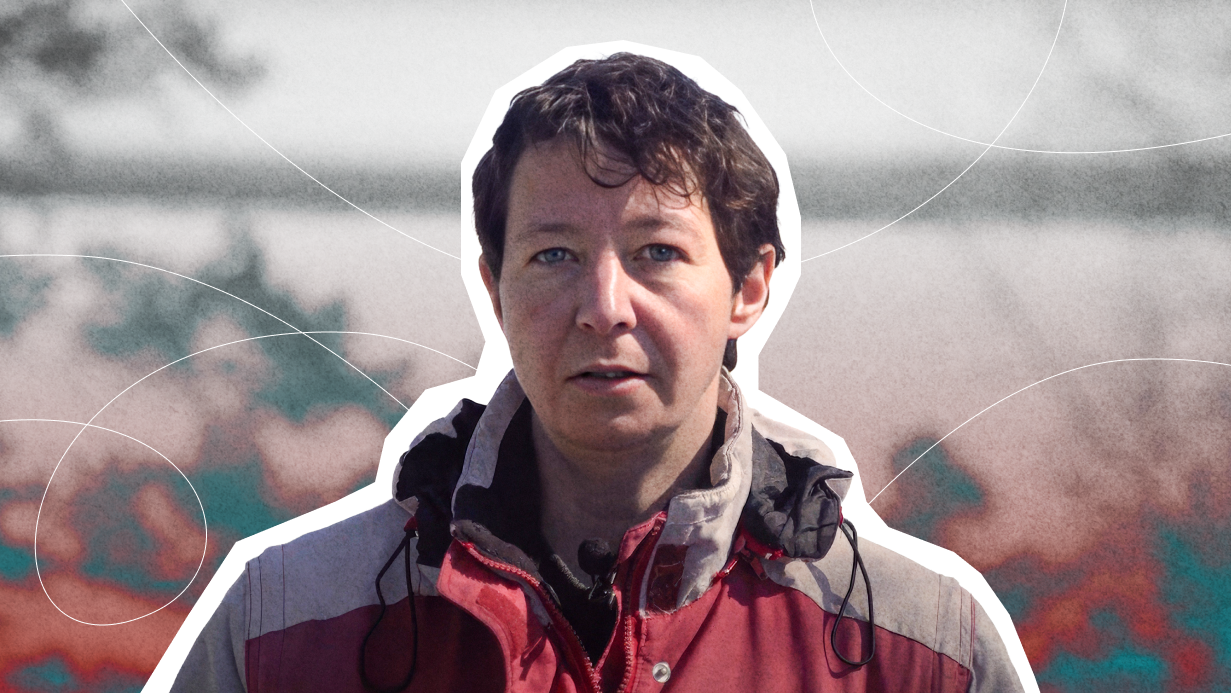
Sofia Rosenfeld has spent her life studying Arctic birds: traveling on expeditions to the Far North, following flocks of geese in a seaplane, and fighting to protect rare species. Now one of Russia’s leading ornithologists, a Doctor of Sciences in Biology, has been sentenced to three and a half years in a penal colony — for two 1,000-ruble donations to the Anti-Corruption Foundation (FBK). Rosenfeld partially admitted guilt: she explained that she had been unable to cancel the recurring payments because she was on an expedition without communications. T-invariant explains why the scientist refused to leave Russia, how the trial unfolded, and what Russian science stands to lose.
The main news about the lives of scholars during the war, videos, and infographics are available on T-invariant’s Telegram channel. Subscribe so you don’t miss anything.
Fifty-year-old Sofia Rosenfeld was taken into custody in the courtroom of Moscow’s Gagarinsky District Court. The scientist was accused of financing an “extremist” organization over two transfers of 1,000 rubles each, sent to the Anti-Corruption Foundation in August and September 2021. The FBK was designated an extremist organization in August 2021, after which donations to the foundation began to be treated as possible financing of extremist activity. The charge carries a range of penalties, from a fine and forced labor to three to eight years in prison.
Prosecutors asked for Rosenfeld to be sentenced to five years in a penal colony. She admitted guilt only in part: “I categorically reject the idea that, first, I share extremist views and, second, that I acted with criminal intent. When I decided to start supporting the FBK, I was motivated solely by the desire to fight corruption. I believe any public support in that struggle is needed. Even in my own work, in scientific research and conservation, I have seen the monstrous forms this evil can take. And it seemed to me that any help in fighting corruption was a good thing.”
Rosenfeld acknowledged that she had signed up for recurring donations to the FBK. When the foundation was designated an extremist organization, she was on a lengthy scientific expedition without communications; as soon as she returned, she canceled the subscription. Her lawyers submitted to the case file a letter in which Rosenfeld asked the foundation to stop the monthly payments. The court was not persuaded.
“They Put On Quite a Show”
Rosenfeld learned that a criminal case had been opened against her on December 5, 2025, shortly after returning from Israel, where she had been visiting her father.
“She was here with me in Israel. Sometime in the twenties of November, she went back to Moscow. Literally the next day, or the day after, they came to search her home and made her sign an undertaking not to leave. They did leave her passports, though — they just made copies,” Sofia’s father, Boris Rosenfeld, tells T-invariant.
During the search, law enforcement officers seized her phone and two laptops. Then came months of waiting. Rosenfeld continued to work and go on expeditions.
“The first hearing was scheduled six months later. But the witness did not show up, so it was postponed. The next one was postponed too. Then they read out the charges. Everything was very pleasant on the surface. Nice young women read the indictment; the wonderful investigator kept calling to ask how things were going, how her health was, what was new. It all seemed more or less decent. Nothing suggested that anything terrible was about to happen. Although I think everything had been decided long before. They put on quite a show,” recalls Sergei (name changed), a friend of Sofia Rosenfeld.
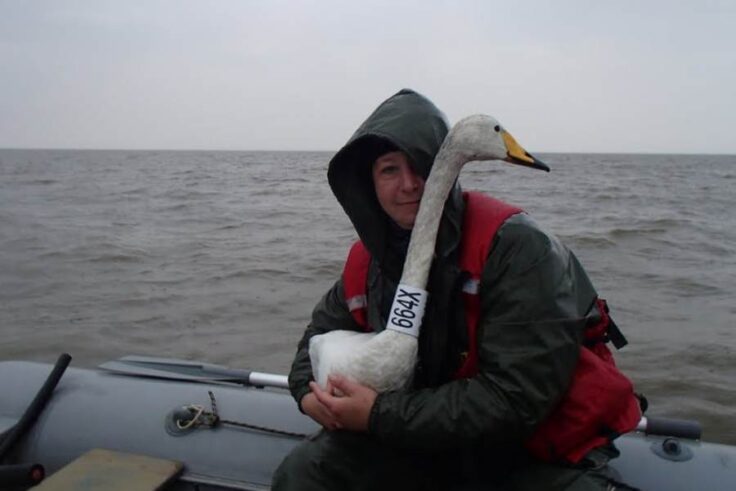
Before every hearing, Rosenfeld packed a bag in case she was taken into custody directly from the courtroom.
“She knew a real prison term was possible. But she thought a fine or forced labor was much more likely. Her lawyers thought so too. That was their mistake. I assume there are general instructions for cases like these. Recently, this has already been the third case in which women were given actual prison terms,” Boris Rosenfeld says.
“Of course there was stress. But for some reason we went into the final hearing feeling fairly relaxed. Just before that, they had even allowed her to go on an expedition beyond the Arctic Circle, to the Polar Urals, to tag musk oxen. Television did a report about her. She only got back on October 2,” Sergei says.
“The last time we spoke was a few weeks ago. She wasn’t making any plans; she was simply waiting to see what would happen next. The hearings came one after another, and she arrived at each one with her bag packed. But they kept being postponed. The last one ended with her being put in handcuffs,” Rosenfeld’s friend and former university classmate, science journalist Ilya Kolmanovsky, tells T-invariant.
According to Rosenfeld’s friends, the court was unhappy that she had admitted guilt only in part.
“The judge and the prosecutor were extremely unhappy that Sonya had only partially admitted guilt. Her situation was this: she is a field biologist and spends six months or more at a time on expeditions. Most of them are in the Far North, under field conditions, with only satellite communications. She had all the evidence showing that when the FBK was designated an extremist organization, she was away on an official expedition — the institute had confirmed it. But none of that mattered to the court. Her lawyer even asked: why is she the one being blamed? The banks processed the transfers while knowing that these payments had been deemed criminal, even though they are perfectly capable of blocking unwanted or suspicious transactions and routinely do so in other cases. Why are there no questions for the bank? The judge simply let that pass. You could see that long statements irritated him. It looked as though none of the defense arguments had any bearing on his decision: the instruction had already been given, and the circumstances of the case did not interest him,” says Anna (name changed), a friend of Sofia Rosenfeld.
“If she had admitted guilt in full, they might have knocked a couple of months off. There were three sentences like that this week. Before this, they had left women alone. I think now everyone is trying to prove their loyalty. I can see no other reason for such terrifying sentences, literally over ‘three ears of grain,’” Sergei says.
Rosenfeld is currently being held at Moscow’s Pechatniki pretrial detention center. She was not allowed to take her packed bag from the courthouse, so at first she was left without her personal belongings.
“Geese Are My Thing”
Sofia Rosenfeld is a Doctor of Sciences in Biology and a senior research fellow at the Russian Bird Ringing Centre of the Severtsov Institute of Ecology and Evolution of the Russian Academy of Sciences. She is one of the best-known specialists in Arctic waterfowl.
Rosenfeld has said that she knew she would become a biologist when she was five. She grew up in Moscow: her father, Boris Rosenfeld, is a mathematician; her mother was an engineer; and her grandfather, Iosif Rosenfeld, was an academician and a Doctor of Sciences in Chemistry. Sonya attended a French-language specialist school. In the late 1980s, the family moved to Israel, but a year and a half later, 15-year-old Sofia returned to Moscow.
“I did not think I had the right to keep a 15-year-old person somewhere by force. When we were leaving, she said she did not want to go. And really, why should she leave? Everything was fine: she had friends at school, and it was a good French school. Why the hell are you going anywhere at all? You have everything: an apartment, a car, jobs. I worked at the Academy of Sciences. And I told her: ‘Listen, we can’t leave you here alone. But if you want to come back, I won’t stand in your way.’ I promised her that. And a year and a half later she really did return. Of course we were worried, especially during the coup attempt. It was 1991. Yes, those were lively times. But afterward everything was fine,” Boris Rosenfeld recalls.
Current videos about science during the war, interviews, podcasts, and streams with prominent scholars are available on T-invariant’s YouTube channel. Become our subscriber!
“Her parents persuaded her to go for at least a year, just to see what life there was like. She went. And a year later she packed a suitcase and said, ‘I’m leaving. I don’t want to abandon my country at a difficult time.’ She came back, finished school, and entered the biology department. She is an extraordinarily determined person,” Anna says.
In Moscow, Sofia lived with her grandmother and aunt and, by her own account, was constantly bringing animals home. In addition to a dog, the apartment housed snakes, frogs, fish, and birds. In 1993, Rosenfeld enrolled in the biology faculty at Moscow State University, specializing in zoology.
“We met in our first year. I heard about her before I saw her: people in our cohort said there was an unusually remarkable person studying with us. It was obvious that there were students, and then there was someone you could already tell was a scientist. For her, science was a deep practice, a form of service,” Ilya Kolmanovsky recalls.
At university, Rosenfeld became interested in photography: she wanted to photograph birds in the Arctic. She also played guitar, studied languages, and competed professionally in show jumping. But Arctic birds had been her main passion since her student years.
“Geese are my thing. These birds amazed me because their social behavior is unique. Geese are like people. All geese, brants, and swans are monogamous; their pairs remain together for many years, sometimes for life. Young birds always make their first migration with their parents, who show them where to fly. Those family ties can also last for years,” she once explained.
Rosenfeld began going on field placements in the Arctic while she was still a student.
“She was the master of those immense open spaces, where there is not a single person for thousands of kilometers. She could go somewhere in Kazakhstan and sleep in a tent when it was minus 16 at night in spring. And then see 15,000 geese through binoculars that no one before her had seen. Make a discovery — find out that a huge population stops there during migration. She is a figure of enormous stature. From the first day, it was clear that she was dealing with something extraordinarily significant. And that is what inspires such deep respect in anyone who comes into contact with her,” Kolmanovsky says.
In 1998, Rosenfeld began postgraduate study at the Severtsov Institute of Ecology and Evolution of the Russian Academy of Sciences, where she has worked ever since. Her main research areas are the ecology and migration of waterfowl, as well as the conservation of migratory birds. During migration, birds travel tens of thousands of kilometers and cross the borders of countries with different conservation laws.
Since 2016, Rosenfeld and her colleagues have literally followed bird flocks in a homemade seaplane, photographing and counting them. The light aircraft can fly at roughly the same speed as the birds and can take off from and land on water, ice, and small clearings. The resulting data allow scientists to estimate population sizes, identify threats to their survival, and develop recommendations for the protection of migratory species.
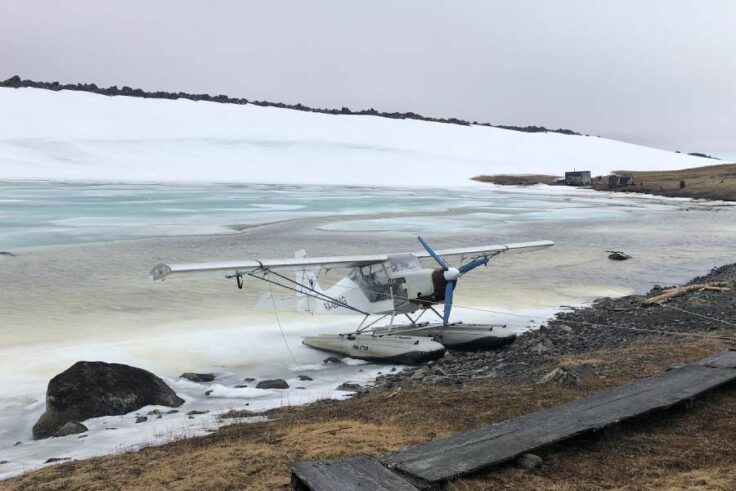
“Sonya devoted her whole life to migratory birds. She literally flew after them in an airplane. She is an enormous expert in this field. That is the kind of person she is. There was no point talking politics with her. Of course she understood everything — all the terrible injustice around her. But her priority was migratory birds. That is what she lives for, and she can talk about nature for hours,” Andrei Rostovtsev, a friend of Sofia Rosenfeld’s father and co-founder of the independent online community Dissernet, tells T-invariant.
“She is a very well-known biologist. She worked on joint projects in the United States and Canada, and French researchers took part in her expeditions. She gave talks at all the most important conferences in her field. Sonya is devoted to wildlife conservation; she is a real patriot, not a fake one. She fought to keep every rare animal species in the Red Data Book and to remove exemptions from hunting laws. In the end, she managed to convince the State Duma that she was right. She is an extraordinary fighter,” Anna says.
Rosenfeld was the first to introduce systematic monitoring of migratory birds. Previously, their numbers had been estimated approximately: researchers counted individuals in a particular area and then extrapolated the figure to the whole territory. Accurate counts, however, are essential both for studying the spatial ecology of species and for preserving their populations, explains Alexandra Panyutina, a research fellow at Tel Aviv University’s School of Zoology: “Suppose you have a major gathering site for migratory birds on an ocean coast, and it is a key site. If something is disrupted there, it will affect bird populations across many countries, over an enormous area. Disrupting migration routes and stopover sites changes the distribution and abundance of a species. That is why research in this field is extremely important.”
Waterfowl are a difficult group to study: they are hunted, which affects population size and reproduction. Many species also live in remote northern regions where fieldwork is difficult.
“There is a strong Russian group working on shorebirds. And there are the people we used to call the ‘goose people.’ That’s it. Sonya is the intellectual architect of all this work on waterfowl. A person at her level cannot be replaced. She is the one who designs the research; the concept of the entire project exists in her head. You cannot replace her with a robot. Scientific niches do not automatically fill themselves when someone drops out. And an education alone is not enough — you have to understand the current realities of a specific problem and know who is doing what around you. And of course, in three and a half years no one will fill that niche,” Panyutina says.
Sofia Rosenfeld had major plans for the coming months: filming a documentary titled Geese of Russia and working on an atlas of geese.
“It is a complete atlas, with descriptions, illustrations, and maps. Every species of goose found in Russia is supposed to be included. She left us all her contacts. We have to finish this work without her,” Sergei explains.
“You Can’t Study Geese from Prison”
Rosenfeld’s friends and colleagues say she categorically refused to leave Russia.
“There are things on which she is absolutely unbending. Leaving is one of them. For her it was completely non-negotiable. She understood all the risks, but nothing was more frightening than leaving and ending up unable to return to the subject of her research. Her science cannot be done anywhere else, because the species she studies live only in the Russian Arctic,” Kolmanovsky says.
Alexandra Panyutina tried more than once to speak to Rosenfeld about leaving Russia, but Rosenfeld avoided the subject.
“To me, the situation looked completely clear from the start. But throughout all this time I never managed to talk to her about it. She was very afraid of a provocation. Especially because her lawyers were telling her the outlook was optimistic: she was only under a travel restriction, and she was a woman and a Doctor of Sciences,” Panyutina says.
According to Panyutina, serious research on waterfowl migration can now be carried out in Russia and Canada.
“Until fairly recently, you could work freely in Russia. In most other countries, that is not the case. Scientists are hemmed in by restrictions on every side — any work requires an incredible number of permits, licenses, and special funding tied to specific tasks. And moving to another country is almost always a huge step down for a scientist. Here you are a leading specialist; there, broadly speaking, you are nobody. You start out as an assistant in someone else’s lab. No one is going to give you a laboratory from scratch. It is very difficult to earn the chance to conduct your own research. But then again, you can’t exactly study geese from prison either,” Panyutina emphasizes.
The administration of the Severtsov Institute of Ecology and Evolution of the Russian Academy of Sciences has not commented on Sofia Rosenfeld’s sentence.
“They gave her a good character reference in court. But after the sentence they decided that saving their own skin came first. I think, of course, they will fire her. How could they not, if she is not showing up for work? They will. Maybe they will wait for the appeal,” Boris Rosenfeld says.
Alexandra Panyutina does not have high hopes for the appeal. In her view, Rosenfeld’s case is far from the last example of the political persecution of scientists.
“Fortunately, the FSB has not come for biologists yet. In physics, things are already very bad. I do not know a single sane person who would choose to work on hypersonics today. You would have to be suicidal. In Sonya’s case, we cannot speak of her being persecuted as a scientist. We are talking about the persecution of a citizen who cares about the fate of her country. More than that, she became a victim of circumstances in the purest sense. When the FBK was banned, she was on a remote expedition without communications and physically could not only not cancel the donations — she could not even learn that they had been prohibited. As soon as she returned, she canceled all the payments. In other words, she did not violate the law currently in force in the Russian Federation. There is some hope that on appeal the court will take into account the major scientific significance of Sofia’s work and her important role in the Russian Academy of Sciences,” Panyutina says.
“It seems to me that today this state is devouring everything living, inside and out. The regime sees a threat in people who can put two and two together and are fairly uncompromising about it. Scientists have things they value above everything else: science, nature, geese, zoology. Many people can compromise; scientists can be extraordinarily stubborn in that respect. What will happen to Russian science next? I think its future is what the late ayatollah called a ‘jihad of knowledge’ — when every scientist must prove their usefulness to the Islamic Revolution in its struggle against the West. Now every scientist, every field of science, has to prove its usefulness in the war Russia has declared on civilization,” Kolmanovsky says.
According to Haaretz, Israel declined to intervene in Rosenfeld’s case, even though she holds an Israeli passport. After she was charged, she sought assistance from the Israeli Embassy in Moscow, but was told that the Israeli authorities could not intervene in decisions by Russian law enforcement because she also holds Russian citizenship.