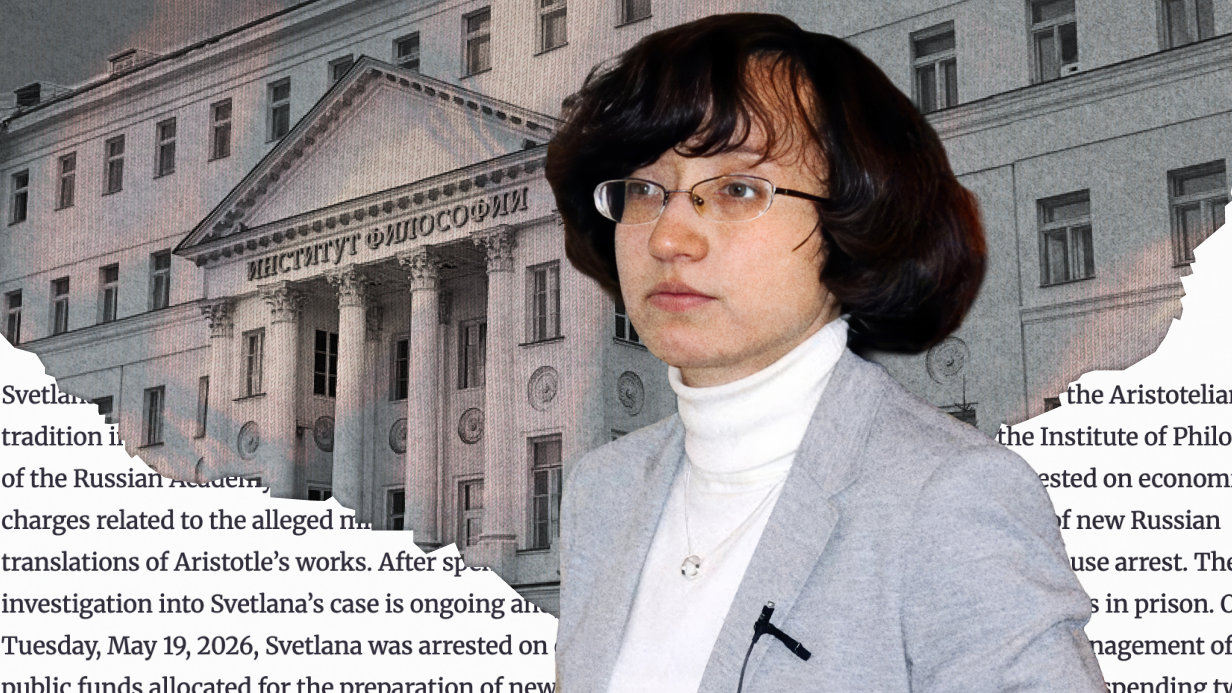
The academic community has launched a signature campaign in support of the philosopher Svetlana Mesyats. She has been charged with fraud on an especially large scale, an accusation that can carry a sentence of up to ten years in prison. Svetlana Mesyats’s prosecution fits the pattern of other criminal cases targeting Russian scholars who have returned to the country. Marina Bykova, a professor at North Carolina State University, reflects on whether public support from the anti-war opposition is useful or dangerous.
The main news about the lives of scholars during the war, videos, and infographics are available on T-invariant’s Telegram channel. Subscribe so you don’t miss anything.
On May 29, the academic community issued an open letter in support of Svetlana Mesyats. Its author is Andrei Rodin, an associate member of the French National Centre for Scientific Research (CNRS).
The signature campaign on Change.org was organized by Michael Chase, a specialist in ancient Greek, Roman, medieval, and Islamic philosophy, until recently a senior research fellow at the Jean Pépin Centre, an adjunct professor in the Department of Greek and Roman Studies at the University of Victoria, and a visiting fellow at the Max Planck Institute for the History of Science. At the time of publication, more than 350 signatures had been collected.
As a reminder, on May 19, 2026, several employees of the Institute of Philosophy of the Russian Academy of Sciences (IF RAS) were summoned for questioning by the Investigative Committee of the Russian Federation. The country’s main institute of philosophy was suspected of violations in preparing a complete scholarly edition of Aristotle’s works with scholarly commentary, including translations of treatises that had not previously been published. The project’s director, the internationally renowned philosopher and scholar of ancient thought Svetlana Mesyats, was placed under house arrest by Moscow’s Tverskoy District Court.
The judge who issued the decision on the measure of restraint was Alexei Krivoruchko, who had taken part in the cases of Sergei Magnitsky and Alexei Navalny. That fact alone points to the political undercurrent of the case. Especially since, according to colleagues, she had been the target of political denunciations long before her arrest. T-invariant asked the philosopher and professor Marina Bykova, who is well acquainted with the situation around the IF RAS, to comment.
T-INVARIANT BACKGROUND
Marina Bykova is a Russian and American philosopher. She defended her Candidate of Sciences dissertation in 1985 and her Doctor of Sciences dissertation in 1993. She is a professor at North Carolina State University and editor-in-chief of the journal Studies in East European Thought. She worked at the IF RAS from 1986 to 1993 and continued to collaborate actively with the Institute after leaving it.
Svetlana Mesyats holds a Candidate of Sciences degree in philosophy. Since 1999 she has worked at the IF RAS, where she is a senior research fellow and deputy head of the Department of Ancient and Medieval Philosophy. She has taught at the Russian State University for the Humanities (RSUH) and the State Academic University for the Humanities (GAUGN). She is the author and co-author of entries and articles in the Great Russian Encyclopedia, the Orthodox Encyclopedia, and other authoritative publications. She is the head of the project to prepare a new academic edition of Aristotle’s collected works in Russian, “The Legacy of Aristotle.”
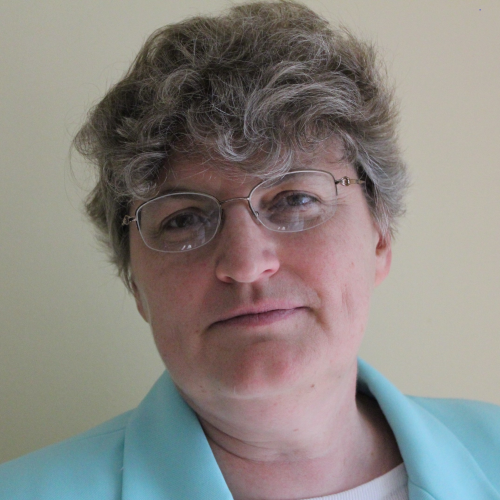
Marina Bykova: Svetlana Mesyats is one of those people who clearly and publicly articulated her anti-war position as early as 2022. That earns deep respect. Soon after the invasion she left Russia, but several months later she returned to Moscow and continued her work at the IF RAS. For the past ten to twelve years, together with a group of fellow scholars of ancient philosophy, Svetlana has been working on Aristotle — particularly on translating and commenting on his texts.
In that sense, her project to publish Aristotle’s collected works would have been a completely logical culmination of this work. But projects of this kind cannot be completed in six years, or even in ten. I myself had the chance to take part in a bilingual Russian-German project to publish Kant’s major works, and I understand very well what such projects involve, how labor-intensive they are, and how much time they require.
Svetlana Mesyats is a scholar of international standing. Work on Aristotle’s collected works is, in essence, an ongoing research project lasting decades. A four-volume edition of Aristotle was published back in the Soviet period, but it was not a complete collected works. Now the earlier translations are being refined, and new ones are being added. To interrupt this work would be a direct loss for scholarship and culture. Can the scholarly community influence the fate of a unique specialist who has come under attack from the repressive machine?
MB: There are only a handful of scholars of ancient philosophy in the world at Svetlana’s level. People who are capable of translating philosophical texts from dead languages are specialists of the very highest class. In addition, one must not forget that Aristotle wrote in technically complex language, and to render his texts in accessible philosophical language without losing important nuances of his thought is a special gift. Not everyone is capable of it.
I began asking myself about public support for Svetlana Mesyats literally immediately after her detention, and I discussed the question in a small circle of colleagues now living in the West. When, in 2021, the Institute of Philosophy protested the appointment of an acting director, we immediately published a major statement in my journal. I managed to mobilize the Western philosophical community: we collected signatures, sent the statement to Moscow, and it was published on the Institute’s website. According to the Institute’s administration, it had a serious impact. But today’s situation is fundamentally different from the one that existed five years ago. Today, the West and Western scholars have been declared enemies. Russian colleagues are openly afraid to communicate even with those of us who have ended up in the West. They are explicitly forbidden to do so, and only a few dare — and then only in secret. So we have to ask ourselves whether our support might do harm.
Through my personal channels, I reached out to colleagues at the Institute and received a frank response: “Please, just not now — no support from the international philosophical community or from the anti-war opposition.” They hope that if Svetlana’s case does not gain international resonance, it may all end with a fine. Whether I agree with that position is a separate question, but it is difficult simply to ignore such a request.
Could attempts to help make the victim’s situation worse? This question arises constantly when political persecution in Russia is at issue. Could other people connected to those who allow themselves to speak too openly suffer as well? According to Marina Bykova, Putin’s regime has built a system in which even those outside Russia cannot speak freely — in particular, they cannot freely support colleagues who have effectively become hostages.
MB: The truth is that we are now limited in what we can do in relation to what is happening in Russia. But, thank God, we can at least speak openly and formulate our position both on the war and on what is happening inside Russia itself. And we do speak — at least some of us do. But part of the emigration remains silent for subjective reasons: some have elderly parents in Russia, some have an apartment there. The same is happening inside the country. By no means are all former colleagues pro-Putin. Many are critical both of the regime and of the war, but they have switched to Aesopian language.
Current videos about science during the war, interviews, podcasts, and streams with prominent scholars are available on T-invariant’s YouTube channel. Become our subscriber!
While uncertainty remains about the intentions of the repressive agencies, it often really does make sense to keep quiet so as not to interfere with the lawyers’ work. However, on May 29, Svetlana Mesyats was charged under Part 4 of Article 159 of the Russian Criminal Code, fraud on an especially large scale, which carries a maximum penalty of up to ten years in prison. It now seems obvious that silence will not help Svetlana preserve her freedom in this political case disguised as an economic one.
MB: Yulia Sineokaya, in the interview she gave to T-invariant, said that at the moment this is an economic case, but that it will turn into a political one. I believe, however, that this case was political from the very beginning and remains so. It is a continuing attack on the Institute and on the liberal-minded colleagues who work there. As I wrote in my recent article, the regime’s task is to break the Institute, subordinate it, and once again turn philosophy into an ideology that legitimizes and serves the regime.
In this exchange from afar, there is in fact no contradiction, because in Russia political persecutions are often framed as ordinary criminal cases. The criminal cases against Navalny are an example. In recent years, however, investigators have often added political charges to such accusations during the trial itself. It is then that the case becomes political in form — but that means it was political from the start.
From outside the country, it is difficult to judge how reasonable it is to adhere to a strategy of silence. Yet there are examples in which intervention by the international academic community clearly did not harm the accused scholars. A vivid example is the case of Sergei Abramov, a corresponding member of the Russian Academy of Sciences and a leading specialist in supercomputers, who was arrested in 2023 for donations to the Anti-Corruption Foundation.
Several prominent members of the Russian Academy of Sciences spoke out in defense of the scholar, including academicians Mikhail Danilov and Yuri Popkov, as well as corresponding member Vladimir Arlazarov. The American Physical Society issued an open letter in support of Abramov. The informal “July 1” club of academicians also made a cautious statement.
The National Supercomputing Forum sent a collective petition by its participants in support of Sergei Abramov to a number of authorities, from the FSB investigative department to the Presidential Administration of the Russian Federation. In the end, the two-year trial in Abramov’s case concluded with a fine of 150,000 rubles.
The case of Oleg Kabov in Novosibirsk is another example, one even more similar to Svetlana Mesyats’s case. Kabov, a corresponding member of the Russian Academy of Sciences and head of the Laboratory for Intensification of Heat Transfer Processes at the Institute of Thermophysics of the Siberian Branch of the RAS, was accused of fraud on an especially large scale under the same Part 4 of Article 159 of the Russian Criminal Code. The scholar was accused of paying bonuses to employees, even though experts claimed that only 37.76 percent of the state assignment had been completed and that the results of the work contained no scientific novelty.
The American Physical Society again spoke out in support of Oleg Kabov, sending letters to RAS President Gennady Krasnikov and to Valery Falkov, Russia’s Minister of Science and Higher Education. In the end, the court limited itself to a suspended sentence without restriction of freedom and compensation for the seven-million-ruble “damage” to the Ministry of Education and Science.
Of course, in both of these cases, the relatively favorable outcome was, above all, the achievement of the lawyers. Still, we can see that publicity and support, including international support, did not get in the way.
The author and signatories believe that Svetlana Mesyats’s arrest is the result of a years-long struggle for control over the IF RAS, one episode of which T-invariant has already covered. “Svetlana, who has never held senior administrative positions either in the Academy of Sciences or in other organizations, has become a victim of this continuing confrontation despite not having taken an active part in it herself. The accusation of misusing funds allocated for a scholarly project on ancient Greek philosophy appears completely implausible,” the open letter says.
Svetlana Mesyats is not the first scholar to become a victim of persecution after returning to Russia. Last year, the philosopher Nikolai Zyuzev, a specialist on Pitirim Sorokin, was charged with treason. Zyuzev, who had long lived in Canada and received Canadian citizenship back in 2008, was arrested during a visit to relatives. He remains under arrest.
The case of Svetlana Mesyats is an alarming signal for the academic community, confirming a pattern of persecution against scholars who come to Russia from abroad. Although the formal grounds for the arrest were economic claims, colleagues and experts regard the accusation as politically motivated. For that reason, in Svetlana Mesyats’s case, broad public attention may increase the chance of avoiding imprisonment.