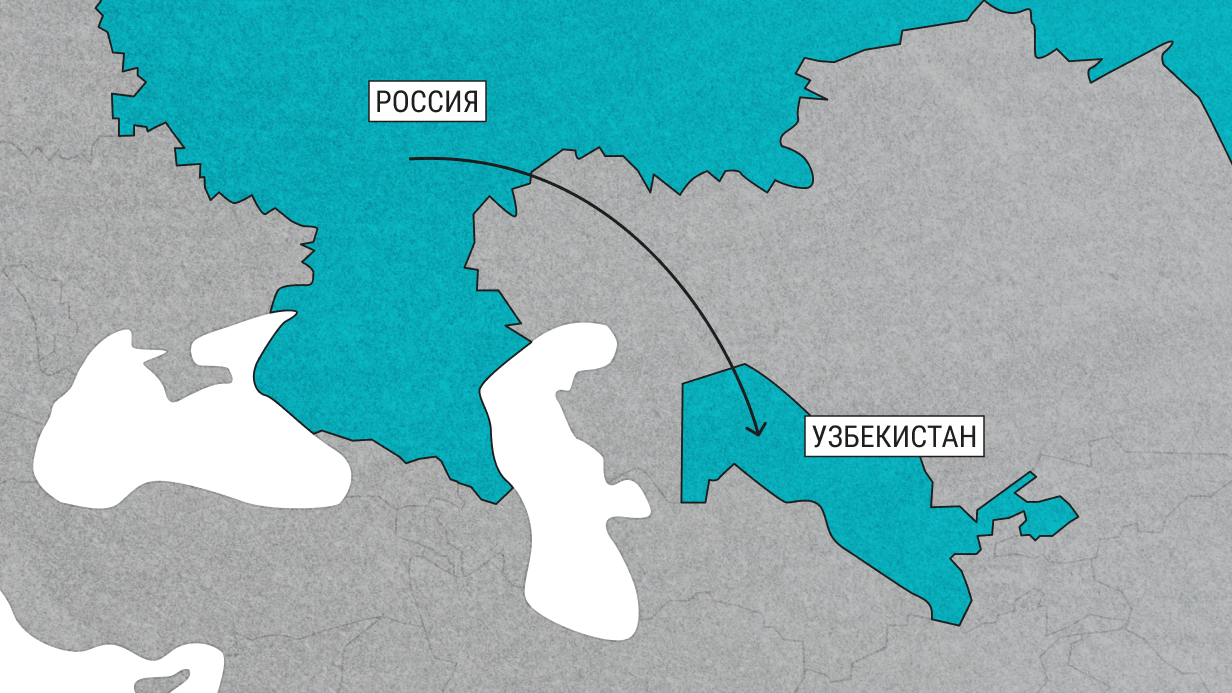
According to Scopus, the number of publications involving Uzbek authors has increased severalfold over the past five years. The problem is that this growth far outpaces both the actual volume of research being conducted and even the speed at which researchers are mastering the basic principles of research ethics. In the latest installment of the Plagiat-Navigator project, several telling stories show how, for money, one can become a full-fledged co-author of someone else’s paper or simply “draw” research results while preserving all the formal trappings of “big science.”
Recently, Shavkat Ayupov, president of the Academy of Sciences of Uzbekistan, spoke about officials who obtain academic degrees at an accelerated pace and about publications containing fabricated results — an area in which, he said, “Uzbekistan ranks highly.”
“You often see claims online: the largest number of papers in ‘pirate’ journals comes from Uzbekistan. Or the largest number of low-quality papers comes from Uzbekistan. This is a huge stain on the reputation of our science,” Shavkat Ayupov lamented.
Buying Co-authorship
In early February 2022, an invitation to buy co-authorship in a paper already prepared for publication, titled Investigation of reaction mechanisms of CO2 reduction to methanol by Ni-C80 and Co-Si60 catalysts, appeared on Facebook. Just two months later, a paper with exactly the same title was published in Inorganic Chemistry Communications.
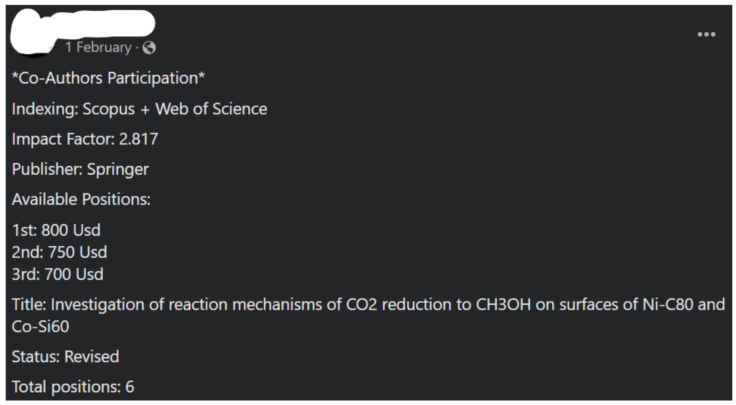
Once the paper appeared, it became clear that A.A. Khalikov, an employee of Tashkent State Pedagogical University, had bought third place in the author list for US$700. The journal later retracted the article, noting that Khalikov’s name had been improperly added to the author list shortly before publication. This is how paper mills — factories producing fraudulent papers — operate: their managers first get a manuscript through the journal’s editorial process, with no objections remaining to the listed authors, and at the very last moment add people who have managed to buy places in the author list before publication. Khalikov’s case is far from unique. Scientific journals have already retracted dozens of similar papers in which Uzbek authors jumped into the last car of a train already departing for publication. For completeness, some of these papers were co-authored with D.O. Bokov, an associate professor at Sechenov First Moscow State Medical University, whom we have encountered before. Purchased co-authorship is mainly bought not by students or graduate students, but by established associate professors and professors. Even Akmal Sidikov, rector of the Fergana Medical Institute, has been caught buying authorship.
The main news about the lives of scholars during the war, videos, and infographics are available on T-invariant’s Telegram channel. Subscribe so you don’t miss anything.
Of course, Uzbek researchers began buying authorship long before this — in Russia. The Dissernet community had documented such transactions on a Moscow exchange repeatedly several years earlier. Some Russian paper mills later relocated to Uzbekistan, which appears to be connected with the sharp rise in joint publications by Uzbek authors and Kuban State Agrarian University: 6 in 2023, 39 in 2024, and 81 in 2025. The main interest of Uzbek researchers, however, shifted toward the much larger and more accessible Asian markets discussed below.
Image Fabrication
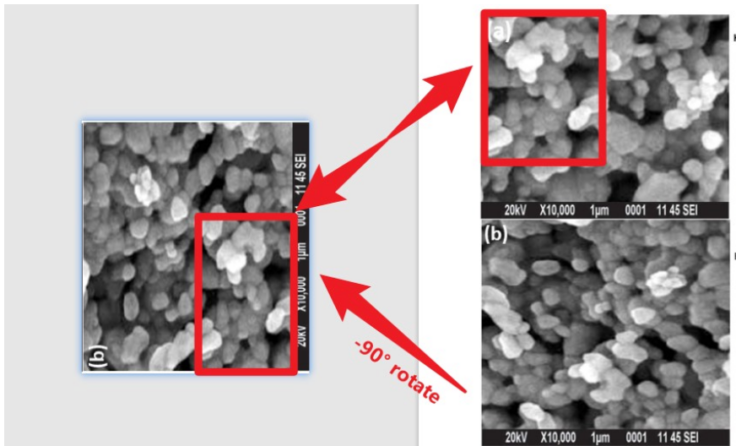
Asian markets for purchased papers and co-authorship are especially popular among researchers from Saudi Arabia, Pakistan, Tunisia, and other Middle Eastern countries. Another employee of Tashkent State Pedagogical University, Sherzod Abdullaev, appeared in just such an international author team. In December 2023, Abdullaev became a co-author of the paper Enhanced electrical and magnetic properties of (Co, Yb) co-doped ZnO memristor for neuromorphic computing. The authors chose a rather unorthodox — if decidedly “rational” — approach to solving the research problem. Imagine that a zinc oxide sample is sitting on your laboratory bench. Look at it from another side, after rotating it by 90 degrees, and it is no longer simply zinc oxide but a sample doped with cobalt. Rotate it once more, and cobalt has been replaced by ytterbium. Once the image manipulation was discovered, the authors said they had accidentally submitted the wrong photographs to the journal. Over the past five years, Abdullaev has published more than 150 papers together with researchers from the Middle East. The scientific community has yet to fully appreciate their scholarly significance.
Professor Elyor Saitov of Tashkent University, like his aforementioned colleague Sherzod Abdullaev, also takes an unconventional approach to solving scientific problems. In a 2025 paper published with Korean, Saudi, Egyptian, and Iraqi co-authors, the peaks in the X-ray diffraction spectra were found to tilt unnaturally, sometimes to the right and sometimes to the left.
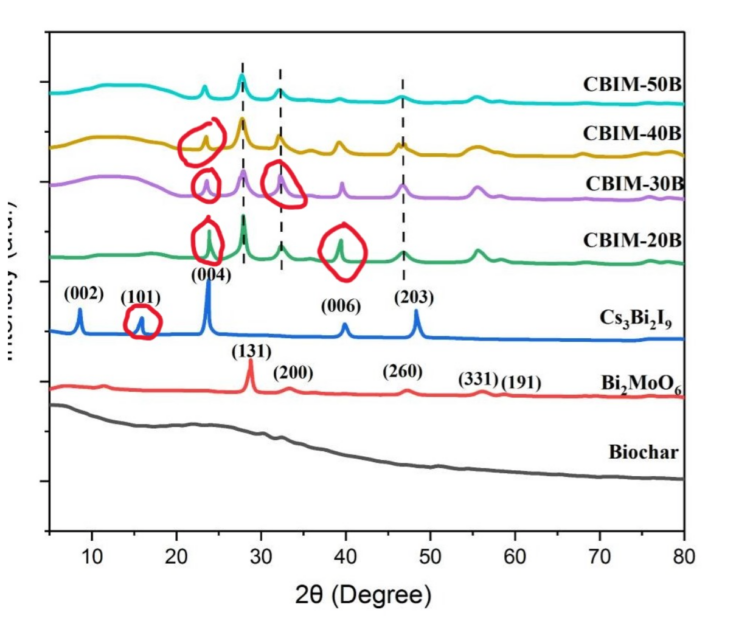
In real X-ray diffraction, peaks have a symmetrical shape and smooth profile. What Professor Saitov published is graphics from an image editor, with each peak manually stretched. A scientific editor seeing this should have sent the paper straight to the trash. But did not. Journals, after all, vary too. Similar “features” of experimental data were also noted in a very recently published paper by Professor Saitov — once again, as is customary, in close collaboration with Middle Eastern researchers.
Artificial Intelligence as a Data Factory
Modern technology makes it possible not only to cut a fragment from one photograph and paste it, rotated, into another image, but also to duplicate the same fragments within a single picture, thereby creating the illusion of genuine scientific research.
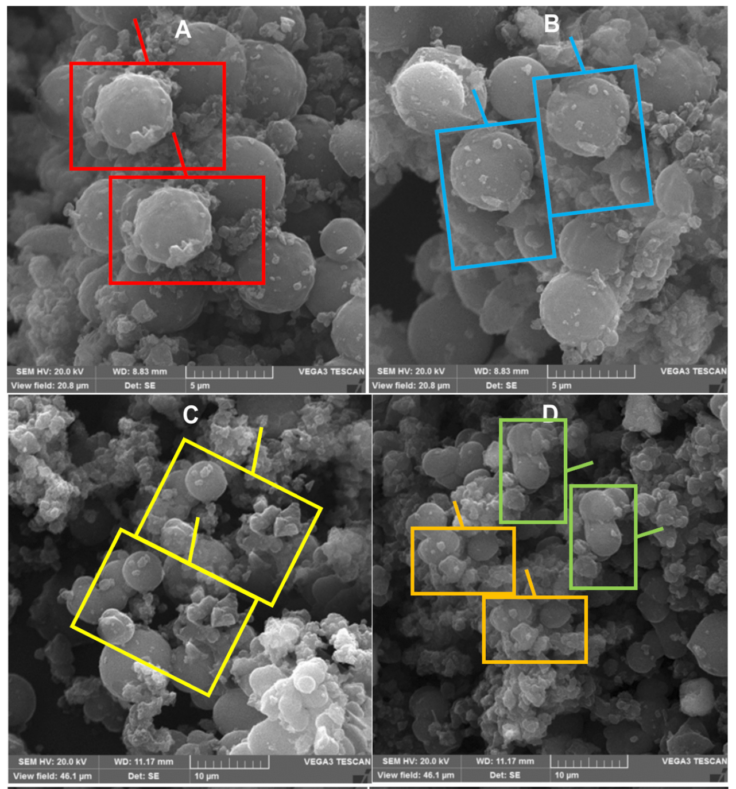
Several Uzbek researchers used this technique in a paper published in 2025 in a prestigious scientific journal from the Springer Nature portfolio. The electron-microscope images contain numerous repeated fragments.
A year earlier, another group of Uzbek researchers published a paper on producing environmentally friendly biofuel using a heterogeneous titanium-dioxide nanocatalyst. The spectra they reported raised serious questions among experts. But the real “cherry on top” was a micrograph of the nanocatalyst, supposedly obtained with a scanning electron microscope. Generative artificial intelligence helped the authors create symmetrical patterns in the image by repeatedly reusing the same small fragments to compile it. As a result, an image presented as the product of scientific research came to resemble a mosaic or the pattern in a child’s kaleidoscope.
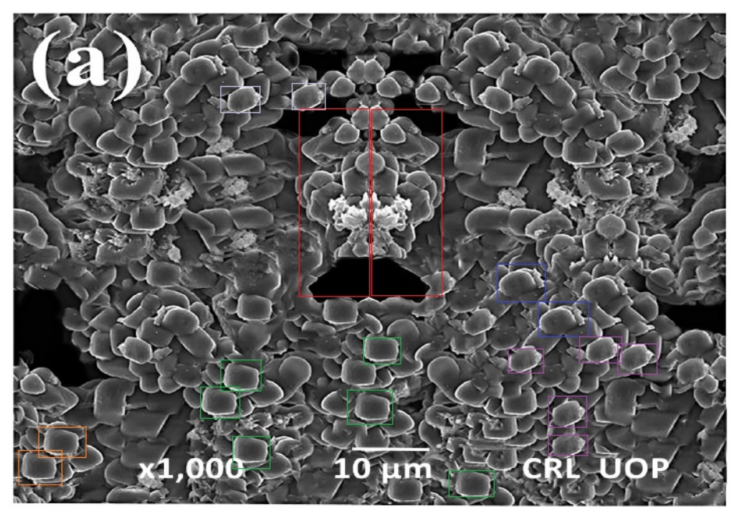
This paper, which creates the illusion of scientific research, has 14 co-authors: six are Uzbek researchers, while the others are from Pakistan, Saudi Arabia, the United States, and Azerbaijan. The Uzbek authors include professors, Doctors of Sciences, heads of divisions and departments, the director of an entire research center at the Customs Institute, and, apparently, the rector of Zahiriddin Muhammad Babur Andijan State University — Professor and Doctor of Biological Sciences Akramjon Yuldashev. All of them — prominent Uzbek scholars — used artificial intelligence to simulate scientific activity.
The same approach is repeatedly used in the work of the well-known chemist Elyor Berdimurodov, a professor at the National University of Uzbekistan. The prominent professor has gone much further than his colleagues, however, also copying images the old-fashioned way from other researchers’ earlier papers.
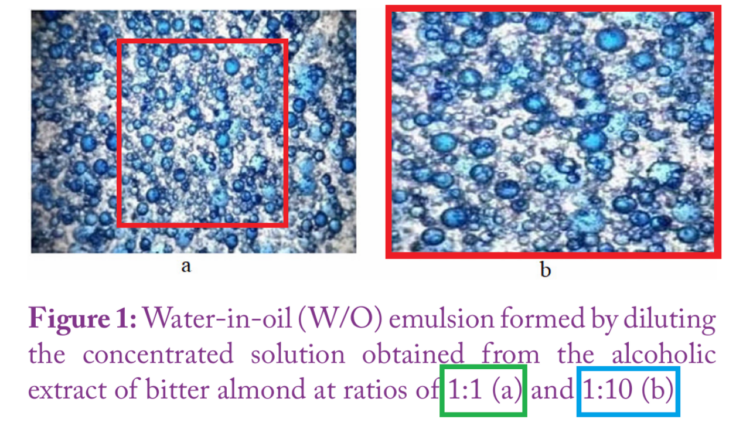
To be fair, not all researchers in Uzbekistan use high-tech methods to “process” the images they publish. In January 2025, Advances in Animal and Veterinary Sciences, a Scopus-indexed journal, published a study by a team from Uzbekistan, India, and Romania on bitter-almond emulsions as a treatment against ticks. To readers’ surprise, emulsions diluted at ratios of 1:1 and 1:10 proved almost indistinguishable from one another under an electron microscope. Artificial intelligence had let the Uzbek authors down again. How the researchers determined the optimal dilution for controlling ticks remained a mystery.
Absurdity in the Formulas
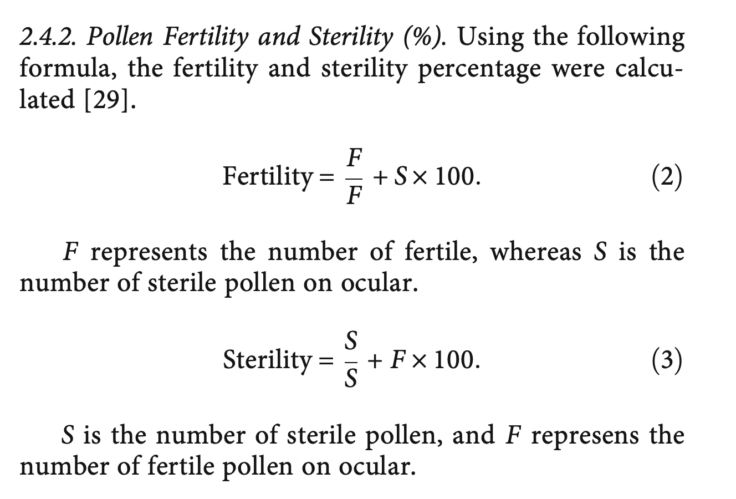
One might conclude that manipulating micrographs or falsifying experimental spectra is relatively sophisticated, not immediately obvious, and that associate professors and professors could simply have failed to notice an unfortunate mistake. After all, what matters is the result, published in a respected international scientific journal. Let us go one step lower and look at a pair of very simple formulas from another paper by the aforementioned authors, this one devoted to the morphological properties of tree pollen. The authors give two formulas for calculating fertility and sterility as percentages. Instead of the correct formula F/(F+S)×100, they publish F/F+S×100, where the first term becomes one and the denominator disappears. This is not a typo; it is a complete absence of editing and of any grasp of basic arithmetic. The result is that, in Uzbek pollen, the more sterile pollen there is (S), the higher the “fertility,” while the more fertile pollen there is (F), the higher the “sterility.”
Fake References and Co-authors
Another Uzbek researcher who actively collaborates with colleagues from Middle Eastern countries is Barno Abdullayeva, vice-rector for research and innovation at Tashkent State Pedagogical University. When retracting one of her papers, the publisher noted that many references in the article contained incorrect information or could not be found at all. Numerous publications by Abdullayeva, likewise containing fictitious bibliographic references, were retracted after it was discovered by chance that Nadia Batool, an employee of the University of Potsdam in Germany, had been included in the author list “for respectability” without her knowledge. An international scandal followed. But neither Vice-Rector Abdullayeva nor her co-authors were able to provide the journal’s editors with any coherent explanation.
This article has introduced only a few representative cases — merely the tip of the iceberg of Uzbek pseudoscience. The field remains poorly studied today, largely because there is little political will inside the country to fight corruption in academia.