Since the start of the full-scale war, several independent educational projects have emerged outside Russia, bringing together faculty and students who have left the country. Some still work primarily with audiences inside Russia; others are trying to build full-fledged universities abroad. But both face the same questions: How do they survive as international funding shrinks? How do they stay connected to Russian society? And how do they avoid carrying old habits of university governance over into their new institutions? What unites Russian higher education in exile, what are its prospects, and why does academic freedom begin with more than just the freedom to teach? T-invariant discussed these questions with political scientist Evgeny Roshchin, co-author of a study by the Center for European Policy Analysis (CEPA).
Shrinking educational opportunities in Russia, repression against faculty, students, and scientists, and the resilience of the current regime, which leaves little reason to expect rapid change, all raise the question of alternative educational institutions — ones beyond the Russian state’s control and free of censorship. The creation of such institutions began even before the full-scale invasion, but it is over the past four-plus years that an entire field of these projects has taken shape: about ten prominent ones and, by various estimates, up to twenty in all. Some, like the Free University, speak openly about themselves and keep their own chronicle; others operate essentially underground. All of them deserve to be documented and examined in detail, although any public account of the findings will necessarily be generalized and incomplete, so as not to make students and faculty inside Russia targets of state repression.
One of the first attempts to compare these new educational institutions was made by the Washington-based Center for European Policy Analysis (CEPA). On June 25, 2026, it published a series of reports, Russian Civil Society in Exile, devoted to émigré initiatives in three fields: education, human rights, and media. All three reports were prepared by a team of authors:
• education — Sowing the Seeds of Renewal: Russian Higher Education in Exile, by Alexandra Yatsyk and Evgeny Roshchin;
• human rights — Dissent Across Borders: Russian Human Rights Organizations in Exile, by Mikhail Komin, Sam Greene, Evgeny Roshchin, and Alexandra Yatsyk;
• media — An Ecosystem of Truth: Russian Independent Media in Exile, by Mikhail Komin and Evgeny Roshchin.
Who Has Stayed Connected to Russia
T-invariant: Your report Sowing the Seeds of Renewal: Russian Higher Education in Exile discusses seven new independent educational institutions, but only four of them are named outright. Was that the authors’ choice, or the choice of the people from the institutions you studied?
Evgeny Roshchin: Neither, actually. From the very beginning, we chose to protect everyone we talked to as much as possible, so we don’t disclose the names of the institutions, even though, obviously, most of these seven are more or less known to everyone. That was the general principle of the whole project, which had three parts: education, human rights organizations, and media. It was our work with the human rights sector, specifically, that tipped the balance toward fairly strict security measures when presenting the results.
So, on the one hand, the report presents seven anonymized institutions whose representatives we spoke with. On the other, we drew on widely known information about the most visible projects, the kind you can pick up from the media: we cite Smolny, the Free University, FLAS, and the Charles University master’s program [in Russian and East European studies, taught in Russian, in partnership with the Boris Nemtsov Foundation for Freedom — T-invariant] as examples to illustrate one aspect or another of the story of independent educational initiatives. But the fact that we mention any of these four institutions doesn’t automatically mean we interviewed people from them.
T-i: Does that mean the other institutions are so secret that you can’t find them by searching public sources?
ER: No, all of these projects can be found if you look for them. In some cases, we’re talking about a research center that’s involved in educational work in one way or another. In others, it’s a civic education initiative, just smaller in scale than the best-known ones. Besides the Free University and Smolny, I’d point to the New School of Political Science and Bazaleti Uni.
T-INVARIANT BACKGROUND
Evgeny Roshchin is a political scientist who holds a PhD in social sciences (University of Jyväskylä, Finland, 2009). Until March 2022, he headed the Faculty of International Relations and Politics at the North-West Institute of Management, the St. Petersburg branch of the Russian Presidential Academy of National Economy and Public Administration (RANEPA); he was also co-director of the Master of Global Public Policy program at RANEPA in Moscow. In March 2022, he resigned in protest against Russia’s invasion of Ukraine and the RANEPA leadership’s statement in support of the war, and then left Russia. He spent two years at the University Center for Human Values at Princeton University. He currently works at the Center for European Policy Analysis (CEPA) and is a visiting scholar at the Henry A. Kissinger Center for Global Affairs at the Johns Hopkins University School of Advanced International Studies (SAIS).
His research covers international politics, the neo-republican theory of freedom, academic freedom and self-censorship in Russian universities, and the nature of dissent under authoritarian regimes. In recent years, he has been studying Russian civil society in exile and international support for its institutions.
T-i: In every case, were you talking to people involved in organizing and running these projects?
ER: It depended on the sector. But it wasn’t a hard-and-fast rule of our methodology. For example, we didn’t set out to talk to every head of every educational project: in some cases we spoke with the people in charge, in others with instructors or people indirectly involved in management. We also talked to donors — essentially all the major institutional donors in this field — to get different perspectives on what we were studying.
T-i: But if we’re talking about educational institutions, there was never a single case where you talked to students?
ER: Students weren’t the subject of our research, because we were trying to answer one big question: Is Russian society in exile still connected to what’s happening in Russia, and can it influence the processes going on there? Coming at it from that angle, we worked exclusively with the organizations themselves, in different fields, and tried to understand their priorities. Are they focused on integrating as quickly as possible into the societies where they’ve ended up — and that affects both how they’re organized and what they prioritize? Or are they still trying to do something in Russia, finding new, previously untried methods, tools, and ways of staying connected to what’s happening there?
That’s what we wanted to look at — and to show the major institutions still watching Russia that organizations in exile are, in fact, capable of getting things done inside the country. In answering that question, we set aside both the readers of independent media and the students of educational initiatives. Questions about the quality of teaching, student satisfaction, how many people actually complete these programs, what their attitudes are, and so on fell outside the scope of the study.
T-i: By interviewing organizers and instructors, did you learn what mattered most to you — how these institutions position themselves?
ER: Partly, yes. We found out their priorities, their values, and their vision of how they’d like to build their projects going forward. The second important parameter of our study was this: we tried to assess how engaged they are with Russian audiences. So we asked how many students join from Russia and how many from Europe, to understand whether these initiatives are in demand among diaspora communities in, say, Europe or the US, or whether there’s demand inside Russia as well.
A Window Cracked Open in a Closed University
T-i: Am I right that all the educational initiatives you studied mostly teach the social sciences and humanities, rather than STEM — science, technology, engineering, and mathematics?
ER: Yes, that’s right. It’s mainly social sciences and humanities.
T-i: But as far as I understand, some projects are bringing in STEM subjects on an experimental basis?
ER: Not so much for specialization as simply to broaden people’s horizons.
T-i: Does that mean the STEM fields in Russia are still in a more or less stable position for now, and students just don’t need an alternative STEM education? Or is that kind of teaching — with the proper curricula and, in the experimental sciences, lab work on top of that — simply too hard to organize?
ER: We know that STEM faculty have been leaving since 2022, which means this area, too, has suffered certain losses in terms of teaching quality. I can’t quantify the scale of those losses, and that matters for understanding how motivated students in these fields are to look for knowledge outside their own institutions.
The social sciences and humanities are, on the whole, more prone to giving rise to initiatives like these, because of the nature of the disciplines. They focus on questions of society, the state, power, and power relations at every level. Since conflict, power, and governance were already at the center of these disciplines’ attention, when a shock like the start of the war hit society and academia, the people who worked on these issues tended to react more actively.
I suppose it was built into the profession itself, into the academic path they’d chosen — especially if they take the values of academic freedom and the free university seriously. As part of that reaction, some of them got involved in creating alternative forms of academic community outside the country. That may well be what explains the character of the prominent educational initiatives we see today.
T-i: I keep track of the persecution, arrests, and prison sentences that scientists and university instructors in Russia are getting, and if anything, there are now more STEM people among those being targeted. At the same time, physics and engineering are becoming increasingly securitized: more and more information falls under the category of state secrets, and more and more people can be accused of espionage, because some long-ago international collaboration gets reclassified as espionage after the fact, just like in the days of the Great Terror. Today, physics and engineering — and presumably other fields as well — are increasingly tied to working for the war, for the defense industry. And it seems to me that independent education in exile could play a big role here, if only by pulling talented students out of this war-oriented system. Are there any prospects for that? Is anything like this being discussed?
ER: You have to understand that we’re talking about completely different orders of magnitude. We have ten or so initiatives that at best teach a few thousand people a year. Russia, meanwhile, still has about a thousand universities and more than two million students.
The institutional capacity of these small initiatives is no match for a task like that, and they won’t be able to replace censored education in Russia under any circumstances. But they can become a window cracked open, one that draws people — not necessarily from the social sciences and humanities, but from STEM as well — who want to better understand what’s going on around them.
Instructors of some courses told us that it isn’t only young students fed up with censorship in their studies who come to them. There are also many people who graduated long ago and are now trying to make sense of the situation we’ve all found ourselves in: what ways out of it there might be, what dilemmas and challenges it poses. Often there’s no one to discuss this with and nothing to read about it where people are — say, at some industrial plant or a technical university in Siberia. For those who feel the need to see past the blinders of propaganda and the constraints of censorship, these initiatives will be an important place where they can not only talk through the questions that trouble them, but also become part of a community of people driven by similar worries. That’s one of the important functions of independent educational initiatives, and it shouldn’t be overlooked: they give people a sense of community. That matters enormously amid atomization and intensifying repression, when it’s utterly impossible to speak your mind without serious consequences.
Donors Leave, Universities Stay
T-i: Am I right — judging, among other things, by how the report ends — that one of your goals was to address this study to donors, so that they would not only understand what they’re paying for in a particular project, but also see the larger, more complex landscape that project fits into, and be able to locate themselves on this map?
ER: This is a think tank report, and the genre has its own particular features: as a rule, it’s aimed at the people who make policy in a given area. In this case, we saw our main audience as institutional donors, both governmental and nongovernmental, as well as national governments that run programs supporting civic initiatives through agencies under their authority. Our task was to tell them to what extent their support for initiatives in exile is consistent with their mission.
As a rule, the mission statements of such organizations include supporting democratically oriented initiatives in particular countries, and Russia was no exception. Ever since the 1990s, civic and educational initiatives in Russia — you know this better than I do — have built up experience working with international grants, which were brought in to develop new projects or areas the state couldn’t handle. This was especially true of human rights initiatives. And it fit the foundations’ goals: they gave money for work being done in a given country and thereby, presumably, fulfilled their mission of strengthening democratic institutions, the rule of law, and so on.
After 2022, the situation changed dramatically. Many of these donors had already been declared “undesirable” before the war, and during the war all the rest followed. That alone shrinks the opportunities for supporting civic initiatives inside the country. On top of that, in 2022 a huge share of activists, journalists, and scientists left for Europe and other parts of the world — and now it was these people who started turning to donors for support.
That raises a question: the donors’ mission is to support democratically oriented initiatives in a specific country, but the money goes to people who aren’t in that country. This dilemma comes up in donor circles all the time, with varying degrees of intensity.
Our report — and the entire series of three reports — takes on this dilemma and shows that it doesn’t really exist: most of the initiatives we analyzed do in fact operate in a hybrid format, with part of the organization abroad and another part still in Russia, carrying on the work. That distribution is exactly what hybridity means. So what we’re telling donors is: don’t worry, your mission can still be fulfilled even if you support initiatives in exile, simply because many of them are still oriented toward their own society, toward the state of affairs back home. That was our main task, and that was the audience we were addressing.
T-i: When you talk about donors, do you mean large donors? Are there alternative sources of funding: tuition fees, crowdfunding?
ER: When I talk about donors, I mean large institutional donors — some of them in Europe, some in the US. Their funding is crucial to the survival of independent educational initiatives. But that doesn’t mean donor money is the only source of support. Donors themselves often ask initiatives to think creatively: a donor isn’t going to be with you forever, and it often has an obligation to rotate its grantees. So a responsible donor will say, “Think about where you’re going to find money tomorrow.” Another approach you see a lot is the recommendation to look for co-funding. If a donor sees that someone else is willing to support an initiative in any amount at all, that’s a signal that the initiative matters not just to its participants and to the donor itself, and that there’s a chance of finding money even if this main donor walks away.
Some initiatives have no choice but to charge students so they can bring in more instructors and pay them for their work. That’s because donor funding may not cover all the costs. And sometimes the donors themselves nudge initiatives to introduce tuition fees in order to put them on a more financially sustainable footing.
Thousands Online, Dozens in the Classroom
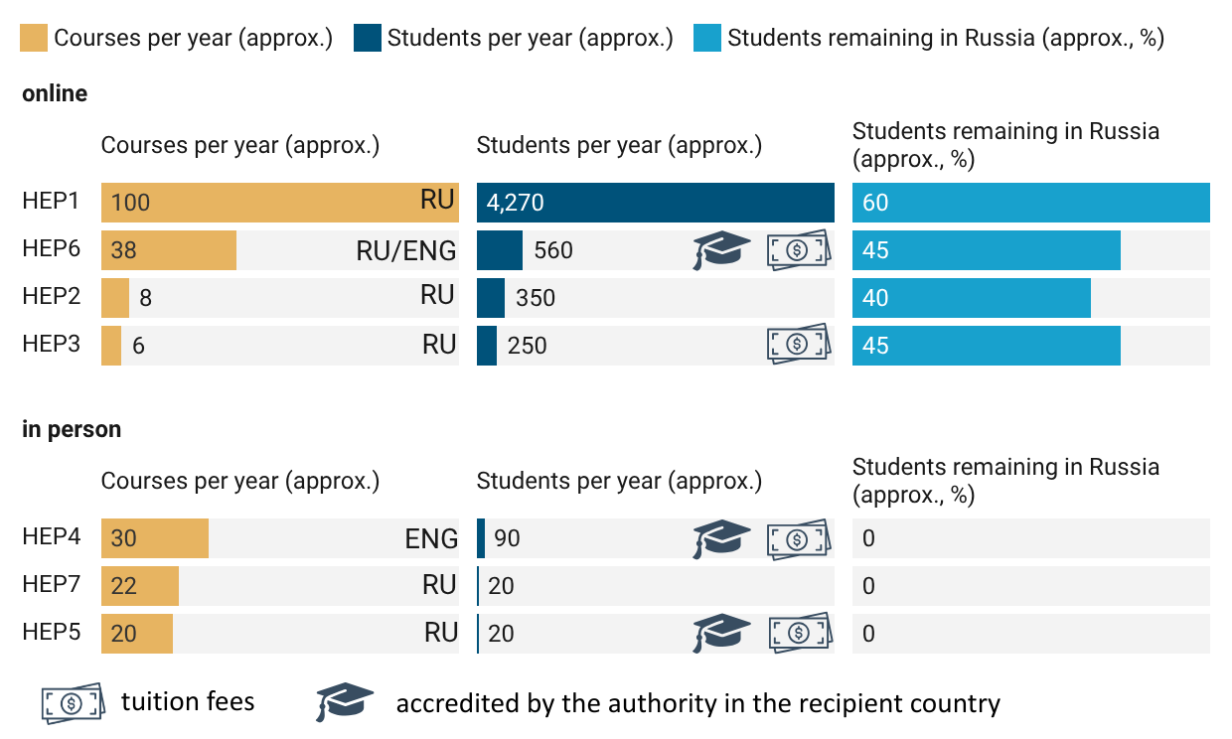
T-i: The report shows that the share of students who live permanently in Russia varies widely from one educational initiative to another: in online projects it reaches about 60%, while for in-person programs we’re talking about dozens of people at best. So these are probably very different models. Just calling them “hybrid” probably isn’t enough. Shouldn’t they be described more specifically after all? And how reliable is the criterion of reaching a specifically Russian audience in the first place — isn’t it too fluid? After all, someone who lives in Russia today may leave tomorrow, and the other way around.
ER: To begin with, this isn’t a very big field overall: there are about ten significant initiatives. It’s extremely hard to generalize from a sample that small, and that wasn’t our goal. The only generalization we allow ourselves has to do precisely with the models. There are essentially two of them: the online learning model and the model of more or less traditional, in-person classroom teaching. Some initiatives try to combine the two, but at their core these are different models, and they involve different motivations, even though everyone’s values are, of course, more or less similar.
The online model means your instructors are scattered all over the world, and you have a certain flexibility in choosing them. True, that flexibility sometimes turns into planning problems: instructors are ordinary people, they have to survive in new circumstances, and new work commitments often keep them from continuing with an online initiative. That’s always an unpleasant experience for a manager: when an instructor is right there in your department, you know you can count on them, but when they’re across the ocean — well, they couldn’t make it, and there’s nothing you can do about it, because you essentially have no contractual relationship with them.
We have a number of initiatives that have managed to draw a fairly substantial number of learners from inside the country. One of these projects has several thousand participants inside Russia. That’s a serious achievement, and one that can only be welcomed if you start from the logic of keeping up access to independent education in a country where, because of censorship and repression, universities offer less and less of it.
Top news on scientists’ work and experiences during the war, along with videos and infographics — subscribe to the T-invariant Telegram channel to stay updated.
The second model is built around in-person classroom teaching. It matters too, but its orientation is fundamentally different. You manage to bring exiled instructors together in one place and convince them that this really is the spot on the map where they’re willing to spend a significant amount of time and maybe even start rebuilding their careers from scratch. After all, there’s always uncertainty here — about the prospects of the educational initiative itself, about immigration status, and about the economic survival of those who decide to take part.
When you launch a real university with real walls, monitors, and a library where you can hold books in your hands and talk to an instructor, you take on the obligation of obtaining all the necessary paperwork in the host country — both a license and accreditation. That means a million negotiations — with the landlord, with ministry officials, with local universities that have to be convinced you won’t become a burden or a competitor for them. In short, there are thousands of routine tasks you’ll have to deal with if you choose institutionalization. It’s a completely different model, and it requires paying more attention to the context you find yourself in. Since the initiatives that have taken this path operate in Europe, they have to account for both national and pan-European specifics as they try to find their place in the European education landscape — in terms of both its norms and its competition.

You’re re-creating an ordinary university, which means you have to fill the classroom — with students either from Russia or from diaspora communities. And the task is no longer necessarily to bring someone over from Russia, but to get students into the classroom at all: you need somebody to teach. That’s the point where the orientation starts to shift.
How many students from Russia can come to a program like that? We’re no longer talking about thousands, or even hundreds, but about dozens at best. And if it really is dozens, plural, that’s already an incredible success for initiatives like these; sometimes it’s even fewer. So you end up with a mix of students from Russia and from other communities in the classroom, and each instructor works with maybe five, at best ten, students from Russia. That’s the obvious contrast between the two models: on the one hand, an audience of hundreds or thousands of people; on the other, a few dozen at best.
And then the question arises: Why do these few people from Russia come? To study at an “undesirable” organization and go back to Russia? These students may be planning to continue their education in Europe — in master’s or other programs — with the ultimate goal of finding a job in the global labor market, whether in Europe or in North America.
For those who are thinking about how to support and develop democratic or quasi-democratic initiatives inside an authoritarian regime, this, as you can imagine, isn’t the main target audience. For them, it might be a good thing if these independent educational initiatives as a whole manage to institutionalize and hold on to their people. In the end, these will be programs and centers for studying what’s happening in Russia, or simply a kind of reserve for preserving human capital for the future — in case something changes in the country. That’s probably the most value these initiatives will hold in the eyes of donors who have to figure out how to keep pursuing their mission.
T-i: But what if we look at the situation not only through the lens of negative developments in Russia — censorship, the suppression of free thought, the outflow of experts and scientists — but also in light of the general crisis of higher education in Europe, the US, and the world as a whole? Might a donor want to support an institution simply because it provides high-quality higher education? In that sense, it doesn’t much matter where a graduate ends up physically — what matters is that the world gets more people who have acquired, as you put it in the report, the skills of critical thinking, of a particular kind of reading, of discussion, and of writing their own analytical texts. All the more so because where they’ll end up can’t be predicted far ahead. Are there donors with that kind of motivation?
ER: Maybe there are, but I don’t know of any. We have to take into account the reality we live in. And the reality is a crisis in donor funding.
That funding has been cut drastically. As you know, an entire agency, the US Agency for International Development (USAID), was effectively dismantled, and that hurt the planning of donor programs at other institutions as well. European budgets aren’t in the best shape either, and it would be naive to assume that additional funding to support independent civic initiatives will appear any time soon. Most likely, it will continue to be about streamlining donor programs. And when a given donor faces the task of streamlining its budget, a proposal to just consider supporting these wonderful independent initiatives won’t, I think, sound especially compelling — because besides our initiatives, there are very serious educational centers out there, such as, say, private universities.
Up-to-date videos on science during wartime, interviews, podcasts, and streams with prominent scientists — subscribe to the T-invariant YouTube channel!
There’s a good chance the donor will ask: What for? Money is tight, we already have institutions that have proven effective — maybe we’ll focus on those. I get asked this question every time we present to donors: Why support everyone if you can support the most effective ones? Why spread money that’s already scarce so thin? You always need to have an answer to that question. And the answer isn’t always comfortable or pleasant for us: sometimes we simply have to reckon with the circumstances we’ve ended up in.
Emigration as an Ethical Gesture
T-i: In the report, you say that the institutions of free Russian education working abroad, or working for Russia from abroad, brought certain traditions with them from Russia. What’s more, some of them chose to keep their ties to old brands to underscore the continuity of those traditions. Could you name some of these good traditions? As I understand it, it’s precisely through these ideas that Russian independent education should position itself in global education today — as an ensemble of communities, institutions, and intellectual centers.
ER: I just visited one of these initiatives in Montenegro, and after talking to the instructors, I realized that it’s about something bigger — a kind of spirit, an ethic of how you relate to teaching and to the university. And specific elements are then layered onto that attitude. You can talk about specific techniques: seminars on slow reading, on deep interpretation. Or, when it comes to quantitative research, you can point to strong instructors with international experience who explain to students what research based on properly collected and processed data looks like. But all of these things are a set of practices built around a central factor: one’s attitude toward the university.
T-i: And how would you define that factor? Is it common to all the institutions in exile?
ER: I think it’s above all a spirit of freedom — freedom of expression and discussion in the classroom. And also, perhaps, a professional ethic of taking seriously the subject you teach or the research you do. It so happens that most of those who left and are involved in these educational initiatives are either good scholars with a serious publication record or respected, much-loved teachers for whom it’s very important to explain the material to a student, get feedback, and not leave the student to fend for themselves. And sometimes they’re both. This is the ethic that was cultivated at Russia’s leading universities. That’s precisely what set them apart from big institutions with huge student cohorts, where instructors carry heavy teaching loads and have no chance to work with students one-on-one.
T-i: When we talk about freedom, about free thought, how important is the background of these instructors, all of whom, as I understand it, have experience of taking an independent stance and of resistance? How important is it, for shaping today’s student — in Russia or outside it — to learn from an instructor who has that kind of experience, or even from whole communities of such instructors?
ER: I think it’s extremely important. And perhaps that’s exactly what will become the distinguishing feature of the educational content that these initiatives provide — including compared with what’s offered inside the country. After all, a great many qualified instructors remain in Russia who are every bit as competent as those who left. But those who left also made a political and ethical gesture — an exodus from a political and educational context where censorship and propaganda were gaining momentum. That gesture is an ethical marker. I don’t mean to say that the instructors who stayed in the country are unethical. A great many of them adhere to generally accepted norms of ethics and law, but in Russia today they are forced to restrict what they say and, in effect, to live in internal emigration.
I think this choice will shape all the subsequent behavior of those involved in the process. When students come into the classroom and join the discussion, they’re dealing with people who decided to fight for their principles.
That fight, again, can take different forms and isn’t always convincing, but what matters is the commitment to an ethical norm itself. And that commitment wasn’t always spelled out: some people made antiwar statements — while still in Russia or after leaving — and some didn’t. But even then, everyone understood.
When someone leaves the country even before the mobilization [in September 2022 — T-invariant], makes a turning-point decision like that, and goes somewhere they have no base and no one is waiting for them, everyone understands what that decision is about and sees it as a gesture. I think this ethical choice will be the most reliable foundation for the spirit of academic freedom in these institutions — it will sustain and safeguard it. That’s the quality I would draw attention to.
T-i: But then what about the anonymized instructors at the Free University, who presumably went anonymous precisely because they are in Russia? Since they haven’t made the political and ethical gesture of exit (emigration), do they position themselves differently from émigré instructors?
ER: Yes, these instructors didn’t “exit” the political community, but they take part in underground resistance for political and ethical reasons. In effect, they stand alongside those whose resistance takes the form of a public gesture.
How Not to Take Authoritarianism With You
T-i: If there are important and valuable traditions worth preserving in these institutions, are there also ones that, in your view, should be discarded or critically reconsidered, so as not to repeat mistakes already made back in Russia? And have you seen mistakes that have already been repeated after relocation? I’m thinking about the particulars of administration, about relations between leaders and faculty and among faculty members themselves. About how conflicts arise and how they get resolved, whether irreconcilable factions and insoluble disagreements emerge within a single institution. How are instructors selected, how are administrators chosen, how does competitive hiring work in general, how is the quality of education measured, and to what extent do those measurements feed into adjustments to curricula and educational policy?
ER: This aspect of life in academic communities wasn’t the focus of our research, so I can’t draw on it here; I can only offer some thoughts in a personal capacity — as someone who talks with colleagues across academic initiatives. Of course, we’re all human. Leaving the country hardly turns a person into someone else, so certain practices, habits, and mannerisms tend to move along with people. And, let’s be honest, even in this community people keep complaining to one another about how some things are administered and about the temperament of some of the leaders.
It’s a problem, but in my view a solvable one. And it has more to do with the transitional period these initiatives are going through. Given the nature of what’s been happening, they’re often the product not of a jointly developed plan — where several scholars from different countries got together at an online conference and started thinking about how to launch something like the European University at St. Petersburg — but of the personal initiative of a project’s founder, who, alone or with a small team, starts bringing in other colleagues. An initiative like that always also has to find a source of support. These factors sometimes mean that the principles of self-governance aren’t fully put into practice. There’s a leader who pushed the project through, found the money, sold the idea to the hosts, and took on the obligations involved in building it. It seems to me that this is a feature of the launch period and, maybe, of a longer transitional period. If a critical mass of people with the ethical principles I was talking about forms around a project, they’ll be able, at later stages, to introduce more tools of collective self-governance and to strengthen the institutions that uphold both academic freedom and a certain standard of quality in educational programs.
If we assume these initiatives will survive for a while yet, it’s logical to expect them to evolve in terms of governance and institutionalization as well — from one-person rule to a more collegial structure.
T-i: Isn’t there a danger that during this difficult period of transformation — or, in fact, of building from scratch — financial hardship on the one hand, and the threat from the Russian state, which declares institutions “undesirable,” on the other, are narrowing the room for horizontal, democratic governance? After all, it’s clear that in a besieged-fortress situation democratic procedures start to work less well, and full transparency is impossible, isn’t it?
ER: There really is no place for democracy in a besieged fortress. But these initiatives don’t exist in a vacuum; they exist in relatively safe, relatively democratic societies, in a common European space. And that style won’t stay legitimate for long, because the initiatives also need to position themselves properly in the places where they are. Even in the case of online initiatives, the participants live in specific countries and interact with the communities there, and those communities interact with donors and governments. Essentially, this is a peer context that shapes the internal dynamics of these institutions from the outside.
So, it seems to me, the risk of these initiatives turning autocratic will be minimized by the very context they’re in now. The second thing that will hold it in check is the need for collective action and solidarity among the participants. In what is essentially a network structure, you won’t get far on a command-and-control apparatus alone. As many participants as possible need to share the initiative’s goals and be motivated enough to take part in the common cause. Autocratization demotivates people in a free association. They’ll simply leave, and the initiatives will start to shrink. That will be visible to everyone, even to observers with no stake in it. Solidarity doesn’t take shape where there’s a drift toward autocratization. So the process you’re describing will run into two very important constraints — an internal one and an external one. And I think they’ll turn out to be much stronger than the incentives toward autocratization.
T-i: But why does it necessarily have to be about autocratization? Couldn’t it be, say, a closed collective leadership — a kind of oligarchy, though not in the sense of financial wealth? Where there’s a core group of administrators and instructors who more or less agree among themselves about what they’re doing and how? They might not even be a numerical majority, but they constitute, so to speak, an authoritative majority and control the budgets, the curricula, and the institution’s development strategy. That’s a bit different from autocratization: in this model, the danger of losing everyone because of one person’s forceful will disappears. But there’s a danger of undemocratic stagnation, where all sorts of moves toward improvement, including toward broader participation, get blocked by this notional core of founders and those who joined them later.
ER: This is a relatively transparent community, and information has a way of leaking out of it. The community is quite small, information circulates easily within it, and the distance between the community and the donor is such that information basically can’t help but reach the institutions or people who support the initiative.
It seems to me that arrangements of collective collusion like these will be vulnerable both to donors and to those who break away from such groups — simply because of the nature of the work. If we were talking about a business corporation, it would probably be a different story. But we’re talking about academic institutions that preach the idea of academic freedom. And even when additional requirements for security and non-disclosure have to be observed, information still leaks out and affects reputations.
And if a reputation starts to suffer, it’s quite likely that any day now the donor will prefer to support a different educational initiative. So — if only for the sake of reputation and building relationships — I hope initiatives like these will think about how to engage with other participants as respectfully as possible and as equals.
T-i: To what extent does external funding oblige the administrators, founders, and leaders of these initiatives to report to their staff on how much donor money they receive and how they spend it? Does the requirement of financial transparency and accountability exist only in the relationship between leadership and donors — or do horizontal, collegial faculty bodies also gain the right to know how much money the institution receives, how it’s spent, and how priorities are set?
ER: In my view, in these initiatives such a requirement would be hard to meet: it’s difficult to say where a particular initiative and its community end. There’s turnover among instructors: some leave, some arrive, some are more involved, some less — the structure, especially in online initiatives, is, as I said, networked rather than formalized. So even if someone wanted to achieve greater transparency, it would be unclear how wide a circle of participants should have access to the information and who should regulate that.
I’d assume that information about what funding comes into the organization is held by the people who, first, wrote the grant application; second, were involved in registering the legal entity whose account receives the money; third, handled security; and so on. It’s a limited circle of people, but, I think, wide enough for the core community to have a sense of what funding the organization receives. In my view, no single leader could keep that knowledge to themselves.
T-i: I have in mind a principle that exists at American private colleges: faculty participation in governance, known as shared governance. Under this tradition, the administration presents financial information to the faculty and discusses the budget and development priorities with them — at general meetings and through representative committees. The specific forms this participation takes and the scope of faculty authority vary from college to college. After all, there’s always less money than there are needs. So in Russian higher education institutions in exile, does the choice of priorities itself become a subject of discussion?
ER: We haven’t heard of practices like that in these initiatives — of leaders reporting to all participants on the funding they’ve received. Maybe we just weren’t able to pick up on it, and such practices do exist, but we haven’t heard of them. In my view, some initiatives have a chance of reaching that level of transparency and accountability. This is exactly where it matters who launched the initiative and whom its survival depends on: if it depends on the key instructors, the chances of institutionalizing transparency rise sharply.