Russia’s Future Weapons on Google’s Hardware. How a Defense Ministry Research Institute Studies Drone Swarms and Why Russia Is Falling Behind Ukraine
In 2025, a Russian military research institute published, in a publicly available scientific journal, a model of a drone swarm breaking through air defenses — a model it computed on Google’s cloud service using an NVIDIA Tesla T4 GPU, a chip introduced in 2018. In the same paper, a leading expert on swarm technologies acknowledges that Russia trails China, the US, and other major powers by almost two orders of magnitude in the volume of research on the subject. T-invariant independently confirmed this gap using the OpenAlex database of scholarly publications and also found that Ukraine publishes one and a half times as many papers on drone swarms as Russia does, and almost three times as many on countering drones. Experts interviewed by T-invariant note that, judging by the technologies used in the November attacks on the Crimean Bridge, Ukraine has pulled ahead not only in theory but also in practice. In their assessment, the Ukrainian Armed Forces used a so-called heterogeneous drone swarm, and the attack caused parts of the bridge structure to collapse.
Top news on scientists’ work and experiences during the war, along with videos and infographics — subscribe to the T-invariant Telegram channel to stay updated.
“We’re losing both the technological and the economic competition globally. And we’re losing it not just to China and the US — in some respects, we’re losing it to Ukraine, however unpleasant that is, even for me… In this war of attrition, we won’t win the competition…” These words cost economist Andrei Klepach his well-paid job at the state corporation VEB.RF. As the media reported, after the uproar over his speech about Russia falling behind, Klepach was fired following a phone call from the Kremlin — practically the same day.
Economists are not the only ones talking about a lost technology race. The Southern Federal University journal Izvestiya SFedU. Engineering Sciences (No. 2, 2025) published a paper by three researchers from the Russian Defense Ministry’s Main Research and Testing Interspecific Center for Advanced Weapons (MJRTC) titled “Machine Learning Model of Swarm Evasion from the Influence of Antagonistic Environment.”
The center was established in 2021, shortly before the start of the full-scale invasion of Ukraine. According to TASS, it has a staff of more than 200. MJRTC researchers take part in conferences on dual-use and military technologies held by the V. A. Trapeznikov Institute of Control Sciences of the Russian Academy of Sciences (ICS RAS). Other Defense Ministry bodies are represented at these conferences as well: the Defense Directorate for Advanced Inter-Service Research and Special Projects, the Directorate for the Development of Artificial Intelligence Technologies, the Main Directorate for Innovative Development, and the Military Scientific Committee of the Russian Armed Forces.
MJRTC is overseen by the Defense Directorate for Advanced Inter-Service Research and Special Projects, whose head, Evgeny Shmyrin, has figured in investigations into the work of the Rubicon Center for Advanced Unmanned Technologies.
The paper’s authors acknowledge that Russia lags far behind in the number of open studies on swarm technologies:
“Over the past 2–3 years alone, the volume of open foreign publications studying various aspects of using swarm structures to solve a wide range of civilian and military-technical tasks has exceeded the number of domestic publications by almost two orders of magnitude. Regrettably, this gap is widening.”
T-invariant checked this claim against the OpenAlex publication database. We analyzed publications from 2022–2026 whose titles or abstracts contain the phrases “UAV swarm,” “drone swarm,” “swarm of unmanned aerial vehicles,” and “multi-UAV,” and broke them down by the countries of the authors’ affiliations.
The paper’s authors — senior researchers Vyacheslav Abrosimov and Gleb Dolgov and junior researcher Ekaterina Mikhailova — were right. In total, these queries returned 10,195 publications worldwide, of which only 92 were linked to Russia. That is about 0.9% of the global total. The overall number of papers found exceeds Russia’s count roughly 111-fold.
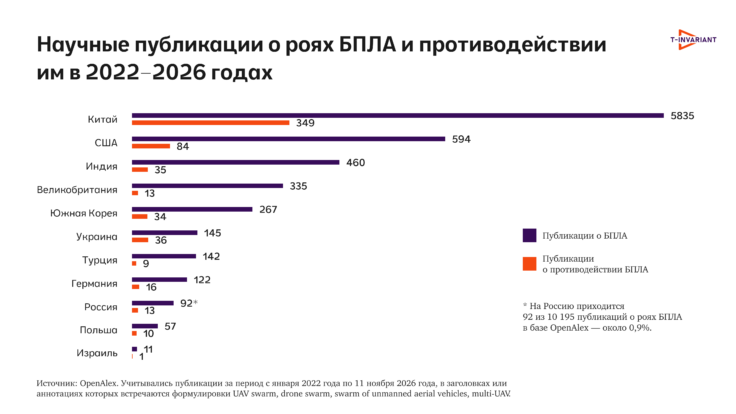
China leads in the number of publications with 5,835 papers — about 63 times as many as Russia and almost ten times as many as the US (594). Ukraine has one and a half times as many publications as Russia: 145 publications versus 92. In research on countering drones, the gap is even wider: 36 papers versus 13, or almost three to one.
That said, the number of open publications is not a direct measure of a country’s technological capabilities. Not all research makes it into OpenAlex, and some military developments may remain classified. Still, the data point to a significant gap between Russia and the leading countries in the number of published papers on swarm technologies.
T-INVARIANT BACKGROUND
Vyacheslav Abrosimov (b. 1952) is a Doctor of Technical Sciences, holds the academic rank of senior researcher, and is a corresponding member of the Russian Academy of Rocket and Artillery Sciences. He is a leading researcher at MJRTC. His work focuses on group control of drones and robots (swarms and “collectives” of autonomous vehicles), multi-agent systems, and the use of artificial intelligence in weapons. His publications include the monographs Group Motion of Intelligent Aerial Vehicles in an Antagonistic Environment (2013) and Collectives of Intelligent Aerial Vehicles (2017). According to the Russian Science Citation Index (RSCI), Abrosimov has 94 publications and 416 citations. International databases list 36 of his works.
In “Machine Learning Model of Swarm Evasion from the Influence of Antagonistic Environment,” Abrosimov and his co-authors write:
“The scope of this work is limited to the problem of penetrating counter-drone defenses (CDD) with small-class drones (mini-, micro-, and nano-UAVs). Their distinguishing features are extremely small geometric and reflective signatures. As a result, powerful Russian ground-forces air defense systems, designed for other purposes, prove to be of little use in detecting and identifying small-class UAVs and show a low kill probability even with gun armament, while expending large amounts of ammunition, etc. Meanwhile, a swarm of such UAVs costs no more than a few hundred thousand rubles. How well such swarms can accomplish various military-technical tasks depends substantially on the technologies used to build the counter-drone defense system, as well as on the UAVs’ strategies of action, both individual and especially collective. The entire range of problems involved in small-UAV swarms carrying out various missions (reconnaissance, logistics, penetration of a guarded facility (the ‘diffuse bomb’ problem), support missions, etc.) comes down to planning problems solved by means of optimization methods, heuristics, machine learning, artificial intelligence, etc.”
Curiously, to train their neural network model, the military institute’s researchers turned to Google’s Colab cloud platform and an NVIDIA Tesla T4 GPU released in 2018. The paper says so outright:
“The neural network model was trained on the Google Colab online platform in a runtime environment with an NVIDIA Tesla T4 GPU. For 30 swarm objects and 1,000 epochs, with images visualizing the process generated every 100 steps, training took approximately 2.5 hours. Training time depends substantially and, as it turned out, nonlinearly on the size of the swarm for which a strategy is being developed. In particular, for a swarm of 200 objects, training takes 13.8 hours, and for 300 objects, as much as 25 hours.”
What do these numbers tell us? In 2025, a Russian Defense Ministry research center builds its model on a free foreign service using a GPU from 2018, and two and a half hours of such computing would cost about two US dollars at commercial rates. And when the researchers try to scale the task up, training time rises sharply — 2.5 hours for thirty vehicles, 25 hours for three hundred — and that is where the experiment stops.
According to user estimates, a single session in the free version of Google Colab lasts no more than 12 hours, a session closes automatically after 90 minutes of inactivity, and the monthly GPU allowance is around 30 hours (although Google itself stresses that access to resources is not guaranteed and that usage limits are dynamic and change over time). Twenty-five hours of continuous computation does not fit within these constraints.
The published data do not reveal whether the institute’s staff paid for the computing time. Nor is it known why they chose Google Colab or whether the center had computing capacity of its own for tasks like these. Still, the very fact that Russian military researchers used an American cloud service is striking, given the sanctions and the Russian authorities’ policy toward foreign tech platforms.
CONTEXT
“The President Has Spoken — We Will Strangle Them”
In 2025, around the same time the paper came out, Putin said that “we need to strangle foreign services like Zoom and Microsoft, which haven’t fully left Russia and are holding back the development of the domestic IT sector.” “The president has spoken — we will strangle them,” Russia’s Minister of Digital Development Maksut Shadayev responded.
Google was among the first foreign tech companies the Russian authorities set out to “strangle.” They brought a whole arsenal of measures to bear: administrative fines and turnover-based fines, penalties in lawsuits filed by media outlets, and asset seizures. Over time, the process reached hyperbolic, almost absurd proportions.
According to media reports, the claims of Russian TV channels against Google for failing to comply with court rulings to restore their YouTube accounts, including accrued penalties, reached the following amounts:
• In late October 2024: 2 undecillion rubles, that is, a 2 followed by 36 zeros.
• By early December 2024: 8 undecillion rubles, that is, an 8 followed by 36 zeros.
• As of February 17, 2025: 2.8 duodecillion rubles. A duodecillion is a 1 followed by 39 zeros.
Abrosimov and his colleagues make no secret of the context of their research. In both the introduction and the conclusion, they refer to “the experience of the special military operation in Ukraine” [the Kremlin’s official term for the war against Ukraine — T-invariant]:
“‘Antagonistic environment’ means an air defense system. The goal of the research is stated without any camouflage: ‘developing an approach to solving a practical problem — getting a UAV swarm to penetrate a facility protected by a defense system.’”
The authors describe the problem as follows. At altitudes of up to 300 meters, individual micro- and nano-drones can be spotted by enemy optics only at a range of 500–700 meters when viewed from the side and 200–400 meters when the drone is flying head-on toward the observer. Mini-drones can be detected at a range of up to two or three kilometers. Combining optical and electronic methods increases the detection range by a factor of 5 to 14, to six to eight kilometers. At altitudes above 500 meters, however, detection becomes difficult.
At ranges of up to ten kilometers, a dense swarm of a hundred vehicles may be perceived as a single large object — “a cruise missile, a small aircraft” — or sometimes as a flock of birds. Individual vehicles with a radar cross-section of no more than 0.01–0.05 square meters, by contrast, can be reliably detected only at a range of two to three kilometers. The authors also examine the capabilities of the Buk surface-to-air missile (SAM) system, which can engage up to 24 targets simultaneously.
The simulation results are as follows. A dense swarm of a hundred objects, each 20 centimeters in size and spaced at safety intervals of the same 20 centimeters, fits into a cube just over a meter on each side. Such a swarm can be wiped out entirely by a single munition with a 50-meter kill radius, even with significant aiming errors. But if the same vehicles are strung out in a line at intervals of three to five meters, the same munition can hit no more than 20–30% of the swarm.
Up-to-date videos on science during wartime, interviews, podcasts, and streams with prominent scientists — subscribe to the T-invariant YouTube channel!
As the authors see it, a swarm of such vehicles “costs no more than a few hundred thousand rubles,” whereas repelling its attacks with SAM missiles is “economically unjustified… and leads to the rapid depletion of the SAM systems’ combat resources and their subsequent inability to repel a possible follow-up strike by aircraft and precision-guided weapons.”
What’s more, the solution to this problem costs essentially nothing: all it takes is changing the geometry of the formation. A swarm that can vary its density depending on the situation flies in a compact group on approach, saving on communications, navigation, and coordination, and then, at the right moment, disperses into a cloud.
Abrosimov has worked on this subject for many years. In 2013, he published the monograph Group Motion of Intelligent Aerial Vehicles in an Antagonistic Environment. It has been cited 50 times, making it his second most cited work.
In fact, 2013 marked a turning point for Abrosimov: he switched from civilian research to military topics. That same year, he published the papers “A Multi-Agent Approach to Describing Aerospace Attack Scenarios” in Aerospace MAI Journal and “A Model of Group Flight of Unmanned Aerial Vehicles in an Emergency.” Both were co-authored with Vladimir Goncharenko, whose research group at the Moscow Aviation Institute (MAI) and the ICS RAS, judging by OpenAlex data and an analysis of key authors’ publications in the RSCI, forms the core of Russia’s scientific school of swarm technologies.
T-INVARIANT BACKGROUND
Other Works by Vyacheslav Abrosimov
“Issues in Formalizing the Motion Trajectories of a Flock and a Swarm of Controlled Objects” (2014).
“Modeling Terrain Monitoring in an Active Hostile Environment Using the Property of Agent ‘Sacrifice’” (2015).
“Necessary and Sufficient Conditions for Agent ‘Self-Sacrifice’” (2016).
The monograph Collectives of Intelligent Aerial Vehicles (2017), Abrosimov’s most cited work, with 53 citations.
“Behavioral Strategy of an Autonomous Robot in a Counteracting Environment” (2017), co-authored with Petr Skobelev, head of the Samara school of multi-agent systems.
“Sacrifice as Paradigm of Robot Behavior in Group” (2019).
“Synthesis of Chaotic Spatiotemporal Structures by a Swarm of Controlled Objects” (2021).
What About Ukraine?
In Ukraine, research on swarm technologies is concentrated in a handful of scientific centers. According to OpenAlex, the leader is the National Aerospace University “Kharkiv Aviation Institute” (80 papers). It is followed by Igor Sikorsky Kyiv Polytechnic Institute (54), Lviv Polytechnic (29), the Ivan Kozhedub Kharkiv National Air Force University (26), and the Kyiv Aviation Institute (24). Research in this area is also carried out at the Glushkov Institute of Cybernetics, the National Defence University of Ukraine, and the State Scientific Research Institute of Armament and Military Equipment Testing and Certification.
Ukraine also has a direct counterpart to Abrosimov’s research — and it was published earlier. In 2024, Oleg Fedorovych, Dmytro Kritskiy, Leonid Malieiev, Kseniia Rybka, and Andrii Rybka of the Kharkiv Aviation Institute published the paper “Military logistics planning models for enemy targets attack by a swarm of combat drones.” The problem is the mirror image of the Russian one: rather than getting a drone swarm through air defenses, the goal is to plan a massive strike by combat drones on enemy targets.
But that is not the main difference. Ukrainian military research institutions publish papers based on empirical data gathered during the war. That same year, 2024, the Kharkiv Air Force University and the National Defence University put out a paper titled “Regarding the Features of the Combat Application of FPV Drones in the War between Russia and Ukraine,” and the National Academy of the National Guard of Ukraine, together with the same university, published an article titled “Main Trends in the Use of Unmanned Aircraft in the Russian-Ukrainian War.”
Russian researchers, for their part, cite “the experience of the special military operation” to justify the relevance of their work, yet they do not offer a single figure drawn from that experience. All the specifications in Abrosimov’s paper come from open sources on air defense and from monographs, not from combat reports. One side publishes observations; the other publishes justifications.
A Closed Field
Experts interviewed by T-invariant are cautious in assessing how far Russia may be lagging behind in cutting-edge military technology.
“Comparing open publication counts makes sense when all else is equal, and especially in basic science. In applied science, and all the more so in military affairs, effectiveness is demonstrated by other indicators. These numbers say only so much about where the warring countries stand relative to each other in practical terms. Some things aren’t published for reasons of secrecy: in the 1940s, papers on nuclear fission vanished from journals precisely when the subject became secret and even top secret. Nor can there be a direct comparison with China. Universities there are under very heavy pressure to publish, because publications are used as a measure of performance. And given that China has many times more universities than other countries, simply for demographic reasons Chinese authors usually win on sheer volume on more or less general topics,” a former senior executive at Russian state corporations that worked with dual-use technologies told T-invariant.
The expert’s argument about China’s numerical advantage, however, can be checked against the same OpenAlex database. While China outpaces Russia 63-fold in the total number of publications on swarm technologies, its lead is even larger, 78-fold, in the number of papers with ten or more citations.
The small number of Russian publications on swarms may point either to a shortage of specialists in the field or to their lack of motivation to publish their findings, says Pavel Luzin, a senior fellow at the Saratoga Foundation.
“Maybe there’s just no one to write for, because the small circle of specialists in the field already know one another and share information directly rather than through publications. But it’s unlikely that drone swarms have gone ‘for official use only,’ into restricted publications. Even if restricted collections of papers have made a comeback, it’s in negligible numbers. And there would be no point to it anyway. If something isn’t in the academic and industry literature, then most likely the state of affairs in that field is just what you’d expect — that is, there’s nothing there,” Luzin argues.
T-INVARIANT BACKGROUND
Why Does the Defense Ministry’s Main Research Center for Advanced Weapons Run Its Model on Google?
The Russian military has at least two centers with computing capacity. The first is the Era military innovation technopolis in Anapa, established in June 2018. Its scientific director is Mikhail Kovalchuk. Organizations that also have computing resources took part in building Era — the nuclear center in Snezhinsk (RFNC-VNIITF) and the Ruselectronics holding company (part of Rostec). There is no independent, verifiable data on the capacity of these systems. The second is the National Defense Management Center (NDMC), housed in the General Staff building in Moscow at 22 Frunzenskaya Embankment. Its tasks include “forecasting the development of armed conflicts and drafting proposals for the country’s leadership.”
So the Defense Ministry does have computing capacity. However, the NDMC is likely geared primarily toward command and control and runs on Russian-made operating systems, while the resources of the Era technopolis are intended for its residents in Anapa. MJRTC, meanwhile, is a separate institution based in Moscow. According to available information, neither the NDMC nor Era’s computing infrastructure is a dedicated cluster of the GPUs needed to train neural networks. So a researcher at a Moscow military research institute who needs a GPU for a few hours does not turn to the NDMC or travel to Anapa.

Luzin does not find it unusual that researchers at a military institute published a paper for which they used Google’s cloud computing.
“Russia needs people with the right qualifications, the right scientific and industrial base, and a favorable institutional environment. None of these is in satisfactory shape in Russia,” Luzin is convinced.
On their own, the military institute researchers’ publications and the analysis of the OpenAlex database do not make it possible to determine how far Russia lags behind in swarm technologies. Still, both the paper’s authors and T-invariant, based on its own check, point to a significant gap in publication activity on the subject.
A New Circus or a “Combat Neural Net”?
Russia’s technological lag, both overall and in the military sphere in particular, is a regular theme for the Z community [the letter Z, painted on Russian military vehicles at the start of the full-scale invasion, became a symbol of support for Russia’s aggression against Ukraine — T-invariant] and pro-war military bloggers. In November, there was much discussion in these circles of the Moscow authorities’ decision to put 66 billion rubles into building a new circus instead of developing a “combat neural net for controlling drones.”
Z-blogger Zhivoff put it most vividly:
“Listen, if Moscow is spending 66 billion to build a circus — not a combat neural network, not a training center for drone pilots, not an institute of some kind of applied electromagnetism, or combat training centers, or a research institute for modern robotics — then the end of the special military operation must be near. Any minute now they’ll cut a deal in Abu Dhabi, and we’ll be ruling the world together with America, selling gas to Europe, and building circuses. Right?
“I mean, if they’ve got money to burn and they’re spending it on circuses, peace must be just around the corner. Why would we need 33 combat neural nets of our own to control drones at 2 billion apiece when we can build a whole CIRCUS in Moscow for that money!!!”
The drone war between Ukraine and Russia goes on, with the advantage shifting back and forth. An ever larger role in it is played not by individual drones but by heterogeneous attacks, that is, the coordinated use of different types of weapons, each performing its own task. Russia has long used this tactic. Geran drones [the Russian version of the Iranian Shahed — T-invariant] are launched in waves together with cheap decoys and cruise and ballistic missiles to overload and exhaust air defenses.
In November 2026, Ukraine demonstrated an even more sophisticated version of this kind of attack when it struck the Crimean Bridge. According to Volodymyr Zelensky, the operation lasted several weeks, consisted of seven stages, and involved 11 types of drones and missiles. First, air defense assets, radar stations, and electronic warfare systems were hit one after another; then the bridge itself was struck. A road span collapsed along with its arch.
An important detail of the attack came to light on November 18: the Ukrainian Armed Forces used “flying modems” — a network of relay drones that provided video links between the strike drones and missiles and their operators. Thanks to the live feed, operators could steer the vehicles through a dense web of Russian air defense and electronic warfare assets. Dozens of relays helped keep communications up even when some of them were shot down or jammed during the operation. The system also made it possible to extend the range of the drones and missiles and to hit targets deep inside enemy territory. On top of that, operators could guide the vehicles to their targets more precisely. This is one more step toward heterogeneous swarms, in which different types of drones perform different tasks and interact with one another.
Another example of how such technologies are developing is the Ukrainian company Swarmer. It builds software that works with different types of UAVs. The operator sets a search area and marks targets on video from a reconnaissance drone. The strike drones then decide on their own in what order to attack. As a rule, the drones work in “scout plus striker” teams. For now, such groups are relatively small — up to 25 vehicles. But the next stage in the development of unmanned technologies apparently lies precisely with systems of this kind.
An artificial intelligence expert interviewed by T-invariant, who asked to remain anonymous, believes that against this backdrop, Russian scientists’ focus on swarms of small, identical vehicles looks somewhat strange. Such swarms are easier to control, but in the specialist’s view, they are less effective than heterogeneous ones.
“The Crimean Bridge case is very interesting in this regard. It was missiles that brought down the arch, but for a whole month before that, drones had been attacking the bridge and the fortifications on its approaches. They were the ones that suppressed the electronic warfare and air defense systems. And swarms were at work there, too, but not classic ones like those described in the paper by the Russian advanced weapons institute. These were so-called heterogeneous swarms: a swarm moves in, but all the drones are different — some carry explosives, others do reconnaissance, still others draw off air defense forces, and so on. It’s something like a carrier strike group, where the attacking is done by the aircraft and destroyers, while the carrier itself only defends itself. But in Russia, judging by the scientific papers, it’s the same old approach: homogeneous swarm — reconfiguration geometry — attack run. And that looks a bit outdated,” the specialist notes.
All in all, neither the full-scale war that began in 2022, nor the national project on unmanned systems, nor multibillion-ruble grants, nor Ukraine’s use of swarm technologies has led to any noticeable rise in the number of Russian scientific publications on drone swarms. At any rate, T-invariant’s analysis of open research on the subject over ten years, based on OpenAlex data, showed that the number of publications in 2025 and 2026 remained roughly at the 2016 level.
Whether there is a hidden part of this research in the form of a classified R&D program on swarm technologies cannot be determined from open sources. One thing, however, has nothing to do with secrecy: for their modeling, Abrosimov and his colleagues used a cloud service from the American company Google and an NVIDIA Tesla T4 GPU released in 2018. The paper describes no flight tests.
Judging by the published study, the Defense Ministry’s lead center for advanced weapons lacked computing equipment of its own to run a model of a swarm of 30 notional vehicles. And this is not an isolated curiosity but perhaps a vivid illustration of the state of Russian science under sanctions and a war that has now been going on for almost five years.