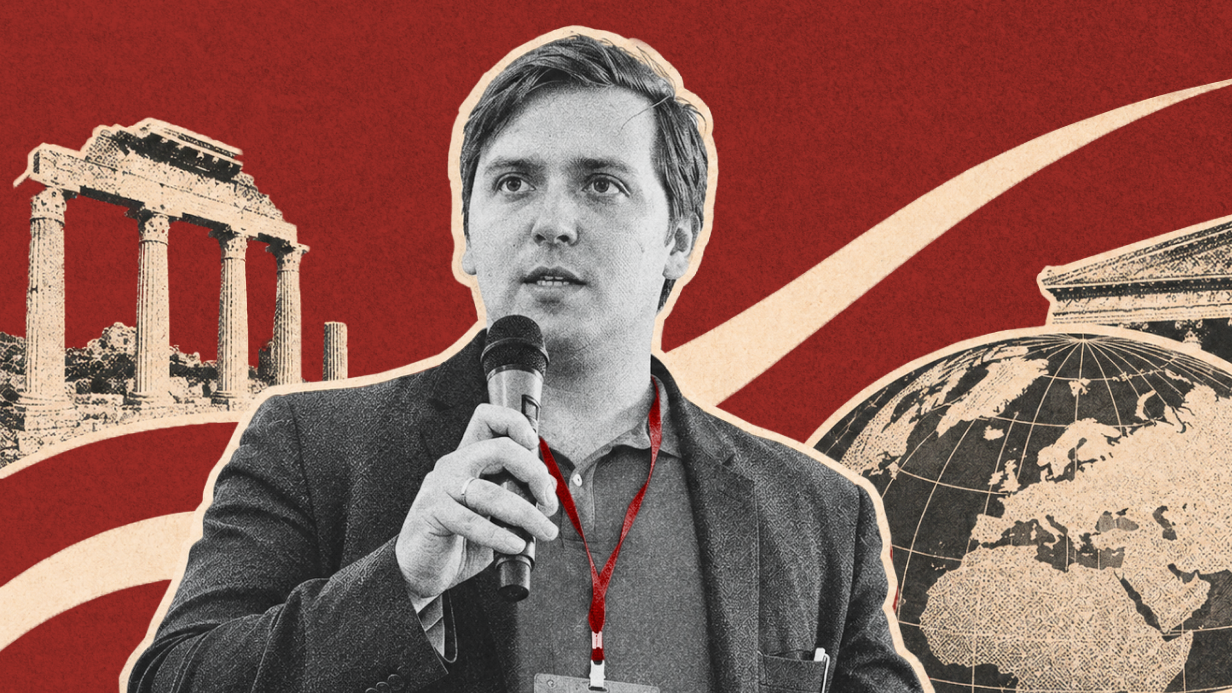
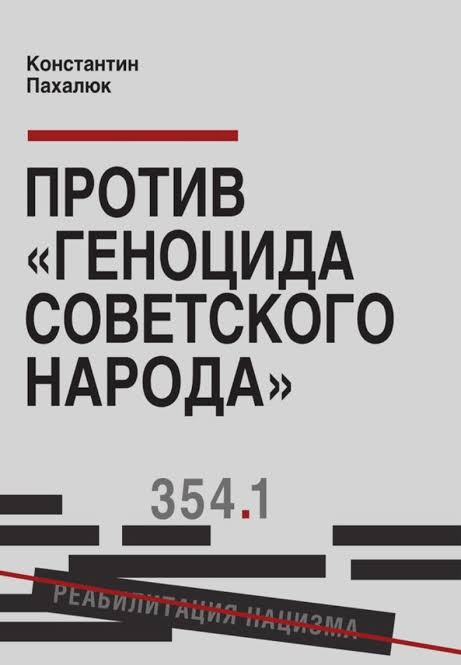
Where does the myth that “we have never attacked anyone” come from? How did the memory of the Great Patriotic War [the Soviet and Russian name for the war against Nazi Germany in 1941–1945 — T-invariant] become a tool of state propaganda and a justification for the current war? In an interview with T-invariant, historian Konstantin Pakhalyuk discusses his new book, Against the “Genocide of the Soviet People,” and explains why the Russian authorities are promoting the concept of the “genocide of the Soviet people,” which pages of history they prefer to keep quiet about, and how ideas about the past shape the way society responds to what is happening today.
On April 9, 2026, President Vladimir Putin signed a law imposing criminal liability for denying the “genocide of the Soviet people” — and now the analytical articles I have written in recent years criticizing this unscholarly concept could “earn” me up to three years in prison. Ironically, on the very same day the Supreme Court of the Russian Federation declared International Memorial an extremist organization. Earlier still, in late February, news broke that Moscow’s GULAG History Museum would be turned into a Museum of the Genocide of the Soviet People, and on April 19, the official day of remembrance of that genocide, a public garden in Tomsk dedicated to the victims of Stalin’s repressions was closed. Behind these remarkable coincidences, one can make out the moral foundations of militarized authoritarianism: forgetting the crimes committed by “our own” in favor of imagining “us” as the victims of other people’s crimes.
(Here and below, the quoted passages are excerpts from Konstantin Pakhalyuk’s book Against the “Genocide of the Soviet People”, prepared with the support of the Juliusz Mieroszewski Centre for Dialogue)
T-invariant: Why did it seem important to you to collect your articles into a book of their own?
Konstantin Pakhalyuk: When this whole campaign around the “genocide of the Soviet people” was just getting started, at the turn of the 2010s and 2020s, I was skeptical of it. I thought: well, here’s yet another budget-skimming project from the Presidential Administration. It’s not my party, and I have no intention of helping out. Naturally, within our small circle of specialists, we took a dim view of the campaign.
But then it outgrew the level of short-term propaganda and turned into a consistent state policy — with institutions, with pressure, and, down the line, with criminal penalties for “denial.” As the campaign unfolded, I began publishing a series of critical articles. And gradually I noticed that people who were still in Russia had gone silent, even though they had opposed it privately before. It’s clear enough why. But I had left Russia, so what was the point of my keeping quiet? When the law making it a criminal offense was passed, I decided to bring all the articles together — and the result is a book about how the memory of Nazi crimes developed in the USSR and Russia, and why the state decided to make a sharp turn toward this concept. After all, this is not just another historical and ideological concept; it is one of the mechanisms for justifying the current war.
T-INVARIANT BACKGROUND
Konstantin Pakhalyuk was born in 1991 in Kaliningrad. In 2020, he defended his Candidate of Political Sciences dissertation [the Russian equivalent of a PhD — T-invariant] at MGIMO University on the topic “Discursive Foundations of the Interpretation of History in the Context of Contemporary Russian Domestic and Foreign Policy.” His research interests include memory politics, in particular the history of the Holocaust and Nazi crimes. He is currently studying Israeli foreign policy and Russian “Z-militarism” [the letter Z has become a symbol of approval of Russia’s aggression against Ukraine — T-invariant]. He writes columns for several Russian-language outlets. In 2024, Russia’s Ministry of Justice added Pakhalyuk to its registry of “foreign agents.”
On the one hand, the authorities and their agents keep telling Russians that “we are the victims of genocide”; on the other, they justify the “denazification” of Ukraine with methods that historians compare to Nazi colonization practices, in particular Generalplan Ost. And the stance some people take simply astonishes me. Take, for example, the polemicist Aleksandr Dyukov, who for decades worked professionally on the Holocaust and wrote about Nazi crimes. You’d think he knew the subject inside out! Yet today he doesn’t just support the aggression — he has sunk to calling for the ethnic cleansing of Ukrainians. That is really what the book is about: how, while talking about “the suffering of our own people in the past,” one can fail to notice one’s own crimes today.
What’s Wrong with the “Genocide of the Soviet People”?
Undoubtedly, the Russian authorities “peeked” at how Armenians promote the memory of the Armenian Genocide, Jews the memory of the Holocaust, Ukrainians the memory of the Holodomor, and the countries of Eastern Europe the memory of communist crimes. Yet they concluded that it all comes down to the status of “we are the victims of genocide” supposedly serving as a kind of indulgence: “the suffering of our own” can be converted into “our merits” and even presented as a justification, an answer to any counteraccusations of other crimes. The Russian authorities’ innovation lies “merely” in the remarkable energy and astonishing persistence with which they have taken up the “genocide of the Soviet people.” It is as if officials had set themselves the goal of winning this “unofficial genocide championship,” failing to notice that promoting the memory of victims is, in reality, not a matter of labels and abstract concepts but of creating evidence-based narratives about specific human fates and convincing others that “our memory” matters. And in the case of the “genocide of the Soviet people,” that memory, on closer inspection, turns out to be not “ours” but the state’s, riddled with gaps, omissions, and distortions.
T-i: What is it about the “genocide of the Soviet people” that you object to so strongly?
KP: First, it is a propaganda campaign imposed by directive from above, and it prescribes a single, standardized view of the Nazi occupation. It is simply wrong for journalists and officials to dictate to researchers how they should study particular historical events.
Second, it is historically absurd to claim that the Nazis had some single policy directed against “the Soviet people.” The point is not only that the “Soviet people” is itself a product of political imagination, but also that Nazi extermination policy was driven by imposing the Nazis’ own, highly specific categories on the occupied population — categories that determined the fundamental approaches of that policy, from deciding whom to turn into collaborators to deciding whom to exterminate, and how.
The third reason is that it is questionable to apply the concept of genocide to every kind of mass crime. Of course, the term is used that way outside professional circles, and there’s nothing to be done about that.
The fourth is the model of memory that underlies it all. For me, after all, the memory of Nazism means reflecting on why all of this happened and how thousands of people became complicit in the crimes. What is being done in Russia is a vivid example of victimhood nationalism, a nationalism grounded in the feeling that we are the victims. Its essence is simple: not only to cast yourself as the eternal victim of other people’s crimes and injustices, but also to keep throwing tantrums about it, so as to focus public attention on how “we are being wronged” and thereby justify your own policies under the slogan “a victim is allowed anything.” A country that considers itself a great power deliberately plays the injured party so that its citizens think less about the crimes committed in their name or with their complicity. Of course, the “genocide of the Soviet people” is part of a broader discourse of “historical Russophobia.” For many years, liberal critics of Russian memory politics focused on the heroic narrative, and even today they continue to see the glorification of heroism as the root of the problem. I, by contrast, argue that it is precisely the way the tragic past is handled that serves as the “moral foundation” for this years-long aggression. In fact, a separate chapter of my book is devoted to how talk of “denazification” has, in practice, produced a whole body of texts calling for the destruction of Ukraine, for repression, and for ethnic cleansing.
In October 2024, Russia held the “Destroyed Childhood” campaign, dedicated to children who were victims of the “genocide of the Soviet people.” It was initiated by the National Center for Historical Memory under the President of the Russian Federation (“Natcist,” if abbreviated). The campaign was timed to coincide with the anniversary of the tragedy in Yeysk. According to the official announcement, in 1942 “the Nazis coldly and methodically murdered 214 children from the Yeysk orphanage. The mass murder was carried out by members of Sonderkommando 10a of Einsatzgruppe D. The children were taken away in special gas vans. During the journey, carbon monoxide was released into the back of the trucks, and the children had no chance of escaping death. The tortured children were aged 4–7.” An unsophisticated reader would come away with the impression that the children were killed simply because they were children — extra mouths to feed, the future of a Soviet people that was being exterminated. But that impression is false. They were murdered for a different reason: because they had disabilities.
T-i: We’ve all heard about the Jewish and Roma victims. But why have first the Soviet and now the Russian authorities so studiously ignored the fact that in Yeysk, for example, the victims were not just children but children with disabilities?
KP: It isn’t always ignored, but it is underestimated because of a widespread rejection of the very idea that the Nazis themselves singled out different groups of victims and treated them differently — as if understanding the perpetrators’ logic meant denying that the suffering was shared.
Russia has no serious historiography of Nazi crimes. The sheer volume of propaganda creates a false impression that the subject has been well researched. In the entire Russian-language sphere, there is not a single book that gives a proper overall account of Nazi crimes, even if only on the territory of the Russian Federation. There is not a single book that examines how the Nazis treated Russians. This is, of course, a failure, and all this rhetoric about the “genocide of the Soviet people” hardly helps produce even a basic understanding of what happened. The problem is that Russia has few historians, and because pay is so low, many university departments are staffed by people who can teach courses but cannot do research, since they have neither the time nor the energy for it. The result is a paradox: there is little money, yet that doesn’t mean only the enthusiasts are left.
For almost ten years now, the state has in effect been saying through its policy, “Nazi crimes need to be studied” — and the field has drawn in many outsiders and opportunists. But that is not scholarship. Unfortunately, many people think that studying Nazi crimes means paraphrasing individual documents in order to show how bad the Nazis were.
Top news on scientists’ work and experiences during the war, along with videos and infographics — subscribe to the T-invariant Telegram channel to stay updated.
Remarkably, as late as the end of the 2010s, almost no one was working even on the concentration camps and death camps. In Russian, for example, no one had written about Majdanek, which I went on to research. All that was available were a few translations from Polish. The same was true of Treblinka. In 2021, a Russian-language search on Yandex turned up only a completely bare-bones Wikipedia article and translations of works by Jürgen Graf, who denied that Treblinka was a death camp. As a result, our books became the first in Russian both on Majdanek and on Treblinka.
As for people with disabilities, the problem is not only one of historiography. This group was long forgotten in the West, too. The people who are remembered are those who leave a record of themselves and who fought for that memory. People with disabilities, by contrast, are the ones who go unheard, and often the ones who are physically unable to bear witness themselves.
In Russia, the subject was raised by the historian Irina Rebrova, who has worked in German academia for many years. In the late 2010s, she was the first to take up this topic, and from the very start the project grew beyond the scope of a personal research effort: she drew media attention to it, organized a traveling exhibition, and initiated collaborative research. She brought together local enthusiasts and amateur regional historians. In other words, while the state was spending millions on “genocide” propaganda, the actual work of studying the history of people with disabilities as victims of Nazism on Russian territory, and of preserving their memory, was being done by a Russian woman who had moved to Germany and was working on German academic funding.
An Understudied War amid Peak Propaganda
At the same time, any in-depth study of Nazi crimes leads to parallels that the Russian authorities find unpleasant. They began by wiping out the opposition and spreading demagoguery about a conspiracy of the “global financial elite,” went on to persecute gay people and Jehovah’s Witnesses, and subjected opponents of the system to torturous conditions in custody. Then they declared the Poles an “artificial nation.” Yes, I was talking about the Nazis just now.
T-i: How is it that World War II, which is talked and written about everywhere, remains so poorly studied?
KP: World War II is a highly ideologized subject. It’s dangerous not only because of the state but also because of a large part of society, which cannot calmly discuss something that has been boiled down to two phrases: “genocide of the Soviet people” and “the Great Victory.” What’s more, the history of Russia has not been separated from the history of the USSR and the Russian Empire. It is precisely the absence of deliberate cultural work in this area that keeps imperial myths reproducing themselves, sometimes without anyone even realizing it.
At the level of society, for example, this means that World War II shrinks down to the Great Patriotic War, while the independent processes that unfolded in Eastern Europe are pushed to the margins. People lived there too, with their own history and their own ideas, and not all of them were eager to become Soviet citizens or to live under communism. A well-known historian who grew up in Grodno once told me that as a child he asked his parents how the war had started in 1941, and they replied: for us, the war started in 1939; in 1941, the Germans simply showed up.
This distorted lens leads people to underestimate a great deal. For instance, the fact that the Soviet Union entered World War II not on June 22, 1941, but on September 17, 1939, when it launched its offensive into eastern Poland. The distorted lens also gets in the way of comparing the occupation policies: the Nazis, for example, destroyed the Polish elite as a distinct category, while the Soviet Union, at Katyn and elsewhere, killed more than 22,000 Polish prisoners who had been deemed “patriots” and “bourgeois nationalists.”
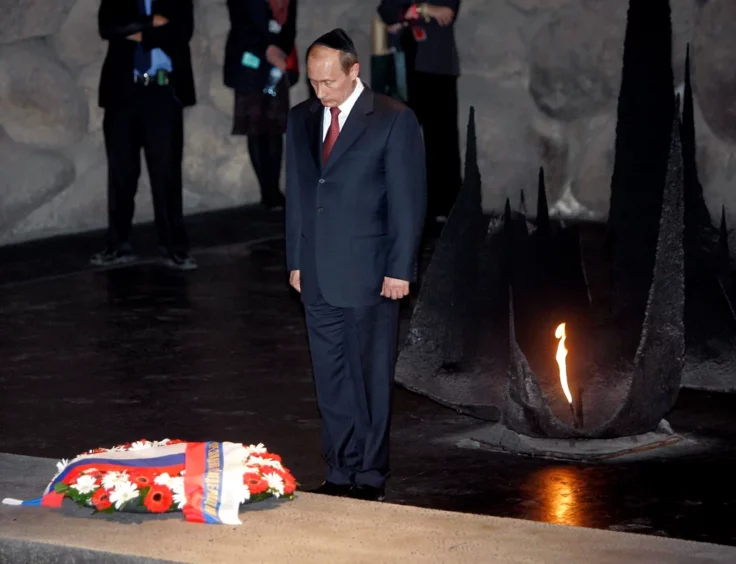
Let me give another example, involving the Holocaust. In the late 2010s, Putin grew fond of saying that 40% of the six million Jews who were murdered were Soviet Jews — “our tragedy.” He didn’t pull the figure out of thin air; it comes from the work of historians. But today, of course, that figure needs to be decolonized. First, it counts the Jews killed within the borders of the USSR as of June 22, 1941, which means it includes more than 1.5 million Jews from the Baltic states and from the parts of Poland and Romania that the USSR annexed in 1939–1940. They were Soviet only in a very loose sense, and that matters for understanding the history of the Holocaust, too. Second, as the historian Alexander Kruglov writes, up to 68,000 Jews died on the territory of Russia itself, while the rest died on the territory of what are now independent countries. One could try using the wartime borders of the RSFSR [the Russian republic within the Soviet Union — T-invariant], which would add 40,000 Crimean Jews, but after 2014 such a move unwittingly plays into the annexation of Crimea. In other words, a historian can talk about Soviet Jews, the Jews of the USSR, and study them, but in my view, one cannot simply borrow this model and make it the basis of public discussion and memorial spaces without caveats that set present-day Russia apart from the USSR.
So it turns out that even the number of murdered Jews is far from straightforward. And this brings us to another, more complex problem: in the 2010s, two narratives — one about the liberation of Europe from Nazism, the other about Nazi crimes — became Russia’s only response to all the heated Eastern European debates over the legacy of the 1930s and 1940s in Europe. Many in Moscow genuinely disliked the accusatory slant toward the USSR that often came through, although it would seem one didn’t have to take this personally: one could have depoliticized the past and invested in getting more Russian scholars, artists, and filmmakers — in short, people in science and culture — to engage in dialogue. But from the second half of the 2000s, the emphasis shifted to deliberately politicizing the past and provoking “memory wars.” And in the 2010s, everything came down to the media production of simple formulas: “we were preparing to repel aggression,” “we got our lands back,” “we defeated Nazism,” “we brought friendly politicians to power,” and so on. In other words, there was an intellectual regression. My colleagues in Poland once asked me point-blank: “So what happened to you Russians after 2014? You were doing such good cultural work here before that, so many projects, so much of everything — and then a complete U-turn.”
In general, this hodgepodge of history and propaganda is hard to untangle, because completely different things get filed under catchy labels. For example, the meaning of “collaboration” has been deliberately stretched: it is used to brand all anti-Soviet national movements, especially the Baltic and Ukrainian ones, as something “treacherous.” Here is an example. Recently, Lukashenko’s Belarus declared Vladimir Katriuk a participant in the “genocide of the Belarusian people” (he took part in the destruction of the Belarusian village of Khatyn and hid in Canada after the war — T-invariant). He was born in Northern Bukovina, which the Soviet Union annexed in 1940. A year later, the Germans arrived. Why on earth should a young Ukrainian guy stay loyal to this strange Soviet Union, which had only just shown up and occupied his homeland? Taking part in the destruction of Khatyn is a crime, but Katriuk is clearly not a traitor in any sense of the word.
Or take another popular image: “liberation.” In the book, I write in detail about how, for instance, the theme of Nazi crimes is tied to promoting the image of the Soviet soldier-liberator and to defining the events of 1944–1945 as “liberation.” Yes, it was liberation from Nazism, but not the granting of freedom, since the arrival of Soviet soldiers was followed by the installation of political regimes friendly to the USSR, the onset of repression, and much else. In some cases, it’s laughable even to hint at any kind of liberation. Take Bulgaria, on which the USSR itself declared war in 1944 (it was the Soviet side that declared war first) and whose political regime it then replaced. Russian propaganda is built in such a way that images of suffering under Nazi terror and of Red Army heroism have served to justify state policy.
What’s more, over the past decade it has become especially popular in the media to draw attention to the liberation of prisoners from concentration camps and from the death camps where Jews were murdered. But if you look more closely, in some cases there was no liberation at all — the Red Army arrived at the sites of camps that had already been destroyed — and in others, the troops freed prisoners whom the Germans themselves had left behind, simply as the front line moved forward. The Russian authorities don’t like being reminded of this. A couple of years ago, for example, the Russian ambassador to Israel, Anatoly Viktorov, launched an entire campaign against the Israeli historian Yaakov Falkov because Falkov, drawing on documents, said that the USSR knew what Auschwitz was but, like the Allies, did nothing to save the Jews and the other prisoners. Essentially, this is a major debate about military and political strategy and its pragmatics, but the Russian authorities don’t like anyone trying to weigh in on subjects that, as they see it, are the rulers’ exclusive preserve. The political scientist Vladimir Gelman has written about the rise of Russian authoritarianism as a process of pushing the masses out of politics; this is a small, symbolic instance of the same process: a historian being pushed out of the discussion of a particular past policy. And in this case, a foreign historian at that.
And even when we talk about the individual actions of soldiers, things aren’t simple either. A collaborative study came out recently on how Soviet soldiers raped liberated women prisoners of the concentration camps, Jewish women, and other women in the liberated territories. Drawing on dozens of women’s memoirs, the authors demonstrate that this was a significant problem. For women, especially those who had survived the concentration camps, sexual violence posed a serious threat. Soviet soldiers inspired fear because the violence was widespread. For obvious reasons, this subject cannot be studied in Russia either, and most Russians don’t understand how deep and painful a mark it has left on the family memory of people in Eastern Europe.
And the issue here is not so much the state’s reaction as society’s defensive reaction. Every country has painful subjects that are hard to study. But when all of this comes with pressure from the state, working becomes very difficult.
Of course, there remain plenty of subjects and problems that aren’t directly tied to the imperial borderlands but are also not getting enough attention. In St. Petersburg, for example, there is the historian and blogger Alexander Shmidke. His team noticed that Soviet partisans shot not only those they considered collaborators but also their families — women and children. Researchers are now trying to establish whether there was an order prescribing such actions. This is a typical example of what you can run into when studying World War II. People in Russia don’t want to hear about it and aren’t ready to take it in.
Sexual violence against women became widespread, and its victims sometimes included even former concentration camp prisoners, Jewish women among them. The historian Daina Eglitis brought together such testimonies and demonstrated that the threat of rape was one of the most important aspects of women’s experience of liberation. The rapists’ rhetoric boiled down to two claims: “We liberated you, so we have the right to demand sex,” and “The Germans wiped out the Jews wholesale, yet you survived, which means you slept with them — so sleep with us, too.” Yes, virtue and vice often go hand in hand, and this is a profound moral problem that calls for study, not silence.
T-i: Why has the subject of rape turned out to be so painful in Russia? How did it come about that Russians automatically take everything Soviet soldiers once did as something they themselves did?
KP: It’s the habit of saying “we” when talking about the actions of other people who are nonetheless “our own,” or of one’s own state. Yet only a handful are willing to reflect on the fact that “our own” can also be wrong and can commit crimes. Most people aren’t ready for that, because humanities education in Russia, and the social sciences and humanities as a whole, are weak. And, unfortunately, the longer the war goes on, the worse it gets. You can’t just sit in silence and at the same time learn to discuss serious subjects. Thoughts are born in words, in language. If you have a suitable circle of intellectuals and philosophers, then it’s possible. If you don’t, it isn’t. But even if there is such an underground circle, it means that only a few people are part of the intellectual conversation.
I was recently at a conference in Poland where people said all the right things about how Russians will need to be taught democracy, human rights, and so on. But what are the authorities doing in Russia right now? They are systematically teaching people to live under authoritarianism. They are teaching people not to notice the crimes committed by the state and the army in their name. The ability not to think about the crimes of one’s ancestors prepares people not to think about what is happening in places like Bucha.
As for sexual violence… The Russian historian Ksenia Sak has shown in her articles how the commissions that investigated the Nazi occupation often hushed up cases of sexual violence by Germans against Soviet women. These subjects were practically never discussed. And discussing such crimes when they were committed by one’s own side is even harder. When it comes to rapes committed by Soviet soldiers, many people view the subject through a Cold War template: it’s enemy propaganda, they say. Today, the reluctance to talk about sexual violence by Red Army soldiers has the same roots as the failure of #MeToo in Russia. Remember the story of Leonid Slutsky, who was accused of sexual harassment? Slutsky is still in power, while those who objected to him have been driven out of the country.
Russia still holds on to remnants of patriarchal culture, and rape is something “shameful.” On top of that, you have to understand that today’s ideas about what is permissible are completely different from those of that time. For example, I read an article about Poles who rescued Jewish women and hid them. It was life-threatening. But in return for rescuing them, they forced the women to have sex. Is that rape or not? By today’s standards, of course it is; it is sexual violence. Back then, I think, the men didn’t see it that way.
We are seeing the norm around marital rape change. Seventy years ago, marriage was seen as giving the husband an unconditional right to his wife’s body. That is no longer the case. The result is a clash of norms. It’s a difficult process for every country. But in Russia, public debate is less developed, because the public sphere is cut off from political action. So even before 2014 and before 2022, you could talk about a great deal, at an obvious cost, but there were no institutions that would allow those discussions to be translated into practice. Public debate went one way, political action another. Naturally, the number of people willing to take part and do something in the first arena kept shrinking. That is the tragedy of the entire liberal discourse of the 2010s: after 2022, its proponents either left the country or ended up semi-underground.
The Great Victory as a Reason to Be Proud of the Past
The image of radical evil in the form of Nazism is needed in order to revel in moral superiority, to cultivate a “sacred fury,” and to come down hard on anyone who can be lumped in with the Nazis, their descendants, or their “rehabilitators.” I probably don’t need to explain to my readers that Russians living today (a handful of veterans aside) have no direct connection to the victory over Hitler, just as today’s Germans have none to Hitlerism. Yet there is a link between declaring oneself “heirs of the Victory” and branding European politicians for their Nazi grandfathers: the search for unassailable grounds for one’s own moral triumph and for imputing inferiority to the other (branding someone for the wrong position of their body in physical space, or for a single word said once, follows the same logic). Authoritarian rulers give anyone who wants it the chance to feel like the “new nobility” without lifting a finger: it is enough that “Grandpa once fought in the war.”
T-i: Why do people so often compare regimes they dislike to Nazism? Why is it Nazism that we so often draw historical parallels with?
KP: An image of radical evil has formed around Nazism. In Soviet times, the story was about fascism as the highest and most perverted form of capitalism. In the 1990s, that framework faded away, but the habit of seeing something significant in these crimes remained. Meanwhile, in the West, a transnational culture of Holocaust memory was taking shape, in which Nazism is understood as radical evil. And that is exactly what appealed to the Russian authorities. The rhetoric of radical evil is easy to manipulate.
Remember 1999: the Balkans, NATO’s intervention against Yugoslavia. Back then, too, this rhetoric served as cover: Milošević as Hitler, the Kosovo Albanians as the Jews, the actions against them as genocide, and so a humanitarian intervention was needed. Russia opposed that rhetoric, but later, in 2008, it used the same rhetoric itself against Georgia: “genocide of the Ossetians, they must be saved.” And then against Ukraine.
The idea of absolute evil makes it possible to create a “cancel culture”: when someone assumes the right to decide what absolute evil is, they automatically decide that any connection to it is grounds for cancellation.
The story of the Austrian Hermann Gmeiner is telling. As a young man, he served in Wehrmacht units on the Eastern Front. But, by his own account, a severe wound and having his life saved by Russians changed his worldview. After the war, Gmeiner devoted his life to creating SOS Children’s Villages to raise orphans. Today such villages exist in more than 130 countries and territories. Gmeiner died in 1986. After the fall of Soviet power, several of these charitable centers opened in Russia as well. A few small streets were even named after him, including one on the outskirts of Pskov.
In March 2022, a pseudo-scholarly history forum called “Fascism 2.0” was held, where a student presented a paper on Gmeiner’s involvement in crimes in Pskov. There are no documents proving this. But while he was serving in the area, the Germans committed many crimes. Gmeiner, as a Wehrmacht soldier, was deemed complicit in them — and therefore Russian streets should not bear his name. After that, the street was indeed renamed, and local media headlines called the philanthropist a “Nazi.” It no longer mattered whether he had taken part in those crimes. Nor did it matter that he had created SOS Children’s Villages for children left without parental care.
I fully understand why Gmeiner is being canceled in Austria now: reports have emerged that he sexually abused children. Naturally, that is a reason to reconsider attitudes toward him and the monuments erected in his honor. But that is precisely the fundamental difference. It’s one thing to seriously examine a person’s individual record, and quite another to engage in sweeping accusations and petty moralizing, which Russian propaganda is full of. In the same way, the rhetoric of Ukraine as absolute evil is being ramped up today, people dig for Nazi and Jewish roots among European leaders, and so on.
T-i: When did the Russian authorities first take up the theme of the “genocide of the Soviet people”?
KP: It all started with a European Parliament resolution adopted in 2019, which stated that World War II was started by Hitler with Stalin’s complicity. The Russian authorities were very unhappy about it.
Speaking at the Lessons of Nuremberg forum, Vladimir Medinsky publicly declared that since the USSR stands accused of complicity in unleashing World War II, the Russian state must prove that it was the Soviet people who were the main victim. So that’s the logic: a victim is allowed anything, and the status of a victim nation supposedly serves as an indulgence for the authorities. On the whole, competition between genocides is not as bad as an attempt to say, “We are the victims, so we can do anything.” Still, this logic of victimhood nationalism is not a Russian invention.
The mythology of liberation has taken such firm root in the minds of Russian officials, many historians, and ordinary citizens that, even 80 years on, any substantive public discussion of those events has effectively been banned. And where one might have built a space for agon, debate, and dialogue — a way to make sense of the different experiences of the war and to overcome mutual grievances between people alive today who have no direct connection to those events — we see a riot of smugness under the saccharine, vulgar banner of “heirs of the Victory.” And this began even before February 24, 2022.
T-i: The cult of the Great Victory existed in the late Soviet Union and in post-Soviet Russia alike. But in recent years it has reached almost unbelievable proportions. Why do you think that is?
KP: It began in the late 2000s. That’s roughly when the authorities realized that turning to history works best for forging a macro-political identity. And it’s also the peculiar quasi-values language of Russian politics. History, after all, doesn’t really commit you to anything. It’s convenient to pick any storyline you like from history. What’s more, people are willing to listen, because there is a certain general familiarity with the events of World War II. It’s such a convenient shared value. What is our value? You can’t exactly say it lies in how much we steal. You can’t show off the palaces in Gelendzhik [a reference to the Black Sea palace attributed to Putin — T-invariant] in public. But the Victory is an excellent shared value. There isn’t really any other. What are Russians proudest of? As polls show, since the mid-2010s about 90% of Russians have been proud of their country’s history. To be proud of something else and to notice anything else, you have to move away from an imperial, state-centered worldview.
At the same time, Russian officialdom today doesn’t deny the hardship of everyday life at the front. The rhetoric runs more along the lines of “we went through all that frontline shit, but in the end we won.” In liberal circles, some people think Russia has a kind of cartoonish, picture-book heroic mythology. The mythology is there, but it isn’t the primitive Soviet kind. It can easily accommodate talk of idiotic commanders, huge losses, and so on. The main thing is that “in the end we won, we held our ground,” and all that. But talking about a Soviet soldier’s penis inside a Polish or German woman — that is forbidden.
Commemorative Dates: A Way to Remind Without Discussing
History can be part of intellectual debates that carry academic knowledge about the past into the public arena, connecting it to the present and to discussions of global issues. And even at this level the Holocaust is an uncomfortable subject, because for decades European debates have centered on questions of guilt and (co-)responsibility, on moral reflection, and on the voices of survivors. Today’s Russian public sphere has no use for any of this — it is even dangerous, because it prompts uncomfortable thoughts about Putin’s aggression.
T-i: The Russian government keeps introducing a huge number of commemorative dates connected in one way or another with the Great Patriotic War. I learned about some of them from your book. Why so many? Why not focus on one or two?
KP: It’s calendrical saturation. They want more dates tied to different events, so that there are more media hooks. What is a commemorative date? It’s a news hook you can time an event to. What media outlet is going to write about World War II on an ordinary day? You need a news peg. The state has more capacity to invent these dates, so it keeps introducing them. What’s more, the problem with these commemorative dates is that, on the one hand, they regulate how people engage with a particular topic, and on the other, they restrict it. Because around Victory Day there really are many problems one is not supposed to discuss. You just don’t talk about sexualized violence on that day. You have to admit, this love of commemorative dates means that we have no date at all when difficult subjects can be raised. As the saying goes, it’s one never-ending wake, one never-ending toast at a funeral.
The same goes for memorialization. The authorities keep drawing people into debates about memorials in public spaces. Is it acceptable to put up monuments to General Vlasov? Including in another country? What should a monument depict? Can Mannerheim be commemorated or not? It might seem that people have a chance to join the discussion. But this memorial discourse is utterly removed from any understanding of history. A debate over whether a monument to Vlasov is needed is a poor starting point for understanding what the “Vlasovite” movement actually was. It is simply not something you can understand by arguing about monuments. On the contrary, it all turns into a muddled “trial of history,” into a petty symbolic power over the people who took part in it.
The whole trouble with Russia’s public conversation about Nazi crimes is that it comes down to perfunctory condemnation rather than an effort to make sense of mass violence and of the psychology of killers and collaborators. And behind this lies a big subject: the individual’s relationship to a criminal system, and therefore the working out of an appropriate strategy of conduct, of a response to that system’s actions — in other words, that same question of responsibility. And here, remarkably, a parallel with the present day emerges: how one ought to behave in response to full-scale aggression. A significant part of the intellectual elite refused to support it, but it turned out that there was nothing in our culture that could suggest answers to this question; there were no ready-made symbolic mechanisms.
We have mechanisms for judging the past: “Stalin is an asshole,” “Hitler killed innocent people.” There is a tradition of criticizing the authorities, the elites, the intelligentsia, but not of reflecting on criminal collective action. Any conversation on this subject is mistakenly perceived as a collective indictment of the people, or is deliberately presented that way by provocateurs, although the point is something else entirely: we do not choose the situations we find ourselves in, but we are responsible for how we respond to them.
The study of history, on the other hand, can be genuinely useful here — not as a source of ready-made templates, but as a way to understand the dilemmas people have faced before, or to understand more deeply how norms have changed, so that individual historical examples don’t become instruments of manipulation. Take, for example, the right of states to send their citizens to war. Estate-based societies are one thing; modern societies, with mass armies that nonetheless “level out” the different classes, are another.
Do we need a memorial culture that explains why the country has to be defended? Yes. But we also need one that makes it possible to tell defense from aggression and, in the case of aggression, helps people understand what they have to do in order not to take part in it and to stop it. It’s professional soldiers who operate on the principle that orders are not to be questioned; civilian life cannot function that way. In Russia, the memory of Afghanistan and Chechnya lives on under the slogan “we did our duty and deserve respect,” although behind this lay an unwillingness to talk publicly about the nature of those wars. And yet, once again, the very Nuremberg Trials that the Russian authorities make such a fuss about established that carrying out a criminal order does not relieve one of responsibility.
Nuremberg: Once and for All
The Russian state marked the 80th anniversary of the Nuremberg Trials with great pomp. Their history has been fashioned into a single fantastical image: the Soviet Union as both the chief victim and the chief victor. It championed the idea of putting the Nazis on trial and gave their leaders their due at the Nuremberg tribunal, even though some of them were being shielded by the “perfidious Western allies” — and today Russia honors the memory of that justice, holds new trials, and fights neo-Nazis. This 80th anniversary was accompanied by such a torrent of propaganda and historical nonsense, voiced both from official podiums and by servile media, that it probably set a record in the category of “Patriotism and Idiocy.”
T-i: You write a great deal about Nuremberg. Why do the Nuremberg Trials, which ended 80 years ago, attract so much attention in Russia today?
KP: Do you know why Russia is so fond of monuments? So that they stand fast and never move, overcoming the ontological insecurity that pervades Russia. That is also where the ultra-legalism comes from: the urge to pin everything down and settle it forever. That is why they like Nuremberg: they present it, mistakenly, as the story of how the USSR, at the height of its greatness, put the enemy on trial, put criminals on trial, and played a decisive role in establishing new norms for the world order. What shows through here is a love of clear-cut answers, of a single act, of one document that supposedly explains everything and puts everything in its place — but in this case it is bound up with the theme of greatness. They need Nuremberg to demonstrate greatness, to show that “we put them on trial,” “we came up with it,” “we were the main force” (which is a lie), that “we condemned them all.” Nuremberg is inseparable from Yalta: together, “we” first managed to settle questions of world governance and then jointly condemned “radical evil.” And that is exactly what Putin and the elites want. They want to settle things, they want the mighty of this world, as the saying goes, to reckon with them — the way they reckoned with Stalin (or rather, the way they imagine the world reckoned with Stalin).
And behind this thirst for greatness, behind these reminders of Russia’s historical role, lie the inner complexes of part of the Russian ruling elite, which never fully got over the collapse of the USSR and failed to see 1991 as an achievement: unlike other empires, the USSR broke up in a relatively civilized way, albeit with local conflicts, which, however, did not affect most people. But the habit of looking at the post-Soviet space through the eyes of the all-Union Central Committee remained, and on top of that came strategic loneliness on the world stage. The collapse of the USSR coincided with yet another phase of globalization and regional integration. And it turned out that the West reckoned with you only formally, while in relations with China Russia was the junior partner because of the economic imbalance — and China, for its part, had pushed Russia out of Central Asia economically by the end of the 2000s. You could strike cartel deals with the Arabs, as in the 2010s, but that was about it. Russia and Iran saved Assad in Syria — and so what? Nothing came of it, because there was no money: he kept going around the neighbors looking for it, to no avail, until he was overthrown. There is no point in going into Africa without money, except for military and political adventures in the Prigozhin style. In the Caucasus, Turkey is gaining strength. The only trump cards are nuclear weapons and issues of global nuclear security, plus the oil and gas sector, with the EU hooked on cheap energy. Everything else, such as weapons or resource extraction technologies, at best helped improve relations with a limited number of governments. In other words, all the talk of a multi-vector foreign policy and the successes in particular areas or sectors covered up a strategic loneliness that nothing could be done about. In the 2000s there were some attempts to reintegrate the post-Soviet space, but it was Kazakhstan and Belarus that gained more from the Eurasian Economic Union, while Ukraine ultimately did not join, which put an end to integration. Add to this the internal processes in the West, which clearly clashed with how a large part of the elite thought things ought to be and were associated with the advance of a progressive, left-liberal agenda.
Up-to-date videos on science during wartime, interviews, podcasts, and streams with prominent scientists — subscribe to the T-invariant YouTube channel!
What MeToo can there be when, in official circles, sex is one of the currencies, and the higher you are in the hierarchy, the fewer the restrictions? What street protests, what crowds of young people with trendy haircuts who dare to lecture worldly-wise grown-ups on how to run the state? It was at the intersection of these processes — imperial complexes, strategic loneliness, examples of successful popular uprisings, and a widening cultural gap with the West — that the 2010s were “born,” with their “conservative turn,” personalist authoritarianism, and desire to change the situation in the post-Soviet space by force. The idea was, “We’ve grown stronger, and they’re actually a bunch of weaklings over there,” and all that remained was a small matter: “Now we’ll start gathering the lands.” But Kyiv could not be taken in 2022, and to keep the whole system from collapsing, literally the entire country, with all its potential and its millions of citizens, was thrown into making sure that a narrow group of elites would not be held accountable. In essence, this is betrayal, and that is precisely why they are so fond of accusing dissenters of it.
Of the assignments for the entire chapter on the Great Patriotic War (in the Medinsky and Torkunov textbook [prepared after the invasion of Ukraine — T-invariant]), only one deals with Nazi crimes. Students are asked to read an excerpt from a report by the Batetsky District commission investigating Nazi crimes in the village of Zhestyanaya Gorka and, on that basis, to prove that the Nazis pursued a “policy of genocide.” Framing the task this way teaches not the basics of conceptual analysis but the knack of fitting a document to a preconceived concept. This is all the more problematic because the authors work with a distorted notion of genocide (if one goes by legal definitions), and the excerpt itself contains no information that would allow these killings to be classified as such.
Fighting Like Our Grandfathers, but for the Cash
T-i: Part of your book is devoted to the new unified history textbook edited by Medinsky. How dangerous do you think it is that history is now taught this way? Many parents of schoolchildren say, “Oh, come on, back in our day we also learned the history of the USSR from official manuals: we just sat through the lesson, passed the test, and forgot it forever. It has no effect on real life.” Is that really so?
KP: If a teacher is good, they won’t blindly follow the Medinsky–Torkunov “textbook.” That’s one thing. Second, if a person doesn’t study history at all, it won’t do much harm to that person in particular.
But I consider reading this textbook harmful in itself. The very act of reading it. Because it constructs a picture of the world that flatly contradicts historical reality, while fostering faith in authoritarian power and breeding a perpetual-victim mentality: that we were always being beaten, always being betrayed, while our rulers always did everything right (well, of course there were mistakes, but the authorities always proceeded from the idea of the people’s good). Students will forget the details, but the overall feeling will stay with them: the feeling that we are victims, that the rulers are basically right, that it’s better not to stand up to the authorities, and, above all, that Russia is not its people but the state. On top of that, years of this kind of humanities education erode the ability to see that the historical process is not only about states.
There are more specific problems, too. Take the sections on culture. They make it seem that the only people who matter are those the state has approved and decorated: a person’s success and worth are measured by a little state medal. It is dangerous to bring up children like this, to fill their heads with junk and lead them down the wrong path.
Abroad, especially in the countries of Central and Eastern Europe, what Russian officials saw as a challenge was the merging of the memory of communist and Nazi crimes. At home, growing nostalgia for the Soviet past and the development of a heroic cult of the Great Patriotic War made it difficult to publicly come to terms with Stalin’s crimes and distance the country from them. Although in 2010 the State Duma adopted a statement acknowledging responsibility for the Katyn massacre, and in 2011 the Presidential Human Rights Council proposed a “de-Stalinization” program, for various reasons these steps remained largely symbolic gestures and did not lead to fundamental change.
T-i: Why are there so many people in Russia who still respect Stalin? After all, nearly every family went through the meat grinder of Stalin’s repressions, and the memory is still relatively fresh. Where does this support come from?
KP: The funniest thing is that Russia’s top leadership doesn’t actually like Stalin. They like the idea of greatness, of course, but neither Putin nor Medvedev has ever been a fan of Stalin; they have always been critical of him. For today’s elite, loving Stalin is also bad form. They see him as an executioner and a murderer who slaughtered his own elite.
For a certain part of society, on the other hand, love for Stalin is a hybrid of left-wing populism (partly channeled by the Communist Party, the KPRF) and a right-wing, red-brown strain. These are critics of Putin not from the left and not from the liberal camp, but from the right: they are unhappy with him not because he is too authoritarian, but because he is “soft,” not tough enough.
The authorities, for their part, don’t really know how to talk about Stalin in official discourse. They hate this clash of meanings: how do you square the thesis of the “Great Victory” with the fact that the victory was forged by a man who unleashed monstrous repressions? For their bureaucratic mindset, this is too complicated and awkward a construction. And an unpleasant one, especially now: after all, if even “the Great Victory does not justify the repressions,” then what could possibly justify Putin?
Russia’s full-scale aggression against Ukraine opens up yet another dimension, not only because of its practices of mass violence but also because of how its propaganda is built: it has armed itself with the denial that Ukrainians exist as a separate people with a separate culture. What is distinctive here is that for many decades the image of Nazi crimes mattered to Russian society, yet it turned out to be compatible with justifying similar practices.
T-i: Does a man who goes off to fight in Ukraine today really feel that he is “carrying on his grandfather’s cause”? Does that work?
KP: It works. Not in the sense that they reflect deeply on history, but they like to think of it that way.
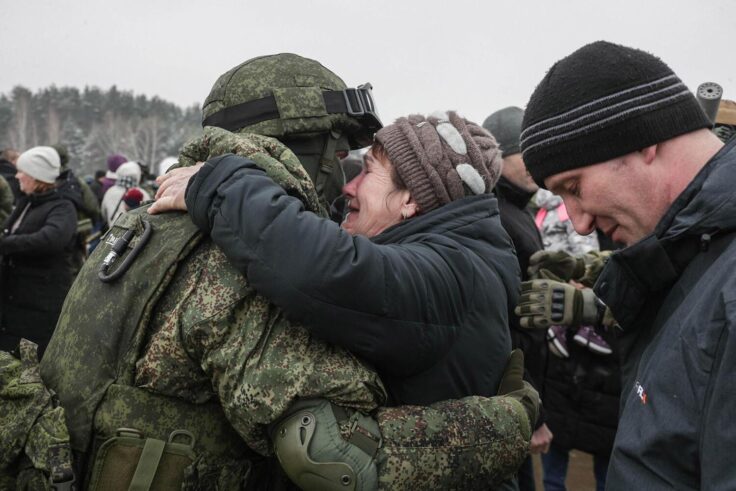
Why do people go to the front? They’re forced to, they want to make money, to become heroes. For young guys it’s hormones, self-assertion. They want to come home with money and medals so that girls will notice them. But to admit to yourself, “I’m going to kill people for cash because I’m a loser and a coward,” is shameful. And this is where “history” comes to the rescue, with ready-made mythological templates: “We are carrying on the heroic deeds of our fathers and great-grandfathers.” Lost a leg at the front? Well, you’re disabled. But now you can tell yourself, “I’m a hero, I fought like our grandfathers did!” And demand special respect.
Mind you, under the Soviet system the treatment of actual disabled veterans was complicated, to put it mildly — just think of the Stalin-era homes for invalids [to which many disabled veterans were removed from city streets after the war — T-invariant]. The authorities started making a huge fuss over veterans only in the 2010s, when there were almost none left.
Overall, the deeper problem lies in the social obligations and the claim to special status of the veterans of this aggression. Should they be paid? Yes: after all, even postwar Germany paid pensions to former SS men. But everyone knows that in Russia the state’s ordinary social obligations are in sorry shape, and so here is a way to defend yourself: shout, “I fought like our grandfathers did!” The claim to special status is more of a problem, and of course, strategically, Russian society would be better off building a culture that firmly establishes taking part in aggression as something shameful and tawdry. The “our boys” rhetoric is just as tawdry. And if a process of reconstruction begins in the country, effort will be needed to ensure, on the one hand, that social obligations are met and we don’t end up with a revanchist backlash, and on the other, that cultural mechanisms take shape that unequivocally condemn this war and participation in it.