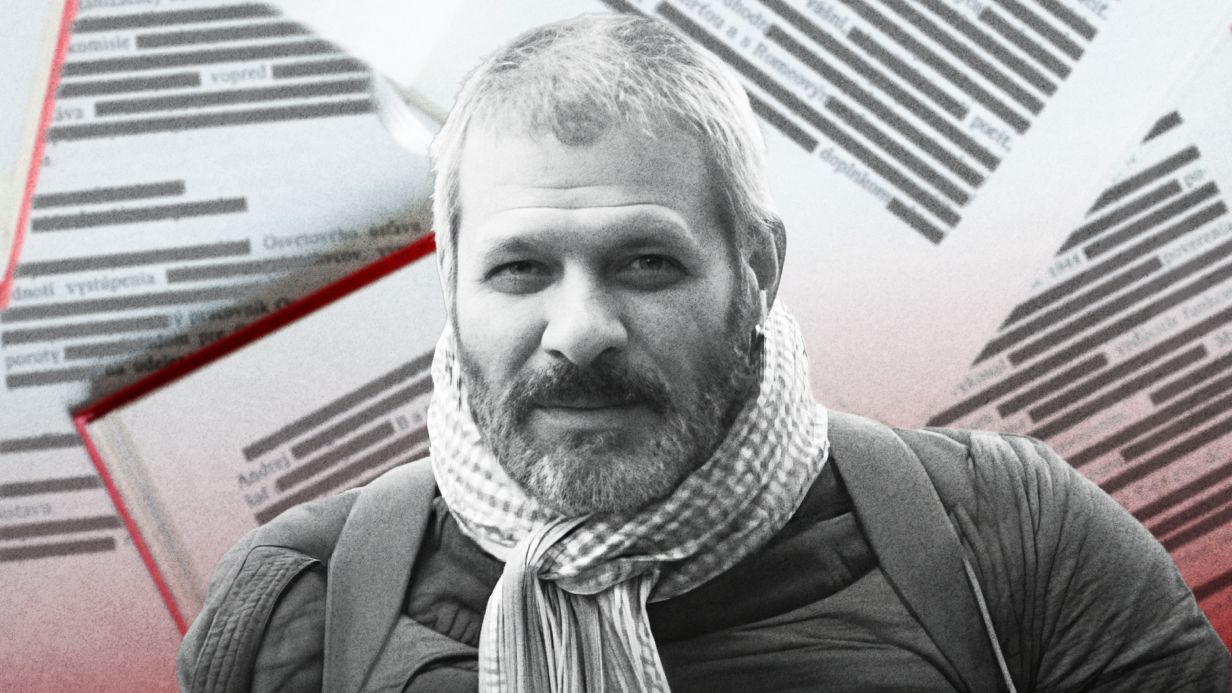
Vladimir Kharitonov is one of the key figures shaping today’s independent Russian-language book world outside Russia. In an interview with T-invariant, the technical director of Freedom Letters and head of the Free University’s publishing project explains how today’s tamizdat differs from Soviet samizdat and why the printed book is still very much alive — TikTok notwithstanding.
T-invariant: You work with several “publishing houses in exile.” What is distinctive about them?
Vladimir Kharitonov: First, there is the publishing project of the Free University — an association of lecturers who either left Russian universities themselves or were dismissed from them. Today it brings together about 200 instructors and several thousand students each year. Since 2022, the Free University Press has published the journal Palladium; 17 issues have already come out. It now appears four times a year. As a rule, each issue is devoted to a particular theme and is prepared by colleagues from different departments. The most recent issue was an exception: it consists entirely of two Memorial reports on Russia’s war crimes. In addition, we publish scholarly and popular-science books written by our professors or recommended by them for publication. At Freedom Letters, I am technical director and oversee book production. That is a completely different kind of publisher: it specializes mainly in books for the broadest possible readership.
T-INVARIANT BACKGROUND
Vladimir Kharitonov was born in Sverdlovsk in 1969. He graduated from Ural State University (UrSU). He holds a Candidate of Sciences degree in philosophy. For many years he taught the history of culture at UrSU and taught a course on digital book publishing at the Higher School of Economics. He teaches publishing at the Free University. He has worked at the publishing houses of UrSU, U-Factoria, Ultra.Culture, AST, and Cabinet Scholar. He is a specialist in e-books — for many years he worked as a consultant for Bookmate — and copyright, and an analyst of the book market. His articles and comments have appeared in Novaya Gazeta, Gorby, Novaya Gazeta Europe, Russia.Post, Gorky, University Book, and other publications. Since 2022 he has lived in Latvia. He is technical director of Freedom Letters and director of the Free University Press.
T-i: Is it fair to say that most Russian-language publishers outside Russia today primarily publish what cannot be published in Russia?
VK: In recent years, many very different kinds of people have left Russia — including people who read books, write books, and, naturally, publish books. The range of Russian-language publishers in emigration is quite broad. But you are right: a significant share of their output consists of books that cannot be released in Russia today. And since the list of prohibitions keeps expanding, the need for publishers abroad remains high.
T-i: What do you see as the main difference between Soviet samizdat and today’s tamizdat? Do contemporary Russian-language publishers abroad perform the same function?
VK: I think the situation is different after all. Just last year, Charlie English’s book The CIA Book Club: The Best Kept Secret of the Cold War came out. It tells the story of how, with support from American intelligence services, illegal literature was printed and smuggled into Poland for the Solidarity movement. It is a very interesting book. And I took away two important things from it. First, Soviet society was far more suppressed and repressive than Poland at the time. Poles were much better prepared to fight their regime. The CIA supplied Poland with equipment for underground printing presses. There was nothing of the kind in the USSR: what existed was only the illegal reproduction of texts that had already been written. Second, such activity is simply impossible today — and unnecessary. The internet exists. Despite blocks, bans, VPNs, and other restrictions, information still gets into Russia, including books in digital format. Digital distribution has become an important channel for spreading books published by publishers in emigration.
PREVIOUSLY IN T-INVARIANT
• Rules Without Rules: How Censorship Is Changing Contemporary Russia
• The Tale of a Lost Gene Pool: How One Book Turned the Statistics of Repression into Human Stories
T-i: What do you think about the censorship that authors today are forced to evade? There is an opinion that censorship is not always evil: it existed in the Soviet years, yet that period left behind many outstanding works. And in general, restrictions in one form or another exist in almost every country.
VK: Naturally, I have a negative view of censorship. Ultimately, it violates the constitutional principles of freedom of speech and freedom of expression. At the same time, various forms of restriction do exist in many countries. Russia is simply a particularly vivid example in this respect.
As for the Soviet experience, such arguments strike me as a literary exaggeration. Yes, books were written then that are still read today. But it is important to remember that they were created not thanks to censorship, but in spite of it. Their authors were counting on those texts eventually seeing the light of day.
T-i: Obviously, there are ideas that are almost impossible to publish anywhere. Where is the line between censorship and reasonable restrictions?
VK: Every society defines that line for itself. In this sense, the United States is a telling example. The federal government has no right to introduce censorship, but restrictions can be imposed at the level of individual states. That is exactly what we are seeing now: the number of bans affecting libraries and children’s and young adult literature is growing. American society is living through this conflict right now, and many people — readers, authors, librarians — are trying to resist these restrictions. I can only support them.
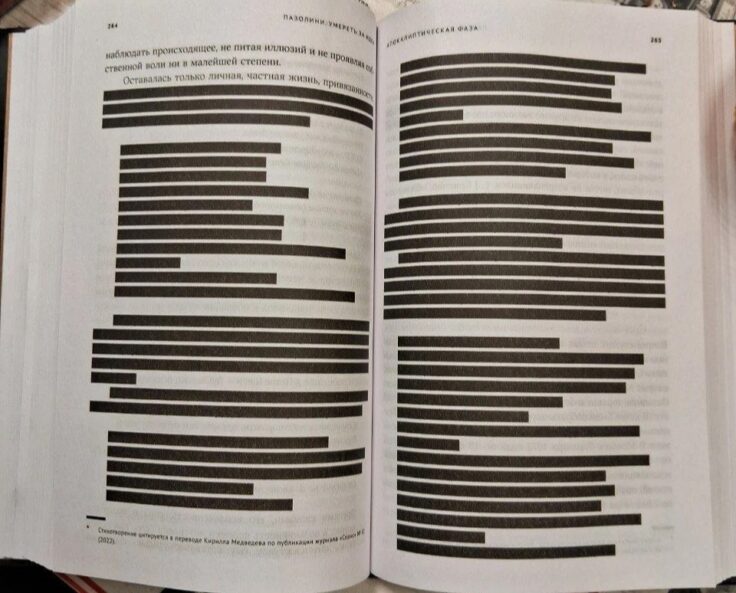
T-i: What do you feel when you pick up a book in which blacked-out bars have replaced words? Can such editions be seen as rarities and symbols of an era that must be preserved for posterity?
VK: Above all, I feel sadness and outrage. I could not even have imagined that individual words would once again begin to be expunged from philosophical treatises. I was completely unprepared for that. Probably because I remember the Soviet period well, and the feeling of freedom that came after censorship was abolished. It seemed that we had finally found ourselves in a world where different books could be published, and where only authors and publishers bore responsibility for them — to their readers and to society.
Of course, today’s demonstratively censored editions — or those censored under pressure — can be regarded as rarities. But when you see the number of censored books and the number of books that cannot be published today, what you feel above all is sadness, grief, and outrage. It is impossible to treat this as normal. Recently I came across a biography of a person quite well known in scholarly circles, in which an entire paragraph had been blacked out. It was simply impossible to understand what had been discussed there. Yes, this person was homosexual. There is nothing terrible or reprehensible about that. It was part of his life and undoubtedly influenced his fate and his path. But the reader will no longer learn that from the book. Or rather, they may be able to learn it somewhere else, but the book itself becomes incomplete, as if gnawed away. And that is very sad.
T-i: There are known cases in which authors based in Russia sign contracts so that the publisher receives rights only to publish and distribute the book within Russia. In this way, the author keeps the option of being published abroad. Have you heard of such cases? Or is this already a trend?
VK: I have not heard of that. But there is nothing strange about it. If only because Russian legislation — specifically Part Four of the Civil Code, which deals with intellectual rights — states directly that an author has the right to dispose of their work as they see fit. A publishing contract is a civil-law contract, and the author may permit or refuse to permit the publisher to use the work in whatever ways the author determines. In that sense, authority over the work remains with the author. For example, the author may allow a publisher to release a book in Russian and sell it only in Russia, or to sell it worldwide. The author may transfer rights to translations and to agreements with foreign publishers, or may keep those rights. Naturally, the amount of the author’s remuneration may depend on this. It is possible that authors who retain translation rights lose income — sometimes a little, sometimes substantially.
The main news about the lives of scholars during the war, videos, and infographics are available on T-invariant’s Telegram channel. Subscribe so you don’t miss anything.
For now, attitudes toward Russian publishers abroad remain complicated, although they have softened over the past few years. After the start of the war, many foreign publishers stated outright that they would not work with Russian partners. Some later revised that position and began gradually restoring contacts. Whether there is now active interaction around selling rights to books by Russian authors, I honestly do not know. But even before, this was not a significant part of the publishing business. It was more of a rarity and an exception — a particular stroke of luck for both author and publisher.
T-i: Another problem for Russian publishers. Suppose a translation of a popular-science book by a Berkeley professor has come out, and the university is later designated an undesirable organization in Russia. What should a publisher do in such a situation?
VK: It is a very difficult story for everyone. Especially if you look at the list of organizations designated as undesirable. Some of the world’s strongest research centers have ended up on it. If we take only American universities, there are Berkeley, Stanford, Yale, and many other outstanding educational and research institutions. Many of them have their own academic presses, and translations of their books have always been an important part of the Russian intellectual and scholarly book market. So what is happening looks very bad and very sad.
I hope that one day this will end. We are now living through a dark period in the history of Russian science and publishing. It is hard for me to imagine that such a situation can go on forever. Although, on the other hand, when Russia began its full-scale war against Ukraine, that also seemed impossible to many people. I remember that feeling very well — as if something utterly unthinkable had happened. Complete absurdity and catastrophe. But somehow we continue to live inside this absurdity.
T-INVARIANT BACKGROUND
After major Western universities were added to Russia’s register of “undesirable organizations,” Valery Fadeev, head of the Presidential Human Rights Council, urged people not to study at them and not to have any dealings with them. “You cannot conduct business or projects with these organizations, finance them, or receive money from them <…> now that Yale University has been declared an undesirable organization, there is no need to study there, and children should not go there to study; one should think about whether to continue working there,” Fadeev said. In addition, the head of the council suggested that research conducted at these universities would hardly be banned in Russia, and advised people with any doubts “not to be shy” about consulting the FSB or the prosecutor’s office.
T-i: How do you think your colleagues who remained in Russia reason about all this? What helps them hold on and continue working?
VK: Not everyone can leave. And not everyone should leave. There are still people in Russia who read books, and there are still publishers who continue producing those books for them. For many of them, a good book is not a book about how wonderful war is, but about how terrible it is. It seems to me that they are doing important and necessary work. Even when the books are not about war. Some publish books about how to remain a normal human being. Some publish novels about our complicated life. Some release books that can support and comfort a person who is finding it hard to live through what is happening.
For many book people, this remains the main source of motivation. And not only for publishers. The same is true of people who continue organizing book fairs. A book fair is one of the few forms of cultural life that seems especially important to me today. It allows people to see that there are other people around who read good books instead of going off to fight.
T-i: We recently interviewed Lida Kanashova and Alexei Fedorchenko, the authors of The Chief of Tales. Among other things, we discussed the problem that much has been written, little has been read, and what is read is quickly forgotten. Do you think books really influence people?
VK: Of course they do.
Current videos about science during the war, interviews, podcasts, and streams with prominent scholars are available on T-invariant’s YouTube channel. Become our subscriber!
T-i: Then why do we keep making the same mistakes?
VK: Because everything happens very slowly. As Bruce Sterling once said, the future has already arrived — it is just not evenly distributed. It does not work like this: we publish a good book, everyone reads it, and the world becomes better. That is not how it works. A couple of years ago I attended a meeting of the Russian-speaking academic diaspora. A former deputy director of the Open Society Institute, who had worked there back in the 1990s, came to the meeting. And I found myself thinking again about what an enormous undertaking that foundation had carried out then. For example, there was a list of books for whose translation and publication one could receive a grant. Many of those books were published. And practically everyone gathered at that meeting had read them. That is how the influence of books works. Their impact should not be overestimated. But neither should it be underestimated. Perhaps scholarly and popular-science books are not as effective as propaganda. But they do work.
T-i: Why, then, does propaganda turn out to be more effective?
VK: Among other reasons, because people don’t read enough.
Reading helps a person build a complex picture of the world. It will not necessarily be a correct one — there are plenty of bad and foolish books too. Reading in itself does not automatically make anyone better. But the world inside one’s head becomes more complex. And this does not have to mean scholarly literature. A person who spends a lifetime reading Dickens also gains a very complex understanding of human relationships, destinies, motives, and actions.
The problem is that not everyone reads books. Propaganda, by contrast, offers simple explanations for complex phenomena. That is why it often seems more convincing. The other thing is that this picture of the world begins to fall apart when it collides with reality, when questions arise for which the system has no answer. For example, if petrol suddenly disappears from gas stations, no one explains it by strikes on oil refineries. And then a person has to look for other explanations for what is happening.
T-i: Does that mean you hope the fridge will eventually beat the television?
VK: In a sense, yes. Let us recall Maslow’s hierarchy of needs: people need to eat, drink, dress, and have a roof over their heads. When problems arise at that level, they begin to regard everything else more critically.
T-i: But people, especially young people, are reading less and less, aren’t they?
VK: Does it seem that way to you? I would not agree. Children really have begun to read less for pleasure. But young adults, if we mean people aged 20 to 30, actually read quite a lot. The other thing is that books have become part of the attention economy. With the emergence of the internet and digital technologies, they have found themselves in the same row as films, music, social networks, news sites, and countless other ways of consuming content. And books are not in the strongest position in that competition: reading a novel is harder than watching a TV series. It takes more time and intellectual effort. A good novel will take 10 to 15 hours. In the same amount of time, you can watch two seasons of a series — and if it is a British series, all four.
On the other hand, about seven years ago it unexpectedly became clear that audiobooks compete perfectly well with all other formats. You can listen to them while running, walking the dog, cleaning, or commuting. As a result, the global book industry, including the Russian one, is experiencing a real audiobook boom. That market is no longer growing as rapidly as before, but it still accounts for a significant share of digital sales. In the United States, audiobook sales have already surpassed sales of text e-books. In Russia, as far as I remember, audiobooks account for about 40 percent of the digital market.
Of course, it is easier to watch short videos on TikTok or scroll through Reels. But this is not only a problem for children. Adults do exactly the same thing. I am not sure there is any serious age dependence here at all.
T-i: What is happening with printed books? What allows them to continue existing?
VK: Printed books are doing fine. The printed book remains an ideal format for many kinds of information. When we talk about book publishing, we often generalize too much. In reality, there are enormous numbers of completely different kinds of books. They are created differently, for different audiences, and are produced and distributed in different ways. A publisher of children’s books and a publisher of monographs on quantum physics have almost nothing in common, except that both deal with books.
The printed book remains a very convenient and attractive object. It is pleasant to hold. It can be beautifully made. And, interestingly, it is precisely against the backdrop of digitalization that demand for beautiful, well-designed books is only growing. Moreover, for many young people, the printed book has become a way to take a break from the phone. And at the same time, it is a way to show others that they are not spending their time meaninglessly, but are reading a novel or a popular-science book.
At the most recent Frankfurt Book Fair, I was delighted to discover a huge hall devoted entirely to Young Adult fantasy. Hundreds of people were standing in line for authors’ autographs. The books themselves may not have been the absolute pinnacle of printing art, but they came very close. They were made with love, attention, and care for the reader. These are books you want to hold in your hands, photograph, and show to others. And it seems to me that this is one proof that the printed book is still alive and popular. Of course, book publishing is changing.
T-i: What changes do you see?
VK: For example, the growth of self-publishing. The very function of the publisher is changing radically: many tasks that used to be tied specifically to a publishing house can now be performed without one. E-books have appeared, and they are already a substantial part of the modern book market. I remember BookExpo America in 2012 very well. Back then, American publishers seriously feared that e-books would “devour” printed books. At the same time, they watched the growth in sales of printed editions with surprise and anxiously awaited the moment when that growth would stop. Over the next ten to fifteen years, the situation stabilized. It turned out that e-books and printed books can coexist perfectly well. Another segment began to disappear instead: mass-market paperbacks — cheap pocket-sized editions in soft covers printed on newsprint. It was with books like those that the history of Penguin began.
The main advantage of mass-market books was that they were cheap. A reader could buy one almost without thinking: for five or six dollars, get a light pleasure, read the book quickly, and forget it just as quickly. Today e-books have the same quality. That is why entire genres are gradually moving into digital form. For example, a huge share of romance novels now exists precisely in electronic format. Such books are rarely reread: they are read once, and the interaction ends there. Although, of course, there are collectors who still keep whole shelves of novels, for example from Harlequin.
A revolution has also taken place in printing itself. I mean print-on-demand and the significant reduction in the cost of short runs. This has had an especially strong effect on academic publishing. Most American university presses have almost completely switched to print-on-demand. Today no one prints large runs of scholarly monographs: their audience is too small, and traditional printing is expensive. Print-on-demand has turned out to be a very successful solution.
T-i: In the film industry, piracy has effectively been legalized today. What is the situation with piracy in book publishing?
VK: Traditional publishers, of course, try to observe copyright. They understand that sooner or later the current situation will end and the legal system will again function in full. But pirated book publishing has existed for a long time. It simply remains a niche phenomenon. If you go, for example, to Avito, you can find pirated translations and editions of many authors, including Stephen King (after the start of the full-scale war, he refused to sign new contracts with Russian publishers. — T-i). Publishers can do nothing about this, since they do not represent the author’s interests. The author himself cannot fight violations while sitting in America. And this does not apply only to King. A similar situation exists in niche science fiction and in many other segments. In many ways, this story is connected not with the war, sanctions, or politics, but with the fact that copyright does not always respond effectively to readers’ real needs.
T-i: What books do you think are profitable to publish today? Is there some kind of sure-fire option?
VK: I do not know. I work on books that I consider necessary. Perhaps for a not very large audience. If I knew the recipe for a future bestseller, I would probably have owned a flourishing publishing house long ago. In reality, no such recipe exists. There are many books about how to write a bestseller, but all of that, of course, is untrue. The history of publishing knows an enormous number of cases when publishers were wrong. Think of Marcel Proust, for example. He had to publish the first volume of In Search of Lost Time at his own expense after publishers rejected it. Today that is hard to believe.
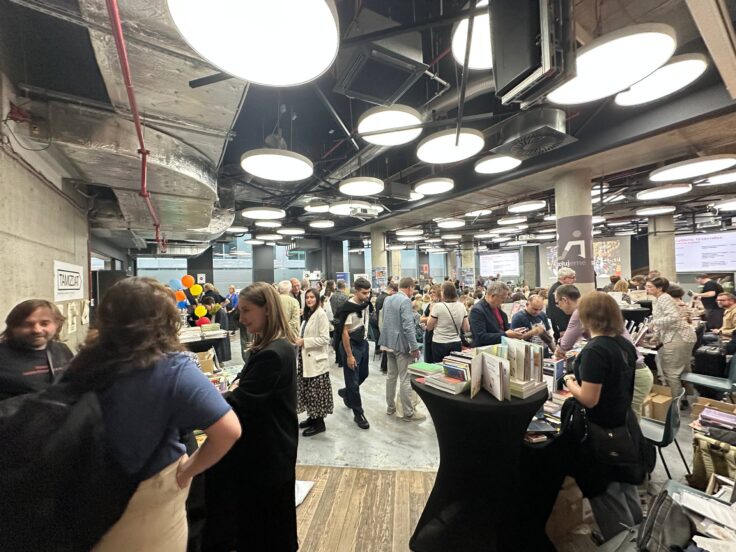
T-i: It is known that you will be taking part in Prague Book Tower / Pražská knižní věž. How exactly?
VK: We have not fully decided yet, but I very much hope we will be able to present our books — above all, Elena Lukyanova’s The Basic Law.
T-i: Is there a book whose publication you are especially proud of?
VK: There are quite a few. For example, Capitalism and Schizophrenia by Gilles Deleuze and Felix Guattari — one of the most important philosophical books of the twentieth century. Montaillou by Le Roy Ladurie, one of the key books of the Annales school of history. Critique of Cynical Reason by Sloterdijk — a very timely book, it seems to me.